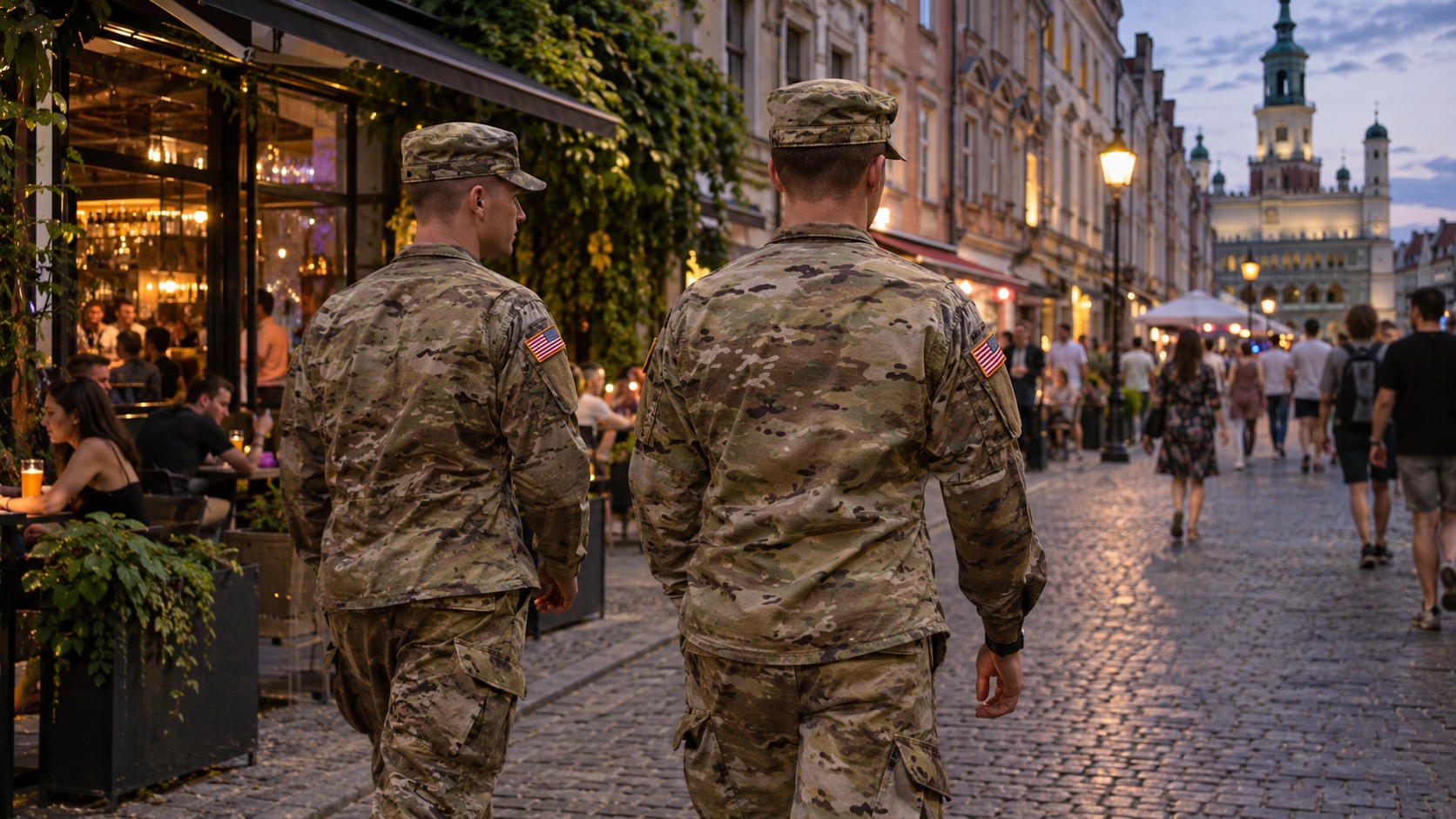
American soldiers serving under the US Army’s V Corps in Poland have been banned from visiting bars, nightclubs, strip clubs and certain karaoke and hookah lounges under new military regulations intended to strengthen discipline and combat readiness across NATO’s eastern flank.
The restrictions were introduced in an updated military order signed by Lieutenant General Thomas Feltey, commander of V Corps, on 5 November 2026.
The order took effect immediately and replaced an earlier version issued in August 2024.
- Find more news from Poland on our Homepage .
Crucially, the new rules also apply to soldiers permanently stationed in Poland, including personnel living outside military installations in Poznań, rather than only those deployed temporarily.
According to Stars and Stripes, which reported the changes on 10 November, the revised policy removes exemptions previously available to permanently assigned troops.
V Corps estimates that more than 15,000 assigned, rotational and supporting personnel fall under its provisions across 16 European countries.
No bars, nightclubs or karaoke lounges
The order prohibits covered soldiers from visiting several categories of nightlife establishments, including bars, strip clubs, nightclubs, casinos and certain karaoke and hookah lounges.
The restrictions apply during off-duty hours as well as when personnel are carrying out their military responsibilities.
However, the US Army has provided definitions intended to distinguish prohibited venues from ordinary restaurants.
A bar is generally classified as an establishment whose primary purpose is serving alcohol and which does not provide tables and menus for seated dining.
Karaoke and hookah lounges fall within the prohibition when they primarily serve alcohol and lack seated dining facilities.
Nightclubs are defined by their emphasis on dancing, music provided by a DJ and alcohol service.
Restaurants are not automatically off-limits simply because they sell alcohol or provide karaoke entertainment.
The distinction is important for soldiers living in Polish cities, where restaurants, pubs and entertainment venues can sometimes offer several services within the same establishment.
According to Stars and Stripes, one soldier affected by the changes said the definitions had created uncertainty about which venues remained permissible, particularly restaurants that become nightlife establishments later in the evening.
The new order directs soldiers to exercise appropriate judgement and seek clarification from commanders when they are uncertain whether a particular establishment is prohibited.
US commander says restrictions protect military readiness
V Corps officials insist that the changes are intended to maintain professional standards and military preparedness.
Feltey, who assumed command in autumn 2026, said soldiers serving in Europe must remain focused on deterring aggression and being ready to respond if necessary.
In comments to Stars and Stripes, the commander emphasised the importance of maintaining an effective military force while stationed alongside NATO allies.
Lieutenant Colonel Vincent Gothard, the corps’ public affairs director, said the restrictions were introduced proactively rather than in response to a particular increase in misconduct.


The same explanation was provided to American military publication Task & Purpose, which reported on the expanded prohibitions on 14 November.
A V Corps spokesperson described the policy as intended to preserve order, discipline and personnel safety.
The command said reducing risks associated with alcohol and other off-duty activities would help ensure soldiers remained prepared for their operational responsibilities.
Restrictions on alcohol and late-night activities
The revised regulations also contain provisions governing alcohol consumption.
Soldiers covered by the applicable restrictions are prohibited from drinking within eight hours of reporting for duty, consuming alcohol while operating vehicles, and possessing or drinking alcohol at specified military installations and forward operating sites.
Personnel on certain temporary assignments lasting more than 30 days are also prohibited from becoming intoxicated.
The previous order included a separate restriction preventing some soldiers on assignments exceeding 30 days from drinking alcohol during their first 96 hours in the European theatre.
That initial four-day restriction has been removed from the updated version.
The rules also address movements outside military installations late at night.
For personnel on qualifying temporary assignments, leaving an installation or forward operating site between 10 pm and 5 am generally requires an approved battle buddy — another service member who accompanies them.
This is not a universal overnight curfew.
According to V Corps officials, soldiers permanently stationed in Europe are not subject to the same battle-buddy requirement for routine local travel.
The restrictions therefore differ according to the individual’s military assignment and circumstances.
Soldiers also told not to disturb wildlife
One of the more unusual additions concerns interactions with wild animals.
As Task & Purpose reported, the revised order prohibits soldiers from approaching, handling, feeding, capturing, adopting, harassing or otherwise interfering with wildlife.
Stars and Stripes clarified that these restrictions cover specified military activities and forward operating locations, subject to limited exceptions.
The command has not publicly identified a particular incident that prompted the additional wildlife provision.
Another change concerns electronic cigarettes and vaping products.
Soldiers are prohibited from purchasing electronic cigarettes, vaping liquids and similar devices from unauthorised vendors.
Approved military or allied forces’ retail outlets remain permitted sources.
These measures form part of the broader conduct regulations rather than separate Polish laws.
Why the rules matter for American troops in Poland
V Corps is one of the US Army’s principal operational headquarters responsible for coordinating American military forces in Europe.
Its main headquarters is based at Fort Knox, Kentucky, while its forward headquarters operates from Camp Kościuszko in Poznań.
According to the US Army’s official description of its European operations, the Polish headquarters plays an important role in coordinating multinational military activity and strengthening cooperation with NATO allies.
The United States maintains both permanently stationed and rotational military personnel in Poland.
American forces participate in military exercises, support deterrence operations and help strengthen NATO’s defensive presence along its eastern flank.
For personnel stationed permanently in Poland, the country is also a place where they live, shop, eat and spend their free time.
That makes restrictions on nightlife establishments particularly relevant to their everyday lives.
The latest order applies across V Corps’ wider European area of responsibility, covering 16 countries, including Poland, Romania and the Baltic states.
However, the regulations should not be interpreted as a blanket ban imposed on every American military service member in Poland regardless of command.
Nor do they prohibit Polish businesses from serving American civilians or other customers.
They are internal US military requirements governing personnel subject to the V Corps order.
What happens if soldiers break the rules?
Violations of the order’s prohibited activities can result in disciplinary consequences under the US military justice system.
According to Stars and Stripes, breaches may be punishable under Article 92 of the Uniform Code of Military Justice, which deals with failures to obey lawful orders and regulations.
Depending on the circumstances, soldiers may also face administrative action.
Commanders are responsible for ensuring personnel understand the updated requirements, including through briefings and procedures for soldiers arriving in Europe.
The order does not establish that particular soldiers have already been disciplined for visiting prohibited establishments.
Instead, it sets out standards the command expects its personnel to follow.
For V Corps leadership, the broader objective is to ensure that American troops stationed across Europe remain disciplined and operationally ready while continuing to work alongside NATO partners.
For soldiers permanently based in Poland, the practical consequence is a tighter set of restrictions on where they can spend their time away from duty.