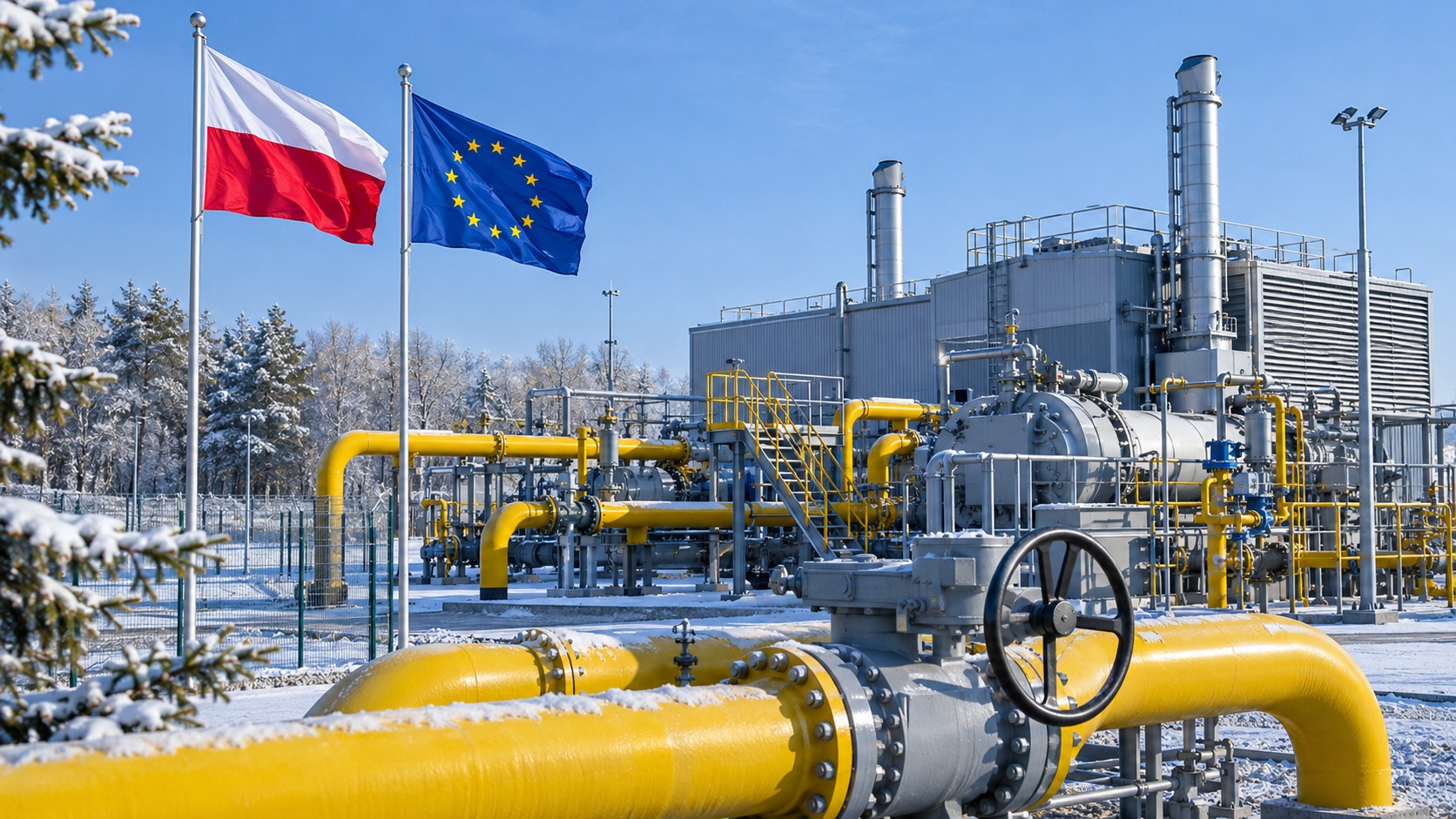
Poland has some of the fullest natural gas storage facilities in the European Union as the continent enters the winter heating season, with Polish reserves standing at 95.5% of capacity while EU-wide storage has fallen to approximately 70%, well below its usual level for this time of year.
The figures, published by Gas Infrastructure Europe (GIE), highlight significant differences in energy reserves across the bloc as colder weather increases demand for heating and electricity generation.
According to data from the European gas-storage monitoring platform AGSI+, Polish facilities held approximately 35.2 terawatt hours (TWh) of natural gas on 18 November, representing 95.5% of available working storage capacity.
- Find more news from Poland on our Homepage .
Across the EU, storage was 69.8% full, equivalent to approximately 791 TWh of natural gas.
The disparity is particularly striking compared with Germany, where storage facilities were only around 57% full, and the Netherlands, where reserves stood at approximately 60.5%.
Italy recorded a substantially higher level of 86.3%, although still below Poland’s figure.
Poland among EU countries with fullest gas reserves
Poland’s 95.5% storage level places it among the countries with the highest proportions of available storage capacity filled.
Portugal recorded a similar percentage, while several major European economies entered the heating season with markedly lower reserves.
Figures reported by PAP Biznes on 19 November showed that EU-wide storage was approximately 70% full, compared with a five-year seasonal average of 88%.
Germany’s storage stood at 57.1%, compared with a five-year average of 87.8% for the equivalent period.
The Netherlands reported 60.7%, against its usual 80.6%.
Poland’s reserves, meanwhile, were slightly below its own five-year seasonal average of 97.4%.
Although Polish storage is not unusually high compared with recent Polish winters, it remains substantially fuller than the EU overall.
The figures also demonstrate that the winter storage situation varies considerably between countries rather than presenting a uniform picture across Europe.
Germany and the Netherlands enter winter with lower reserves
Germany’s relatively low storage level is significant because it has the largest underground gas-storage capacity in the European Union.
German storage facilities can hold approximately 247 TWh of working gas, compared with around 37 TWh in Poland.
Consequently, even with Germany’s facilities only about 57% full, the country held approximately 141 TWh of gas on 18 November — considerably more than Poland’s 35.2 TWh.
The distinction is important: a higher storage percentage does not necessarily mean a country possesses more gas in absolute terms or has sufficient reserves to meet all its winter demand.
Italy similarly held approximately 175 TWh of gas in storage, despite having a lower percentage of its capacity filled than Poland.
However, lower storage levels reduce the buffer available to meet unexpected increases in demand or disruption to imports.


In its 2026–27 Winter Supply Outlook, the European Network of Transmission System Operators for Gas (ENTSOG) warned that European underground storage facilities had entered the heating season with historically low inventories.
The organisation highlighted the importance of maintaining supplies of liquefied natural gas (LNG) throughout winter to reduce pressure on storage facilities.
Poland benefits from diversified gas supplies
Poland’s relatively strong storage position comes after years of investment in infrastructure designed to reduce dependence on Russian gas.
The country has expanded its ability to obtain natural gas from different international suppliers through the Świnoujście LNG terminal on the Baltic coast, the Baltic Pipe connecting Poland to Norwegian gas supplies, and pipeline links with neighbouring European countries.
According to Poland’s gas transmission operator GAZ-SYSTEM, these connections provide alternative supply routes and greater flexibility in responding to changes in demand.
Poland has also been investing in additional underground storage capacity.
Earlier this month, Polish energy group Orlen announced the completion of an expansion project at its Wierzchowice underground gas-storage facility.
The investment is expected to increase the site’s working capacity and contribute to a broader expansion of Poland’s storage system.
The development was covered separately by Poland 24 Business.
Nevertheless, storage facilities remain only one component of Poland’s energy-security arrangements.
The availability of imported gas, domestic production, pipeline capacity, weather conditions and consumption levels also determine how comfortably a country can meet demand during the winter.
EU storage rules aim to protect winter supplies
The European Union introduced mandatory gas-storage filling requirements following the energy crisis that began in 2021 and intensified after Russia’s full-scale invasion of Ukraine in February 2022.
The measures were designed to ensure that member states maintained sufficient reserves before winter, reducing the risk of severe shortages during supply disruptions.
Under the EU’s revised gas-storage rules, countries are generally required to reach a 90% filling target during a flexible period between 1 October and 1 December.
The rules, extended until the end of 2027, also permit deviations under specified difficult market or technical circumstances.
The current EU-wide storage figure of around 70% should not therefore be interpreted automatically as evidence that every member state has breached its legal obligations.
The requirements apply under country-specific arrangements, including exemptions and flexibility provisions.
EU authorities monitor compliance, market conditions and the availability of alternative supplies.
European Commission says EU is prepared for winter
Despite the lower-than-usual inventories, European officials have sought to reassure consumers that the bloc’s gas infrastructure remains capable of meeting demand.
On Friday, 20 November, the European Commission’s Gas Coordination Group confirmed that the EU remained prepared for winter despite challenging prices and geopolitical uncertainty.
The group noted that storage levels were around 70% and continued to provide an important reserve during the heating season.
Its assessment follows the October winter outlook from ENTSOG, which concluded that Europe’s infrastructure was sufficiently flexible to meet winter demand under the conditions examined.
However, the network organisation also warned that prolonged restrictions on LNG supplies could significantly reduce inventories, particularly if colder weather drives up consumption.
The situation is therefore more complex than the storage percentages alone suggest.
Lower reserves can increase exposure to international gas prices and supply disruptions without necessarily indicating an imminent shortage.
What does this mean for Poland?
For Poland, the latest figures provide a relatively favourable starting position compared with much of the European Union.
With storage facilities approximately 95.5% full, the country has retained a substantial reserve as winter gas demand increases.
That offers a buffer against sudden changes in consumption or supply interruptions.
However, it does not guarantee that Polish households and businesses will be insulated from rising gas prices.
Poland remains connected to the wider European energy market, meaning fluctuations in international LNG prices and other supply costs can affect domestic conditions.
The length and severity of winter, as well as the reliability of continuing imports, will determine how much gas countries need to withdraw from storage over the coming months.
For now, the latest European figures show a clear difference: Poland’s gas storage is close to full, while the European Union as a whole enters winter with reserves considerably below recent seasonal averages.