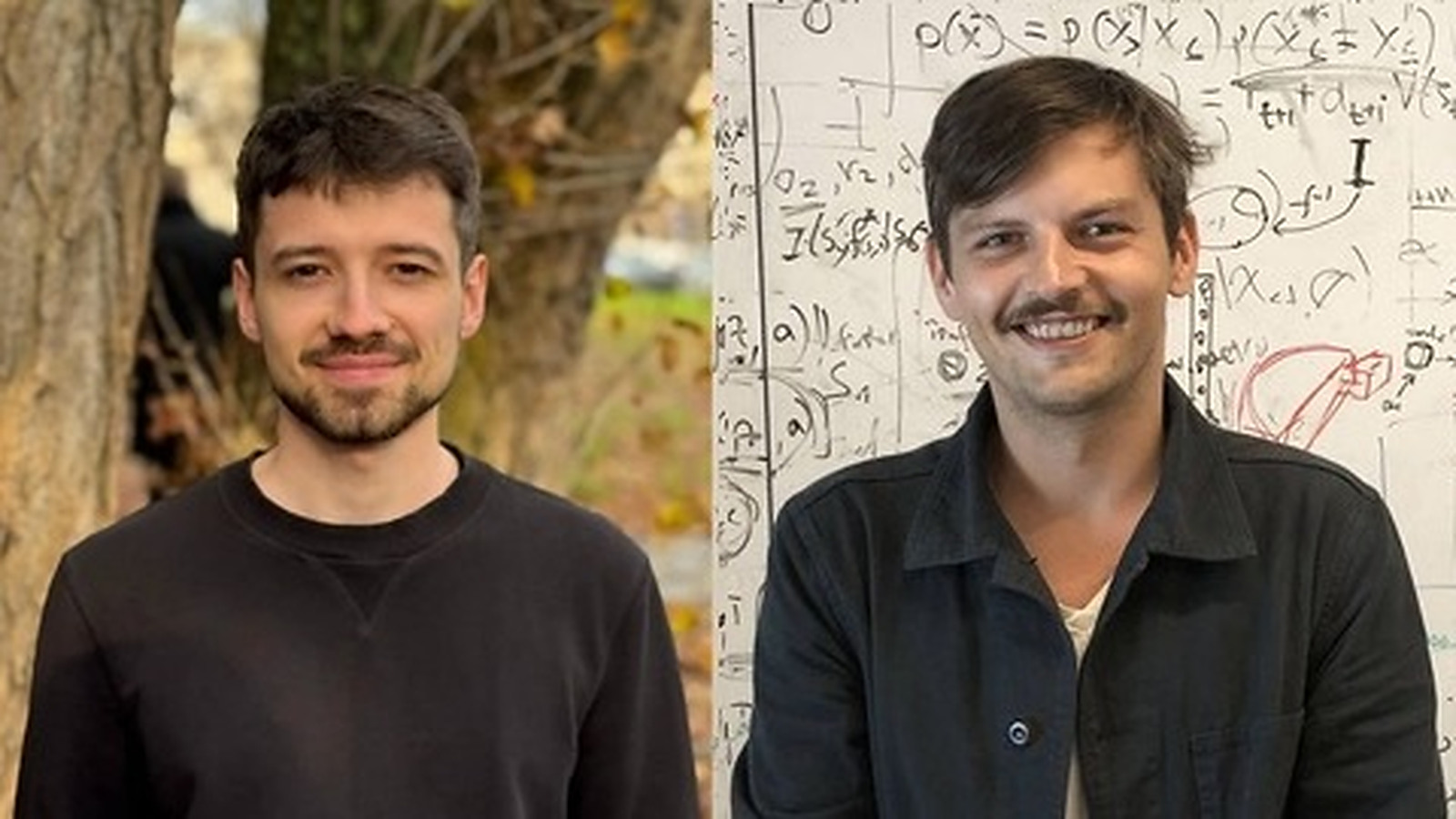
Two Polish researchers working on different challenges in artificial intelligence have been awarded equal first prizes in the 2026 Witold Lipski Prize, one of Poland’s established honours for young computer scientists.
Hubert Baniecki, who studies how to make AI models easier to understand, and Dr Michał Nauman, whose work focuses on systems that learn through experience, will each receive PLN 25,000.
The awards were reported on 7 October, with the University of Warsaw confirming the success of its two researchers the following day.
- Find more news from Poland on our Homepage .
Their recognition brings together two important questions facing modern artificial intelligence: how can people understand the decisions made by increasingly complex systems, and how can those systems learn to solve new problems more effectively?
Both winners have strong connections to the University of Warsaw. Baniecki is a doctoral researcher at its Faculty of Mathematics, Informatics and Mechanics, while Nauman completed his doctorate there earlier in 2026.
Making artificial intelligence easier to understand
For Hubert Baniecki, a central research challenge is understanding what happens inside machine-learning models.
Modern AI systems can recognise images, process language and identify patterns in enormous datasets. But explaining precisely why a complex model produces a particular result can be difficult, even for the people who develop it.
Baniecki works in explainable artificial intelligence, commonly abbreviated to XAI.
His research develops algorithms and methods for investigating model behaviour, including how different features of an input influence an AI system’s output.
The goal is not simply to produce a plausible explanation, but to make explanations more faithful to the models themselves and more reliable when the underlying data changes.
This is particularly relevant in fields where decisions need careful scrutiny.
In medical research, for example, machine-learning models may be used to analyse information associated with patient risks. Understanding what contributes to a model’s assessment can help researchers evaluate its behaviour and limitations.
That does not mean such explanations automatically make an AI system medically reliable or suitable for clinical use.
Baniecki is supervised at the University of Warsaw by Professor Przemysław Biecek. He also conducts research at the Centre for Credible AI and has gained international experience through a research internship at Meta in New York and visiting research appointments at Ludwig Maximilian University of Munich.
His work has appeared at major machine-learning conferences including NeurIPS, ICML and ICLR.
He has also contributed to DALEX, an open-source software project providing tools for examining and explaining machine-learning models.
Teaching machines to learn through experience
Dr Michał Nauman’s research tackles a different problem: how AI systems can learn what to do by taking actions, observing the results and improving their behaviour.
The approach is called reinforcement learning.
Unlike methods that depend primarily on examples paired with correct answers, reinforcement learning allows a system to learn through feedback from its interactions with an environment.
A simplified example is a robot learning to move an object. It can attempt different movements, observe their consequences and gradually improve its strategy.


Nauman studies how these techniques can become more efficient and work across increasingly complex tasks.
A particular focus of his research is scaling reinforcement learning: examining how larger models, greater computing resources and experience accumulated across different tasks can improve learning.
His work also investigates whether strategies learned in one setting can transfer to others.
Nauman defended his doctoral dissertation, Sample-Efficient Actor-Critic Algorithms in Reinforcement Learning, at the University of Warsaw in June 2026, under Professor Marek Cygan.
He previously studied at the University of Amsterdam and spent time as a visiting researcher at the University of California, Berkeley.
Like Baniecki, his research has appeared at major international conferences, including ICML, NeurIPS and ICLR.
The two researchers also presented their work at the 2026 ML in PL conference in Warsaw on 9 October, giving audiences an opportunity to learn about the research behind their awards.
An award honouring a Polish computer science pioneer
The Witold Lipski Prize was established in 2005 to commemorate a Polish computer scientist known for his work in areas including algorithms, database theory and combinatorics.
Now in its 22nd edition, the competition recognises younger Polish researchers for scientific achievements in theoretical and applied computer science.
Both 2026 first prizes were awarded in applied computer science. No prize was awarded in the theoretical category.
An honourable mention, without a monetary award, went to Dr Kamil Deja, a researcher associated with Warsaw University of Technology and the IDEAS Research Institute. His work includes generative AI and diffusion models.
The competition is organised by the IDEAS Research Institute, with financial support from the Kościuszko Foundation.
The two principal winners’ recognition is also a success for the University of Warsaw, which has helped train both researchers.
Their scientific interests are different, but closely connected to the future development of artificial intelligence: Baniecki is investigating how complex systems can be better understood, while Nauman is developing ways for systems to learn more effectively through interaction.
Neither award represents the completion of a commercial product or a newly proven medical treatment.
Instead, the prizes recognise sustained scientific research in fields where fundamental questions about AI’s capabilities and reliability remain open.
For two researchers with roots in the same Warsaw faculty, that work has now earned equal recognition — and another chapter in the history of a prize named after one of Poland’s computer science pioneers.