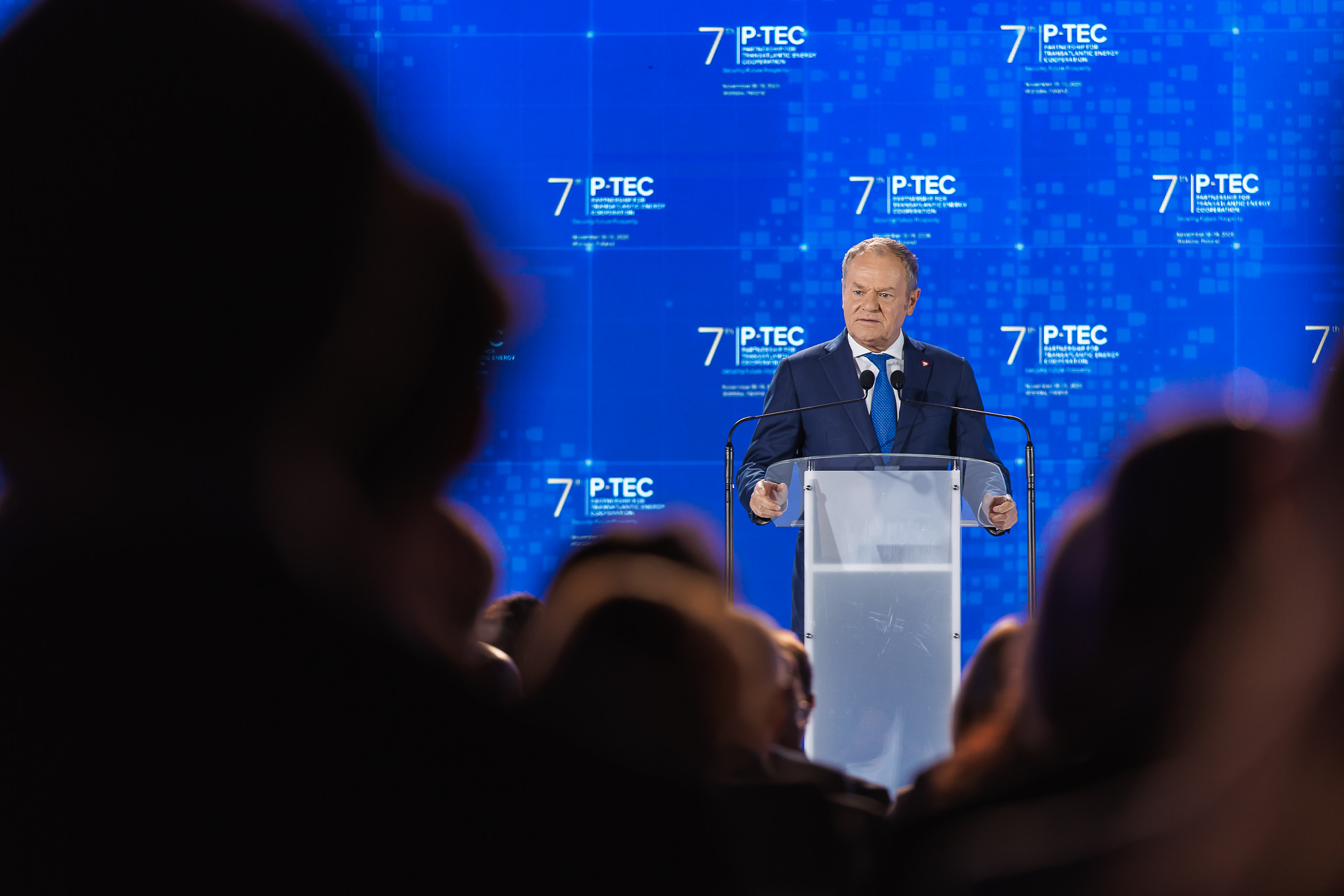
Polish Prime Minister Donald Tusk has declared that the years of building Europe’s energy dependence on Russia are over, urging closer cooperation between Poland, the United States and other European countries to secure alternative supplies. Speaking at an international energy summit in Warsaw on 18 November, Tusk argued that energy security must be treated as an essential part of national and European security.
The prime minister addressed the seventh ministerial meeting of the Partnership for Transatlantic Energy Cooperation (P-TEC), attended by US officials, representatives of European governments and energy industry leaders.
According to the Polish Prime Minister’s Office, Tusk said Poland had worked to diversify its energy supplies and encourage European countries to reduce their reliance on a single supplier.
- Find more news from Poland on our Homepage .
He argued that Russia’s war against Ukraine had demonstrated the security risks associated with excessive energy dependence.
Poland has broken its dependence on Russian gas
Tusk said the period in which European countries increased their reliance on Russian energy was now in the past.
His comments reflected a substantial change in Poland’s gas supply arrangements since 2022, when Russia stopped deliveries to the country.
According to the Polish Ministry of Energy, Poland has not imported Russian gas since that year.
The country now relies primarily on alternative supplies delivered through its liquefied natural gas (LNG) terminal at Świnoujście and the Baltic Pipe pipeline, which brings Norwegian gas through Denmark.
Domestic gas production provides an additional source of supply.
The government says these investments have enabled Poland to operate its gas system without depending on deliveries from Russia.
The shift has been particularly significant because Poland was historically reliant on Russian pipeline gas, leaving it exposed to disputes over supply, prices and political relations with Moscow.
Tusk calls for closer energy cooperation with the US
At the Warsaw summit, Tusk emphasised the importance of cooperation between Poland, the United States and the wider European region.
He identified LNG, civilian nuclear power and electricity transmission as central areas for future collaboration.
The prime minister also argued that energy policy should be guided by security, economic considerations and reliable partnerships rather than political ideology.
The Polish Ministry of Energy’s summit report highlighted Warsaw’s ambition to become an important entry point for American energy supplies into Central and Eastern Europe.
US Energy Secretary Chris Wright described Poland as a strategic partner and an important gateway to the region.
Energy Minister Miłosz Motyka said Poland’s developing gas infrastructure could benefit neighbouring countries as they seek alternatives to Russian supplies.
The cooperation is not limited to gas imports. Poland is also developing its first nuclear power station, planned for Lubiatowo-Kopalino on the Baltic coast, with American nuclear technology.
The project remains under development and is not yet generating electricity.
New agreements aim to supply Central Europe
The two-day P-TEC summit concluded on 19 November with a series of agreements and initiatives intended to strengthen energy cooperation.


Polish energy company ORLEN signed agreements with Slovakia’s SPP and Hungary’s MVM ONEnergy concerning potential cooperation on LNG supplies.
According to the Ministry of Energy’s announcement, the arrangements could allow greater use of Polish gas infrastructure to supply neighbouring markets.
They represent potential commercial cooperation rather than confirmation of specific new gas deliveries or contracted volumes.
Poland also intends to expand its import capacity through a floating LNG terminal near Gdańsk.
The ministry’s published infrastructure figures put the existing annual capacity of the Baltic Pipe at up to 10 billion cubic metres and the Świnoujście terminal at 8.3 billion cubic metres.
The planned Gdańsk terminal is expected to add approximately 6.1 billion cubic metres of annual capacity from 2028.
These projects could strengthen Poland’s role in supplying countries that have historically depended more heavily on Russian gas.
Europe has not yet completely abandoned Russian energy
Although Poland has eliminated its direct dependence on Russian gas imports, the position across the European Union remains more complicated.
Figures from the European Commission show that Russia accounted for approximately 12% of EU gas imports in 2025, compared with 45% in 2021.
The European Union Agency for the Cooperation of Energy Regulators (ACER) reported that five EU member states continued importing Russian LNG during summer 2026.
The EU has adopted legally binding rules to phase out the remaining Russian gas imports.
Under the regulation approved by the Council in January 2026, restrictions are being introduced in stages, with the remaining long-term LNG contracts subject to a ban from January 2027 and most long-term pipeline contracts ending by autumn 2027.
Tusk’s declaration therefore reflects the political and strategic shift away from Russia rather than the completion of Europe’s transition.
Energy security remains a European priority
The Warsaw summit also highlighted the importance of protecting energy infrastructure against physical attacks, cyber threats and other security risks.
In a joint statement issued on 19 November, the Polish and American energy ministers supported greater cooperation on diversified gas supplies, nuclear technology, critical infrastructure and assistance to Ukraine.
The statement reaffirmed support for Ukraine’s sovereignty and for restoring energy facilities damaged during Russia’s invasion.
For Poland, the strategic objective is now broader than securing its own gas supplies.
Warsaw wants to use the infrastructure developed over the past decade to support neighbouring countries as the European Union completes its transition away from Russian energy.
The agreements reached during the summit show the direction of that effort, although their commercial and operational results will depend on subsequent investment and implementation decisions.