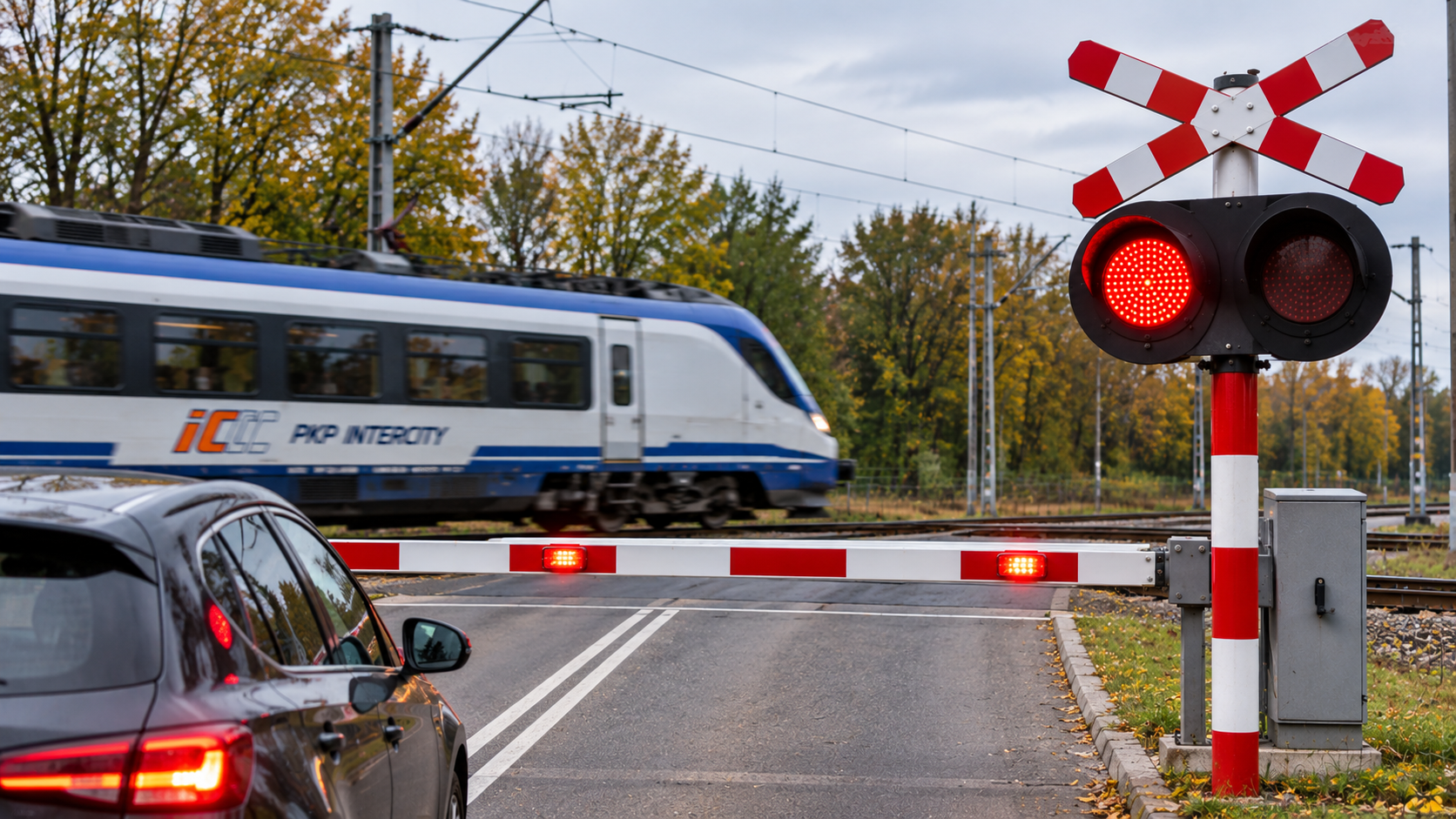
Drivers in Poland now face losing their driving licences for three months if they commit serious traffic offences at railway level crossings, under tougher road-safety rules that came into force on Saturday, 21 November 2026. The new penalty applies to motorists who ignore red warning lights, drive around barriers or enter railway tracks when there is no space to exit safely.
The measures apply nationwide and are intended to reduce the number of fatal collisions between road vehicles and trains.
The changes were introduced under the Act of 8 October 2026 amending Poland’s Road Traffic Law, which was published in the Journal of Laws on 6 November.
- Find more news from Poland on our Homepage .
The legislation adds a three-month driving licence suspension to penalties already imposed for some of the most dangerous behaviour at railway crossings.
Four railway crossing offences now carry a driving ban
According to guidance issued by Warsaw Metropolitan Police, the new suspension rules cover four categories of violations:
- Driving around lowered barriers: Bypassing closed barriers or half-barriers to enter a railway crossing.
- Entering while barriers are moving: Driving onto a crossing after barriers have started lowering or before they have fully risen.
- Ignoring red railway signals: Passing a signal showing a steady red light, flashing red light or alternating red lights.
- Entering without space to exit: Driving onto a crossing when traffic or another obstruction prevents the vehicle from continuing beyond the tracks.
These behaviours were already prohibited. The legal change introduces the additional consequence of a three-month licence suspension.
For example, a driver who enters a crossing while traffic is stationary on the opposite side may now lose their licence even if no collision occurs.
The new rules also mean that a driver cannot legally proceed simply because a barrier has started rising. They must wait until the lifting process has been completed.
Police can retain licences immediately
The changes amend Articles 135 and 135a of Poland’s Road Traffic Law, giving police grounds to retain a driving licence when one of the specified violations is established.
The officer initiates the process by retaining the licence and issuing a receipt. The relevant local administrative authority, known as the starosta, subsequently issues the formal decision concerning the three-month suspension.
The procedure is administrative and does not require a criminal conviction before the initial police action.
Importantly for international motorists, the legislation also amends provisions concerning driving licences issued outside Poland.
This means drivers holding foreign-issued licences are not automatically exempt from the new enforcement measures.
However, the legislation’s application in Poland should not be confused with automatically cancelling a foreign driver’s entitlement in every country where their licence is recognised.
Fines and penalty points still apply
The three-month suspension is an additional consequence rather than a replacement for existing penalties.
According to the Małopolska Police’s explanation of the new rules, drivers committing the specified offences still face:
- A PLN 2,000 fine.
- A PLN 4,000 fine for a repeat offence within two years.
- Fifteen penalty points.
The new licence suspension comes on top of those sanctions.
The legislation separately strengthens the criminal-law consequences of particularly serious transport offences. Courts must impose a driving ban of at least three years following a conviction for causing a transport disaster under Article 173 of the Criminal Code.
That criminal penalty is distinct from the three-month administrative suspension for railway crossing violations.
Twenty-seven people died at railway crossings in 2025
The government introduced the tougher rules amid concerns about accidents at railway level crossings.

According to statistics published by Poland’s national police headquarters, there were 51 accidents at railway crossings in 2025, resulting in 27 deaths.
That represented an increase from 39 accidents and 23 fatalities recorded in 2024.
By the end of October 2026, police had recorded a further 42 accidents, in which 19 people died and 49 were injured.
The authorities identify drivers ignoring warning signs, entering crossings as barriers close and becoming trapped on railway tracks as recurring safety concerns.
Unlike ordinary road junctions, railway crossings leave drivers with very limited opportunities to avoid an approaching train once a vehicle becomes stranded on the tracks.
Police urge drivers not to take risks
Polish police have issued reminders of the new rules ahead of their introduction.
The Pomeranian Police’s safety guidance urges motorists to approach crossings cautiously, obey signals and ensure there is sufficient space beyond the tracks before proceeding.
Officers also remind drivers that if a vehicle becomes immobilised on a crossing, the immediate priority is to get everyone to safety and alert emergency services.
Polish railway crossings are fitted with yellow emergency information stickers displaying an individual crossing identification number.
Drivers reporting an emergency can provide that number when calling 112, helping emergency services identify the precise location.
The new law applies across Poland from 21 November, making the three-month licence suspension an immediate potential consequence for drivers who disregard the specified railway crossing restrictions.