

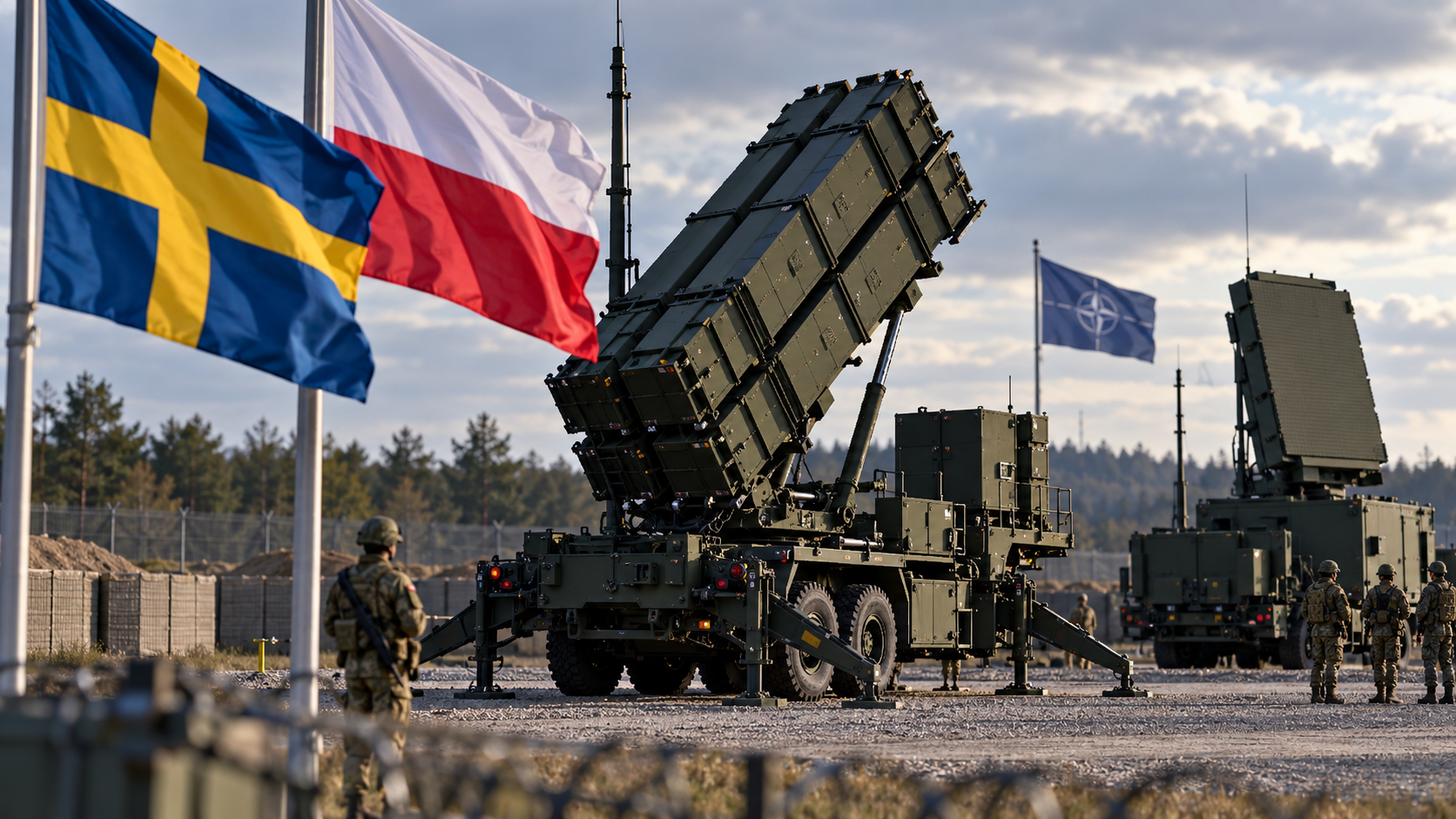
Sweden will deploy a Patriot air-defence system and around 100 military personnel to south-eastern Poland from December, strengthening protection around NATO’s logistics hub at Rzeszów that handles military and civilian assistance destined for Ukraine. It will be the first time Sweden has deployed its Patriot system on a NATO mission.
The deployment was announced by Swedish Prime Minister Ulf Kristersson on Tuesday, 6 October. The Swedish government said the unit’s primary task would be protecting the NATO logistics hub used to transfer and deliver assistance to Ukraine.
Sweden will take over Patriot duties currently carried out by the Netherlands. Dutch forces have protected the logistics centre since December 2025, with the Netherlands extending its Patriot deployment until the beginning of December 2026.
- Find more news from Poland on our Homepage .
The Swedish Armed Forces confirmed that the Patriot deployment will involve approximately 100 personnel from the Air Defence Regiment, known as Lv 6, with support from the Blekinge Air Wing.
The unit will operate under NATO Air Command and form part of the alliance’s Integrated Air and Missile Defence system.
Sweden has not disclosed how many Patriot launchers or other system components will be sent to Poland. Reuters reported that Stockholm declined to provide the number of Patriot units involved.
The deployment will protect the logistics hub at Rzeszów, which plays a central role in NATO Security Assistance and Training for Ukraine, or NSATU. Weapons, military equipment and other supplies provided by NATO countries pass through the hub before continuing towards Ukraine.
Swedish Defence Minister Pål Jonson said the deployment was prompted by what Stockholm regards as a deteriorating regional security environment, including repeated violations of NATO members’ airspace and Russian efforts to disrupt Western support for Ukraine.
Foreign Minister Maria Malmer Stenergard likewise said protecting the logistics chain was important to ensuring both military and civilian assistance continued to reach Ukraine. Those assessments are the Swedish government’s stated rationale for the deployment.
The Patriot system is designed to detect and intercept airborne threats including aircraft, cruise missiles and certain ballistic missiles. Sweden operates the US-made system domestically under the designation Air Defence System 103.
The Polish deployment will mark a new step in Sweden’s integration into NATO operations since joining the alliance in 2024. It is also part of a broader Swedish air-defence contribution to Poland.
Sweden began a separate fighter deployment on 1 October involving Gripen aircraft supporting NATO’s Integrated Air and Missile Defence and the protection of the same logistics hub. The Swedish Armed Forces said that mission would initially run for two months.
Kristersson said the purpose of both the Gripen and Patriot contributions was to protect the Polish-based logistics hub and ensure that important equipment continued reaching Ukraine.
The Patriot mission is scheduled to begin at the start of December. Sweden’s armed forces say the unit has initially been tasked with the operation through the end of 2026, while preparations are being made for it to continue during the first half of 2027.
The handover also illustrates how NATO allies are rotating scarce high-end air-defence assets through Poland. The Netherlands deployed Patriot, NASAMS and counter-drone systems to protect the Rzeszów hub, backed by roughly 150 personnel. Its Patriot component is due to remain until early December, when Sweden is expected to assume the role.
Poland itself operates Patriot batteries as part of its national air-defence network, meaning the Swedish deployment will supplement rather than replace Polish air defences.
For NATO, Rzeszów has taken on strategic importance since Russia’s full-scale invasion of Ukraine. Its position close to the Ukrainian border allows equipment arriving from across the alliance to be consolidated and moved onwards while remaining inside NATO territory until the final stage of the journey.
Sweden’s decision will therefore place one of its most advanced air-defence capabilities directly on NATO’s eastern flank, with its immediate mission centred not on Ukraine itself but on protecting the Polish logistics infrastructure that enables allied support to continue.