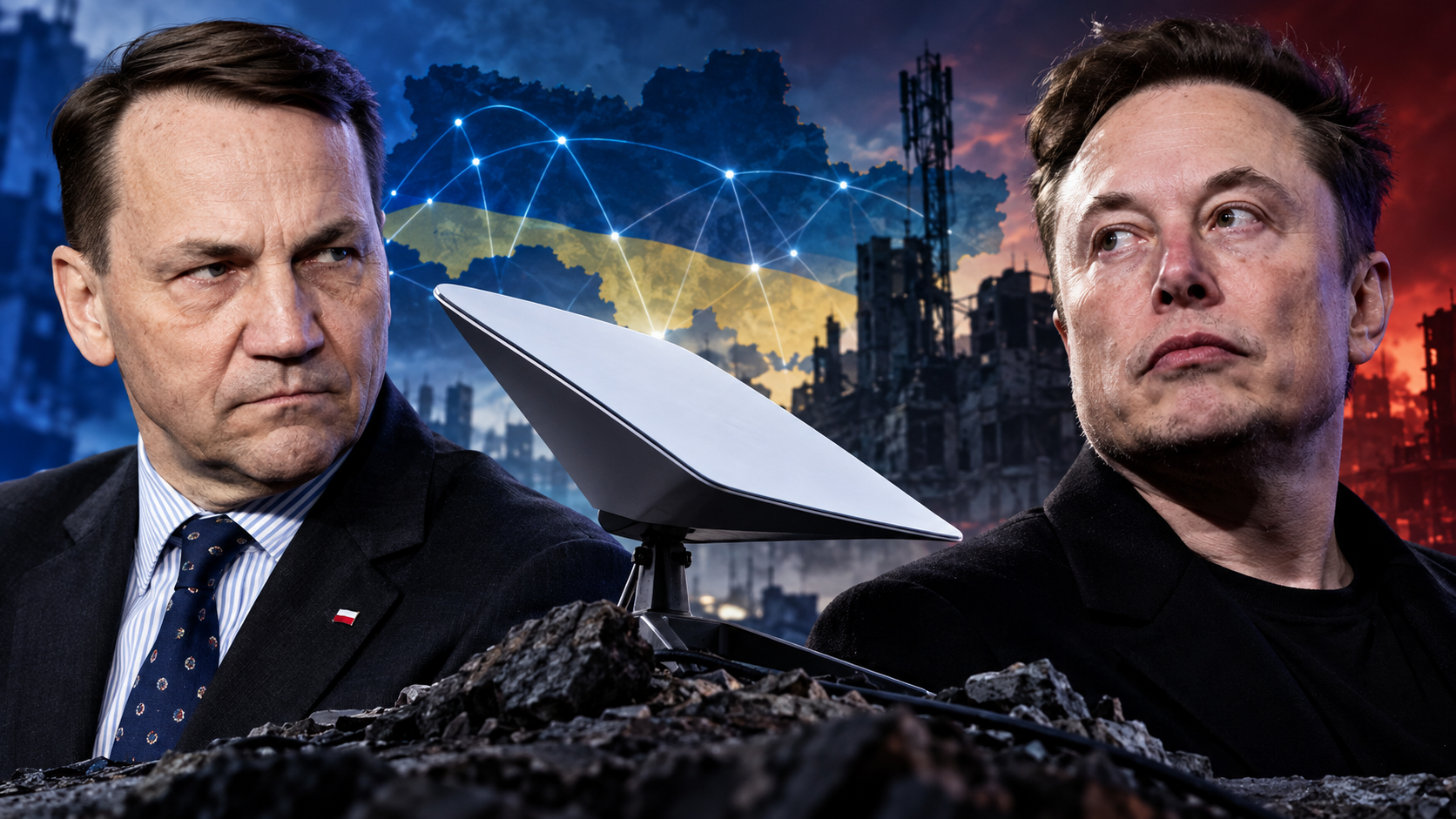
Polish Foreign Minister Radosław Sikorski has publicly challenged Elon Musk over restrictions on Starlink satellite communications that Ukrainian officials say have disrupted military drone operations, questioning whether the billionaire is allowing political considerations to influence a service vital to Ukraine’s defence.
The intervention on Wednesday, 14 October, followed reports from Kyiv that SpaceX, Musk’s aerospace company, had introduced restrictions on satellite terminals used aboard moving military equipment without warning Ukrainian forces.
The changes reportedly interrupted drone missions and complicated operations near the front line, raising fresh questions about Ukraine’s dependence on American-controlled communications technology.
- Find more news from Poland on our Homepage .
Sikorski’s criticism carries particular weight because Poland pays for Starlink services supplied to Ukraine, making Warsaw both an important military supporter of Kyiv and a customer of Musk’s company.
In a direct message to Musk published on X, Sikorski wrote:
“Hey, @elonmusk, big man, are you playing politics with your products again? As your European customers, we are watching you.”
The remarks revived a public dispute between the Polish minister and Musk dating back to March 2025.
The reason for the latest restrictions has not been independently established. Sikorski’s suggestion that politics could be involved remains a question rather than a verified explanation.
Ukraine reports sudden restrictions on Starlink
The dispute began after Ukrainian officials reported unexpected changes to the performance of Starlink satellite terminals used for military operations.
Serhiy Beskrestnov, a Ukrainian presidential adviser specialising in military communications technology, said SpaceX had introduced restrictions overnight without giving Ukrainian forces advance notice.
According to Reuters’ reporting on the technical disruption, the limitation particularly affected terminals operating aboard platforms moving faster than approximately 160 kilometres per hour, or 100 miles per hour.
Beskrestnov said the restriction applied to the military-focused Starshield service package.
He reported that several Ukrainian missions had been disrupted because military personnel were unaware that their communications equipment would stop operating normally under certain conditions.
Units from Ukraine’s 7th Rapid Reaction Corps, operating on the southeastern front, also reported difficulties.
According to their account, some terminals experienced connection interruptions lasting between 10 and 20 seconds at speeds of approximately 110–120 kilometres per hour.
Even short interruptions can seriously affect unmanned aircraft that rely on a continuous communications link for navigation and remote control.
The corps said some missions had to be cancelled.
These reports concern particular operational restrictions, especially involving moving terminals. They do not establish that Starlink internet access has been shut down throughout Ukraine.
Drone attacks and air defence affected
Starlink has become an important component of Ukraine’s military communications infrastructure since Russia launched its full-scale invasion in February 2022.
Satellite terminals help Ukrainian units communicate in areas where conventional infrastructure has been damaged or destroyed.
Their relative resistance to electronic jamming has also made them valuable for certain unmanned aircraft operations.


Ukrainian forces use satellite communications for reconnaissance, logistical support and remotely operated aircraft, including some drones deployed against Russian military positions in occupied Ukrainian territory.
The reported restrictions are not limited to offensive operations.
According to additional reporting by Interfax-Ukraine, Beskrestnov warned that the limitations could also affect Ukrainian interceptor drones designed to defend the country against faster Russian unmanned aircraft.
The adviser raised particular concerns about defending against jet-powered variants of the Shahed attack drone.
The precise scale of the resulting operational disruption has not been independently established.
By Wednesday afternoon, Interfax-Ukraine reported, citing Ukrainian Defence Ministry sources, that officials were contacting SpaceX, the United States and NATO partners to clarify the situation.
According to those sources, Ukrainian units were also testing and using alternative communications arrangements while gathering information about the affected systems.
Poland pays for Ukraine’s Starlink connectivity
The diplomatic significance of Sikorski’s intervention lies partly in Poland’s financial contribution to Ukraine’s access to Starlink.
Warsaw has been among the principal suppliers of satellite terminals and has financed continuing subscriptions.
The Polish Ministry of Digital Affairs confirmed in 2025 that Poland had undertaken to pay subscription charges for terminals supplied to Ukraine between 2022 and 2024, while also funding the purchase of another 5,000 devices.
The ministry described maintaining Ukrainian communications as an important element of cooperation between the countries.
Poland’s support has served civilian as well as military needs, including emergency communications, healthcare, transport infrastructure and maintaining connectivity in areas affected by the war.
In March 2025, Sikorski publicly stated that Poland was spending approximately $50 million annually on Starlink services for Ukraine.
The latest Interfax-Ukraine reporting states that Poland continues to finance the operation of more than 29,000 terminals.
However, no evidence has yet established whether the particular systems affected by the latest military restrictions are among those funded by Warsaw.
This distinction is important because the reported changes concern specific operational services, rather than every Starlink connection supplied to Ukraine.
Nevertheless, Poland’s role as a substantial paying customer explains why Sikorski has taken a direct interest in the company’s decisions.
A renewed dispute between Sikorski and Musk
Wednesday’s exchange follows an unusually public confrontation between the Polish foreign minister and Musk in March 2025.
The earlier dispute began when Musk suggested that Ukraine’s front line depended so heavily on Starlink that it could collapse without the service.
Sikorski responded by pointing out that Poland paid substantial subscription costs and warned that Warsaw might seek alternative providers if SpaceX became unreliable.
US Secretary of State Marco Rubio then entered the argument, accusing Sikorski of misrepresenting American intentions and defending Starlink’s contribution to Ukraine’s war effort.
Musk responded personally, dismissing Sikorski as a “small man” and arguing that Poland covered only a fraction of the service’s overall costs.
The confrontation became a wider debate over whether Ukraine’s military communications should depend so heavily on a private company controlled by one individual.
Musk later insisted that Starlink would not be withdrawn from Ukraine or used as leverage in political negotiations, despite his disagreements with aspects of Western policy towards the war.
The exchange was documented at the time by Reuters in its March 2025 account of the diplomatic dispute.
Sikorski’s latest reference to Musk as a “big man” appears to be a deliberate allusion to their previous disagreement.
As of the latest reporting examined for this article, Musk had not publicly answered the new challenge.
Restrictions come amid worsening US-Ukraine relations
The Starlink controversy comes during a period of renewed tension between Washington and Kyiv.
US President Donald Trump has criticised Ukrainian President Volodymyr Zelenskyy and pressed Ukraine to stop attacking Russian oil refineries.
Washington has argued that the strikes contribute to international fuel-market disruption, although the wider energy crisis also reflects the ongoing conflict involving Iran.
Trump has also announced a proposed ceasefire covering attacks on energy infrastructure, but Russia and Ukraine did not publicly confirm an agreed reciprocal arrangement at the time of his announcement.
Russian missile and drone attacks on Ukrainian energy facilities have continued.
These developments have heightened concern in Kyiv about the reliability of American support.
However, the timing of the Starlink restrictions does not establish that Trump requested them, that Musk ordered them for political reasons or that they form part of a coordinated attempt to pressure Ukraine.
SpaceX has not provided a publicly verified technical or contractual explanation for the new limits.
The wider question of Europe’s dependence on Starlink
The dispute highlights a security issue extending beyond Ukraine: the increasing reliance of European governments and armed forces on commercially operated satellite networks.
Starlink has advantages in areas where conventional internet and communications infrastructure is unreliable or vulnerable to attack.
However, dependence on a commercial provider also exposes customers to changes in access, operating conditions, technical policies and contractual arrangements.
For military users, decisions affecting connection availability or terminal functionality can have immediate operational consequences.
Poland’s position as a customer gives Sikorski a direct basis for questioning the reliability of the service.
It also raises questions about whether European governments need additional satellite communications providers and contingency systems for critical operations.
No evidence currently establishes that Poland has decided to terminate its Starlink arrangements or that Ukraine is preparing to abandon the system.
For now, Ukrainian officials are seeking clarification while assessing the impact of the restrictions.
Sikorski’s intervention adds a diplomatic dimension to that process.
His warning to Musk underscores a broader concern: technology supplied by private companies can become essential to national security, but governments may have limited influence when access or operating conditions change.
The immediate question remains why the restrictions were introduced and how quickly the disrupted Ukrainian capabilities can be restored.