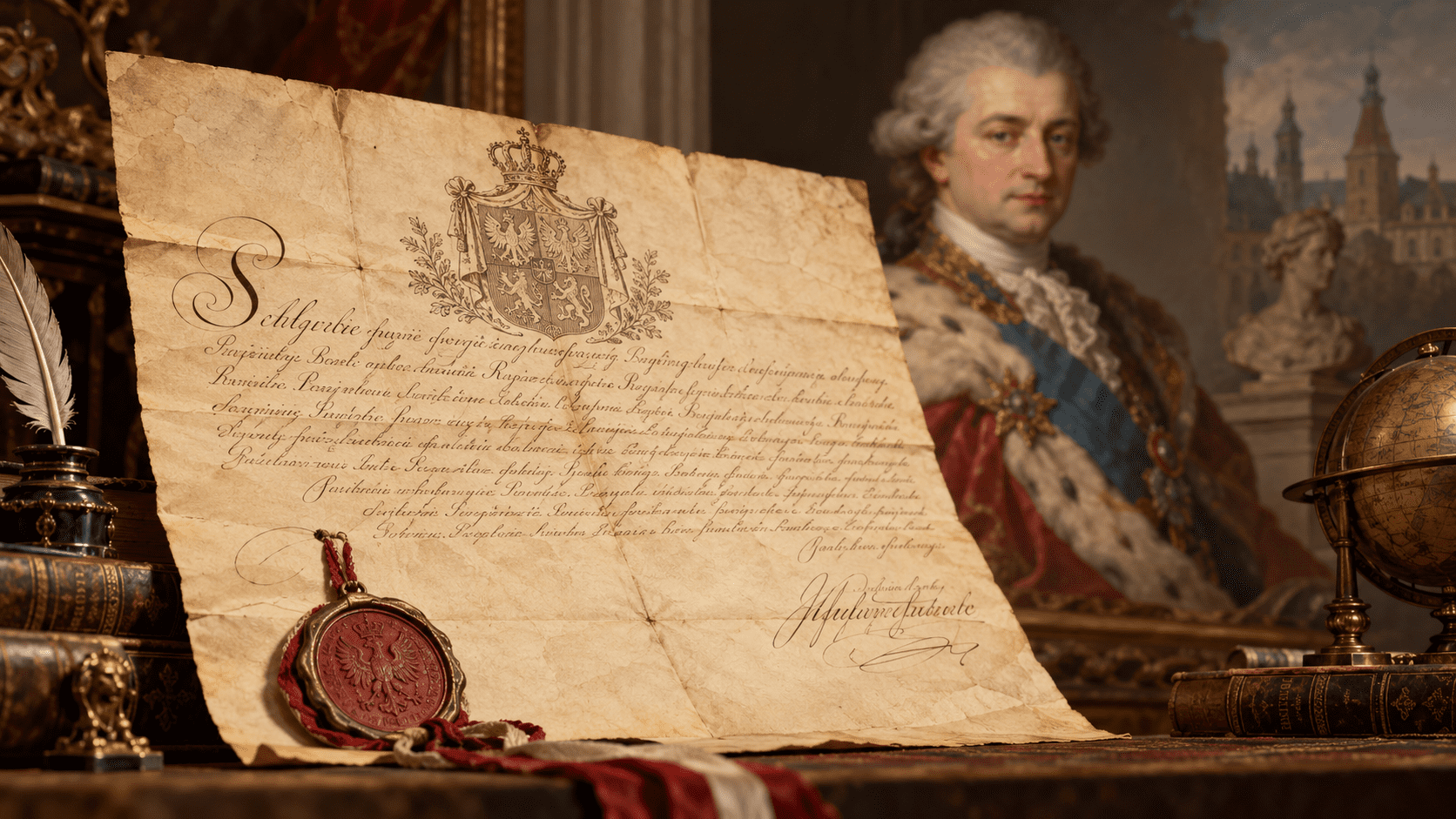
In 1773, the Polish-Lithuanian Commonwealth had just suffered one of the greatest political shocks in its history.
Russia, Prussia and Austria had seized large parts of its territory in the First Partition, exposing the weakness of a state whose political system had become increasingly vulnerable to interference from neighbouring powers.
Yet on 14 October 1773, during the very parliament forced to deal with the consequences of partition, the Commonwealth established an institution with a strikingly different purpose: to overhaul education.
- Find more news from Poland on our Homepage .
The Commission of National Education, known in Polish as the Komisja Edukacji Narodowej or KEN, became one of Europe’s earliest central state authorities responsible for education.
Its ambitions went far beyond keeping schools open.
Reformers wanted to reorganise the entire educational system, modernise what children were taught and produce a generation better prepared to serve a Commonwealth desperately trying to strengthen itself.
A crisis created an opportunity
The Commission emerged from another dramatic change taking place across Catholic Europe.
In 1773, Pope Clement XIV suppressed the Society of Jesus. The Jesuits had operated a substantial network of schools in the Polish-Lithuanian Commonwealth, and their dissolution threatened to leave a major gap in education.
It also created an opportunity.
Rather than simply allowing the former Jesuit school network and property to fragment, the Commonwealth placed educational resources under a new public authority.
King Stanisław August Poniatowski, an important patron of Enlightenment reform, supported the initiative. On 14 October, the Partition Sejm formally established the Commission.
Its members included leading political figures from both the Polish Crown and the Grand Duchy of Lithuania, among them Ignacy Potocki, Adam Kazimierz Czartoryski, Joachim Chreptowicz and Michał Poniatowski.
The timing was significant.
The First Partition had demonstrated that reform was no longer an abstract intellectual project. For many members of Poland-Lithuania’s political elite, strengthening institutions had become a question of whether the Commonwealth could continue to exist as an independent state.
Education was part of that struggle.
Changing what children were taught
The Commission gradually developed a more coherent system linking different levels of education.
Schools were reorganised, universities were reformed and greater attention was paid to teacher preparation and inspection.
Just as important was what happened inside classrooms.
The reformers wanted education to be more useful to society and more closely connected with the intellectual currents of the Enlightenment.
Greater emphasis was placed on subjects including natural sciences, mathematics, history and geography, while instruction in the Polish language gained importance.
You May Also Be Interested In

Education was also expected to produce citizens who understood their obligations towards the Commonwealth.
That combination of practical knowledge and civic education reflected a central belief of the reform movement: repairing the state required more than changing laws. It required changing how future generations were educated.
The Commission also sought to reduce an older educational model dominated heavily by Latin and traditional classical instruction in favour of a broader curriculum based on contemporary knowledge.
The change was not instantaneous, nor was implementation uniform throughout the enormous and diverse Commonwealth. But the scale of the project was remarkable for the period.
Textbooks, teachers and universities
One of the Commission’s most important innovations came in 1775, when it created the Society for Elementary Books.
Led by Ignacy Potocki, with former Jesuit Grzegorz Piramowicz serving as secretary, the society developed curricula and commissioned textbooks for the new school system.
This was more consequential than simply replacing old schoolbooks.
Teaching scientific subjects in Polish required educators to develop or standardise terminology in fields that had often been taught through Latin. New texts were prepared for grammar, mathematics, natural sciences and elementary education.
The Commission also transformed higher education.
The old academies in Kraków and Vilnius were reorganised as the principal higher-education institutions for the Polish Crown and the Grand Duchy of Lithuania respectively.
In Kraków, Hugo Kołłątaj played a major role in reforming the university. Academic structures and subjects were reorganised, and the institution was given a central place in training teachers and supervising schools.
The Commission increasingly treated teaching itself as a profession requiring preparation, defined responsibilities and institutional oversight.
By the standards of eighteenth-century Europe, this level of central coordination was highly unusual.
Was it the world’s first education ministry?
Polish institutions frequently describe the Commission of National Education as the first ministry of education in Europe, and it is sometimes described even more broadly as the first of its kind in the world.
That description needs some care.
Eighteenth-century institutions do not map neatly onto modern government ministries, and claims of absolute priority depend on how a “ministry of education” is defined.
What is much less controversial is the Commission’s pioneering character.
It was a central public body created by parliament, responsible for overseeing and reforming a broad education system across a state. Academic historians of education regard its organisation and ambitions as exceptional in the European context.
Its significance therefore does not depend on winning a contest over which country can claim the world’s first education ministry.
The achievement was substantial in its own right.
Reform before the disappearance of the state
The Commission continued its work until the final years of the Commonwealth.
Its reforms could not solve the political and military problems surrounding Poland-Lithuania. Further partitions followed, and in 1795 the Commonwealth disappeared from the map of Europe as an independent state.
But the educational project outlasted the political circumstances that had created it.
Textbooks, teaching practices and ideas developed under the Commission continued to influence education during the partition period, when Polish lands were divided between Russia, Prussia and Austria.
The Commission also retained an important place in Polish historical memory as an example of the reform movement that attempted to modernise the Commonwealth before its destruction.
That legacy remains visible every 14 October.
Modern Poland marks the anniversary as National Education Day, the annual celebration of teachers and other education workers.
The date therefore links today’s Polish schools with an institution created 253 years ago, at a moment when a weakened state tried to answer territorial catastrophe not only with diplomacy and political reform, but with classrooms, teachers and books.