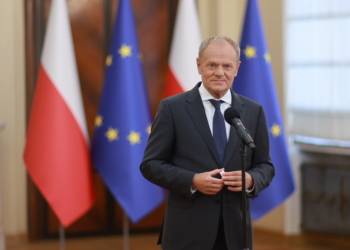
A Polish MP from Prime Minister Donald Tusk’s governing Civic Coalition has been placed in pretrial detention for 88 days after a court upheld an appeal by European prosecutors investigating alleged corruption and trading in influence. Police detained Wojciech Król inside a courtroom in Katowice on Thursday, 5 November.
Król, who also chairs Poland’s National Media Council, was attending a hearing at the Katowice Regional Court when judges overturned an earlier decision refusing to place him in custody.
The ruling followed an appeal by the European Public Prosecutor’s Office (EPPO), which is conducting a wider investigation into suspected corruption and irregularities involving EU-funded infrastructure projects in southern Poland.
- Find more news from Poland on our Homepage .
According to TVP Katowice’s report on the hearing, Król was taken into custody immediately after the decision was announced.
He faces four corruption-related allegations and has repeatedly denied wrongdoing. No court has found him guilty.
Court reverses earlier refusal to detain MP
The decision marks a significant development in proceedings that began months earlier.
On 17 September, Poland’s parliament, the Sejm, voted to authorise Król’s detention and possible pretrial imprisonment. The motion received 422 votes in favour, three against and five abstentions.
Król was subsequently detained by officers from Poland’s Central Anti-Corruption Bureau (CBA) and questioned by European prosecutors.
However, the Katowice-East District Court initially rejected the prosecution’s application for pretrial detention, concluding that less restrictive preventive measures would be sufficient. Poland-24 reported on that earlier ruling in September.
European prosecutors challenged that decision.
On 5 November, the higher Katowice Regional Court accepted the prosecution’s appeal and ordered Król into custody for 88 days. He was detained by police before leaving the courtroom.
The latest ruling concerns whether Król should remain in custody while the investigation continues. It does not determine whether the criminal allegations against him are true.
What is Wojciech Król accused of?
The allegations form part of a broader EPPO investigation into suspected corruption, trading in influence and procurement fraud involving public infrastructure and European Union funding.
The investigation initially focused on modernisation of tram infrastructure across the Upper Silesian-Zagłębie Metropolis, a large urban area surrounding Katowice.
In its account of the wider investigation, the EPPO said the tram infrastructure programme received approximately PLN 1.9 billion (€448 million) in EU funding between 2007 and 2027.
That figure describes funding associated with the infrastructure programme, not the amount prosecutors allege Król personally received or misappropriated.
In its 30 July announcement, the EPPO said additional evidence had emerged suggesting that a serving Polish MP had accepted financial benefits in exchange for arranging favourable outcomes for companies.
The prosecution subsequently presented Król with four allegations.
As Poland-24 previously reported, drawing on the prosecutorial material, one allegation concerns the suspected acceptance of at least €330,000 in exchange for assisting a business seeking more than PLN 27 million in European funding for a development project in Chorzów.
Another concerns an alleged payment of at least PLN 37,000 linked to promises of assistance with appointments and business opportunities.

These are accusations made by investigators, not established findings of criminal wrongdoing.
Król has disputed the allegations, including claims involving travel expenses and the use of a vehicle provided by another person.
Investigation brings European prosecutors into Polish politics
The case is particularly significant because the EPPO is an independent European Union prosecution service responsible for investigating offences affecting the EU’s financial interests.
Poland joined the EPPO system following the change of government in late 2023, making this investigation an important early test of the institution’s involvement in high-profile Polish political cases.
In May 2026, the European Chief Prosecutor requested that the Sejm lift the parliamentary immunity of a serving Polish MP in connection with the investigation.
Parliament initially permitted criminal proceedings against Król in July but refused to authorise his detention.
The EPPO later submitted a second application, citing additional alleged offences and grounds for detention.
In September, parliament approved the renewed detention request.
The investigation has also involved other suspects, including public officials and businesspeople. Their legal situations are separate from Król’s, and each remains entitled to the presumption of innocence.
Detention raises questions over National Media Council
Król’s detention also creates uncertainty surrounding the leadership of Poland’s National Media Council (Rada Mediów Narodowych).
The five-member body is responsible for appointing and dismissing management and supervisory board members at public-media institutions, including TVP, Polish Radio and the Polish Press Agency.
Król remains its chairman.
According to reporting by Rzeczpospolita, council members face a potential procedural obstacle because meetings are convened by the chairman.
The newspaper reported that other members had previously sought Król’s resignation from the position, but he had declined.
One possibility raised by a council source was that Król might participate remotely in meetings if the relevant judicial authorities permitted it. Whether such an arrangement would be authorised remains uncertain.
His detention does not, by itself, constitute a criminal conviction or automatically establish that his membership of the council has ended.
Civic Coalition suspends Król
Król belongs to Civic Coalition, the largest party grouping in Prime Minister Donald Tusk’s governing alliance.
Following the escalation of the investigation in September, he was suspended from the Civic Coalition parliamentary club and lost his position as one of its deputy chairs.
That suspension is a political and parliamentary-club measure, separate from the criminal proceedings. Król remains a member of the Sejm.
The legal proceedings are continuing, and the EPPO has not publicly established a timetable for any eventual trial.
The immediate consequence of Thursday’s decision is that Król faces continued detention while investigators pursue the case.
He remains presumed innocent unless convicted by a competent court.