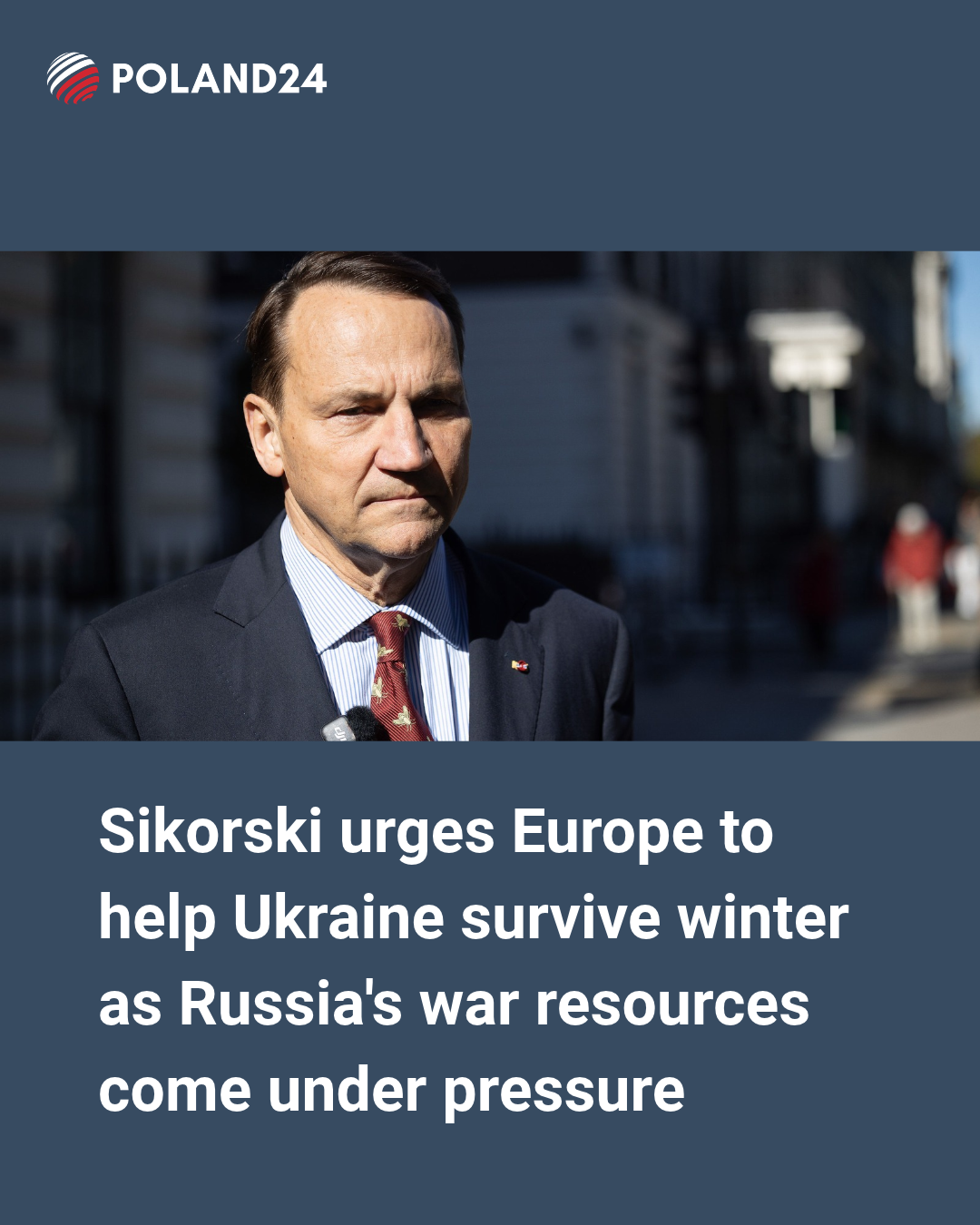
Poland’s Foreign Minister Radosław Sikorski has urged European governments and the Polish public to intensify assistance to Ukraine before winter, warning that Russia is attempting to exploit freezing temperatures and attacks on energy infrastructure to weaken the country’s resistance. Speaking in northern Poland on Saturday, 24 October, Sikorski argued that Moscow’s military offensive had stalled and suggested that Russian resources could begin to run down in 2027 if Ukraine withstands the coming winter.
Sikorski, who also serves as Poland’s deputy prime minister, made the remarks during an open meeting with residents at the Kashubian-Pomeranian Higher School in Wejherowo.
According to original reporting by Radio Gdańsk, the minister appealed for increased deliveries of electricity generators and humanitarian supplies, while urging Polish society to show solidarity with Ukrainians facing renewed Russian attacks.
- Find more news from Poland on our Homepage .
He argued that the next few months would be particularly important for Ukraine’s ability to sustain its defence.
“If Ukraine survives this winter, I am optimistic,” Sikorski said, adding that he expected Russian resources to begin running down next year.
His remarks were an assessment of the war’s possible direction, not an announcement of new Polish government funding or an independently established prediction of Russia’s military capabilities.
Russia is counting on winter, Sikorski warns
Sikorski described the military situation along Ukraine’s roughly 1,200-kilometre front line as largely static, arguing that Russian forces had failed to achieve a decisive breakthrough despite sustaining substantial losses.
He suggested that Russian President Vladimir Putin was relying on two factors to change the situation: further mobilisation and the arrival of winter.
According to the PAP account published by Rzeczpospolita, Sikorski argued that Russia was seeking to bring approximately 200,000 additional personnel into the war while targeting Ukrainian heating and electricity infrastructure.
He referred to the historical concept of “General Winter”, describing Moscow’s apparent hope that harsh weather would place additional pressure on Ukraine.
The minister’s assessment of the front line and Russia’s mobilisation intentions should not be treated as independently verified military findings.
However, the danger posed by Russian attacks on Ukrainian energy infrastructure is well documented.
In an assessment published on 16 October, the United Nations Human Rights Monitoring Mission in Ukraine warned that renewed Russian strikes were placing electricity and heating systems under severe pressure.
The UN reported that attacks on 13–14 October struck several major Ukrainian energy facilities, including three principal power stations serving Kyiv.
According to Ukrainian authorities cited by the UN, those attacks temporarily left approximately 600,000 people in the capital without electricity.
The UN warned that continued destruction of energy and heating infrastructure as winter approaches could inflict significant suffering on civilians.
Poland calls for generators and humanitarian assistance
Sikorski urged the Polish public and European countries to increase practical assistance capable of helping Ukrainian households survive prolonged power and heating disruptions.
He specifically highlighted electricity generators, which can provide emergency power when conventional supplies are unavailable.
The equipment can be essential for hospitals, emergency shelters, water systems and other services that must continue operating during blackouts.
Sikorski also appealed for greater understanding towards Ukrainians affected by the war, describing the severity of the attacks they were experiencing.

His comments build on earlier Polish humanitarian efforts.
In January 2026, the Polish Interior Ministry announced emergency assistance consisting of 379 electricity generators and 18 heaters from the Government Agency for Strategic Reserves.
A further 447 generators were to be provided through European Union funding, while Warsaw pledged an additional 90 units.
Those deliveries were announced during the previous winter and should not be confused with a new commitment arising from Sikorski’s Wejherowo speech.
During Saturday’s meeting, the foreign minister called for increased assistance but did not announce a specific new funding package or delivery programme.
UN seeks $358 million to help Ukrainians through winter
The scale of Ukraine’s humanitarian requirements has already prompted an international response.
In July, the United Nations launched its 2026–2027 Winter Response Plan, seeking $358.4 million to assist approximately 2.1 million vulnerable people.
The programme covers October 2026 to March 2027 and includes heating assistance, repairs to damaged homes, healthcare, food, protection and financial support.
It focuses particularly on communities near the front line, displaced people and households whose access to essential services has been disrupted.
The European Union has also announced substantial energy assistance.
According to the European Commission’s Ukraine energy-security programme, a package worth approximately €922 million was announced in February for the 2026–2027 winter period.
The programme is intended to strengthen electricity generation, improve grid resilience, support heating systems and reduce the vulnerability of Ukraine’s energy infrastructure.
The Commission has also coordinated the delivery of thousands of generators and transformers since Russia launched its full-scale invasion in February 2022.
These programmes demonstrate that preparations for winter are already under way, although continued Russian attacks create new requirements for repairs, replacement equipment and emergency supplies.
Could Russia’s resources begin running out in 2027?
Alongside his humanitarian appeal, Sikorski suggested that the financial and military costs of the war could become increasingly difficult for Russia to sustain.
He pointed to Ukrainian attacks on Russian refineries, ports and defence-related facilities, arguing that Kyiv was imposing growing costs on Moscow despite Russia’s larger economy and population.
The minister also stressed the importance of maintaining sanctions and economic pressure on Russia.
Independent economic research supports the conclusion that Moscow faces mounting financial constraints, but it offers a more cautious assessment than an imminent exhaustion of Russian resources.
The Bank of Finland’s October forecast projects Russian economic growth of approximately 0.5% in both 2027 and 2028.
Its research institute, BOFIT, identified persistent budget deficits, financial pressures and limited prospects for stronger economic growth.
However, it also concluded that Russia could continue financing the war and maintaining current production levels, making an immediate economic crisis unlikely.
A separate September report by the Kyiv School of Economics Institute similarly found that financing the war was becoming increasingly difficult and expensive.
Nevertheless, it concluded that Russia’s ability to continue paying for the conflict was not yet immediately threatened.
These assessments suggest Moscow may face growing economic constraints without establishing that it will run out of the resources needed to continue fighting in 2027.
Sikorski’s prediction is therefore best understood as a conditional political and strategic assessment.
Why Ukraine’s winter matters to Poland and Europe
Poland has been one of Ukraine’s principal European supporters since the start of Russia’s full-scale invasion.
Its geographical position makes it an important route for international humanitarian assistance, military equipment and commercial transport.
Warsaw also regards Ukraine’s ability to defend itself as a central element of Polish national security.
A prolonged disruption to Ukrainian electricity and heating supplies could create additional humanitarian requirements, complicate economic activity and place further pressure on Ukraine’s civilian population.
In addition to generators, Ukraine needs functioning transmission networks, replacement transformers, emergency heating equipment and protection for critical infrastructure.
Western governments therefore face two related challenges: helping Ukraine withstand continuing military attacks and ensuring that its civilian population can survive the consequences.
Sikorski’s appeal places particular emphasis on the second.
For the Polish foreign minister, maintaining support through the winter is not simply a humanitarian obligation. It is also part of a longer-term strategy intended to help Ukraine preserve its independence while increasing economic and military pressure on Russia.
His argument is that if Ukrainians can endure another winter of attacks, the balance of resources may gradually become less favourable to Moscow.
Whether that assessment proves correct remains uncertain. The immediate concern is ensuring that Ukrainian households, hospitals and essential services have the electricity and heating they need in the months ahead.