Global online fashion retailer Shein has announced €500 million (approximately PLN 2.2 billion) in investment in its Polish logistics operations during 2026, reinforcing the Wrocław region’s role as one of the company’s principal European distribution centres. The expansion is expected to support around 2,000 additional jobs by the end of the year, bringing its reported workforce in Poland to more than 10,000, as the retailer increases warehouse capacity, introduces more automation and seeks to deliver products to European customers more quickly.
The investment, announced on Wednesday, 4 November, builds on Shein’s existing operations in Lower Silesia, where the company began developing its European logistics network in 2022.
According to the company’s investment announcement reported by Reuters, Shein is expanding its distribution infrastructure to improve delivery times and make its European operations more flexible.
- Find more news from Poland on our Homepage .
The €500 million represents investment allocated to 2026, rather than a wholly new sum being committed for future years. Polish business reporting indicates that the programme will bring Shein’s cumulative investment in Poland since 2022 to approximately €1 billion, equivalent to around PLN 4.4 billion.
The company has not provided a complete public breakdown identifying how much of this year’s €500 million has already been spent and how much remains to be invested.
Around 2,000 additional jobs planned
One of the most significant elements of the announcement is the expected expansion of employment.
Shein currently has approximately 8,000 people working across its Polish logistics operations, according to company representatives interviewed by Wrocław’s municipal news service.
The company intends to recruit around 2,000 additional employees by the end of 2026.
The new positions are expected to cover logistics, warehouse operations, supply-chain management and technology-related activities.
If achieved, the recruitment target would bring the workforce associated with Shein’s Polish operations to more than 10,000.
The figures are company-reported employment and recruitment targets, not independently verified numbers of jobs already created by the latest investment.
Shein has been expanding its presence in Poland for several years. In December 2025, the company announced the opening of an advanced European logistics hub, saying its operations would support at least 5,000 jobs in Lower Silesia.
The latest announcement indicates how quickly the scale of those operations has grown.
A network of warehouses across Lower Silesia
Although much of the reporting has focused on Shein’s facilities in Magnice, south of Wrocław, the company’s Polish logistics network extends across several locations.
During a visit by journalists on 4 November, company representatives described a network of approximately 20 warehouses with a combined area of around one million square metres.
Its principal operational complex in Kąty Wrocławskie comprises three modern warehouses covering approximately 250,000 square metres, according to the local reporting.
Other facilities are located in Magnice, Kobierzyce, Pietrzykowice and Bielany Wrocławskie, with additional operations elsewhere in Poland.
The company has therefore established a wider logistics network rather than relying on a single distribution centre.
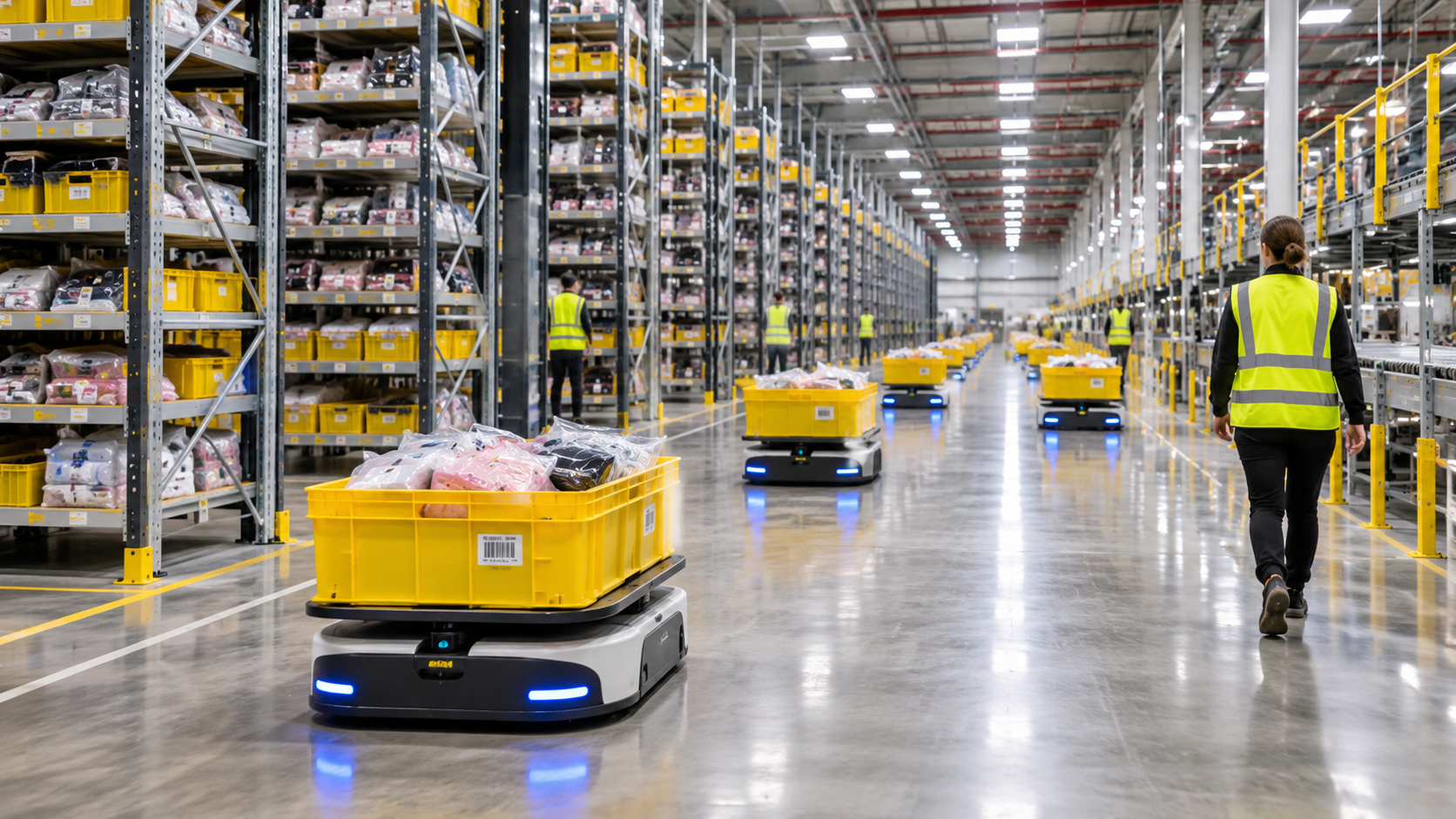
Within the Kąty Wrocławskie complex, automated systems handle storage, sorting and the preparation of customer orders.
The network is expected to operate with more than 6,500 autonomous robots by the end of 2026.
You May Also Be Interested In


These machines move goods between storage areas and order-processing stations, helping the company manage large volumes of products.
For consumers, the aim is faster delivery.
Shein says customers in selected European markets can receive products already stored in its Polish distribution facilities within approximately 48 hours. Actual delivery times depend on the destination, product availability and other logistical factors.
Why Shein is expanding in Poland
The Wrocław region offers several advantages for a company distributing products across Europe.
Its location in southwestern Poland provides access to major road networks connecting Poland with Germany, Czechia and other European markets.
The region also has an established logistics industry, experienced workers and numerous transport and warehousing businesses.
During the announcement, Michał Kania, Shein’s public affairs director in Poland, identified transport infrastructure, access to specialist services and the availability of qualified personnel as important factors behind the company’s decision to develop its operations in Lower Silesia.
The expansion also creates opportunities for Polish companies providing services to the distribution network.
According to Shein, it works with more than 230 Polish small and medium-sized businesses, including suppliers and companies involved in transport and logistics.
It also operates a marketplace through which Polish sellers can reach customers in other European countries.
The company says more than 500 Polish brands and sellers have joined its marketplace since the Polish version launched in April 2025.
These figures describe Shein’s reported business relationships. They do not establish the value of contracts awarded to Polish suppliers or the wider economic benefit of the investment.
New EU parcel charges change the economics of online shopping
The Polish expansion comes as Shein and other large international e-commerce platforms adjust to significant changes in European Union customs rules.
On 1 July 2026, the EU introduced a temporary €3 customs duty on qualifying items in low-value consignments imported from outside the bloc.
The measure applies to eligible shipments worth no more than €150 and replaces the previous customs-duty exemption.
A separate €2 EU handling fee began applying on 1 November 2026.
The European Commission’s customs reform guidance explains that the customs duty and the handling fee serve different purposes.
The duty addresses the previous preferential treatment of low-value imports, while the handling fee helps cover the cost of customs supervision and processing.
The European Commission argues that the changes are necessary to improve competition between businesses operating within the EU and retailers shipping large quantities of inexpensive products directly from outside the bloc.
It has also raised concerns about product safety, customs compliance and the enormous volume of small e-commerce shipments entering Europe.
For retailers such as Shein, Temu and AliExpress, these changes increase the importance of efficient regional logistics.
Storing products closer to European customers can reduce reliance on individual shipments from overseas and improve delivery speed.
However, maintaining warehouses inside the EU does not automatically exempt imported products from applicable customs duties or product-safety requirements.
Shein has presented its investment primarily as a means of improving efficiency, flexibility and resilience.
Although the timing coincides with the new customs regime, the company has not publicly provided a financial calculation demonstrating how much of its Polish investment is attributable specifically to the EU charges.
Investment comes amid scrutiny of Shein’s business model
The expansion also comes during a period of heightened regulatory attention towards major international online marketplaces.
In February 2026, the European Commission opened formal proceedings against Shein under the Digital Services Act.
The investigation concerns the company’s systems for preventing the sale of illegal products, the transparency of its recommendation systems and aspects of the platform’s design that may create risks for consumers.
Opening an investigation does not establish that Shein has breached EU law.
Separately, European policymakers have raised concerns about the effect of large volumes of low-cost imports on traditional retailers and the enforcement of product standards.
These debates form part of the broader commercial environment in which Shein is expanding.
They do not alter the significance of the Polish logistics investment, but they provide context for the regulatory pressures affecting the company’s European operations.
Poland strengthens its position in European e-commerce
The announcement reinforces Poland’s importance as a distribution base for international retailers serving customers across the continent.
Shein’s operations have grown from an initial presence in 2022 into a substantial network of automated warehouses, transport services and employment opportunities.
With its 2026 investment programme valued at €500 million, the company expects its cumulative spending in Poland to reach approximately €1 billion.
For Lower Silesia, the immediate implications include further recruitment and demand for logistics-related services.
For European customers, the potential benefit is faster access to products held in regional warehouses.
The longer-term economic effects will depend on how the investment is completed, how many additional jobs materialise and how the company’s European business develops.
Shein has not announced that its global or European corporate headquarters will relocate to Poland.
Instead, the latest expansion confirms the country’s growing role as a central part of the retailer’s European distribution infrastructure.