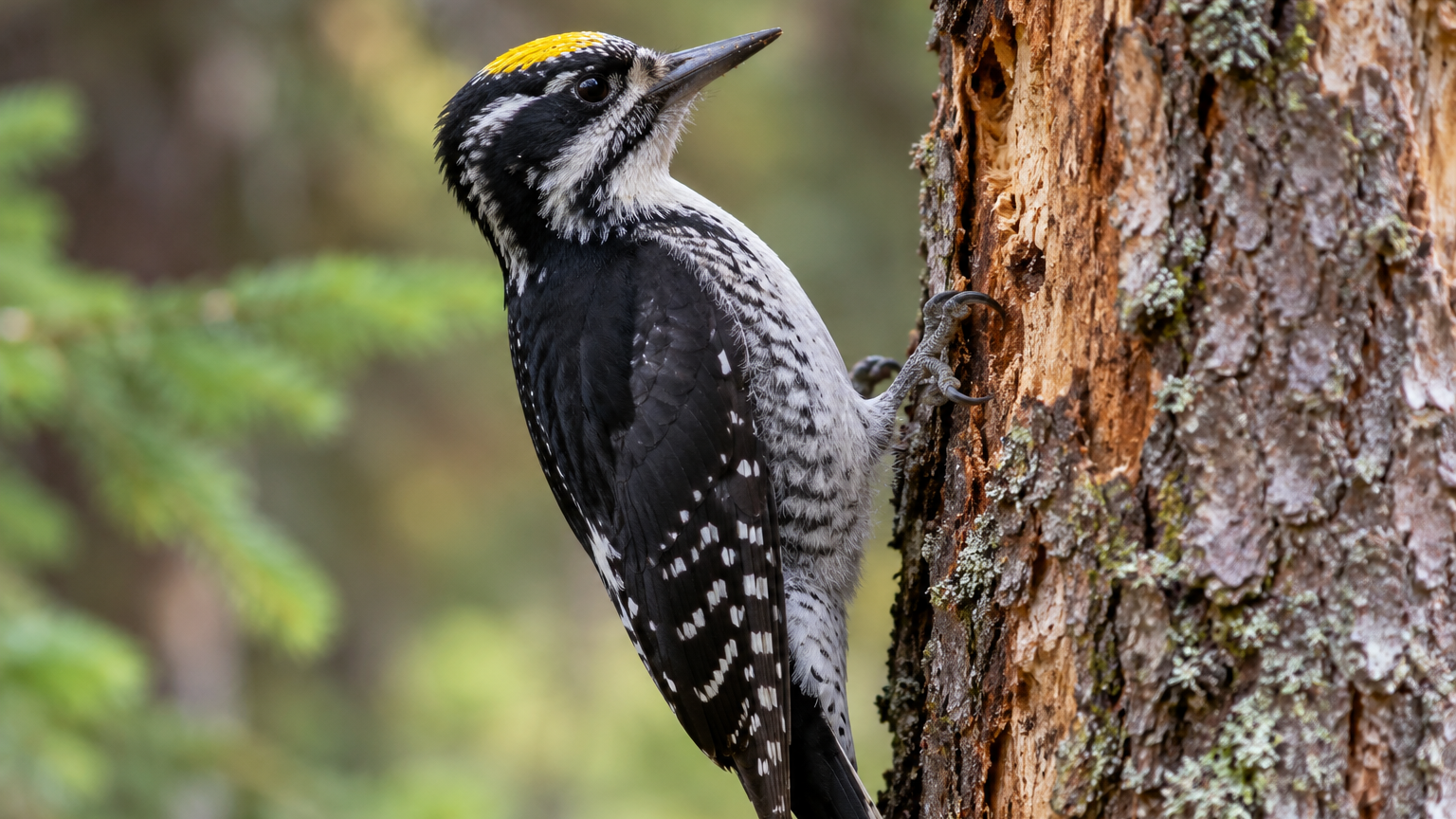
One of Poland’s rarest woodpeckers has been confirmed breeding in the country’s southwestern mountains for the first time in almost 130 years. Researchers discovered a nest containing chicks of the Eurasian three-toed woodpecker in the Sudeten Mountains, establishing the first documented breeding record in the Polish part of the range since the late 19th century. The discovery, announced by Poland’s State Forests in October 2026, highlights the importance of preserving mature mountain forests and naturally decaying trees.
The rare bird, known scientifically as Picoides tridactylus, was found nesting in the Mały Śnieżnik nature reserve, part of the Śnieżnik Massif near Poland’s border with the Czech Republic.
According to the official announcement from Poland’s State Forests, the discovery is the first confirmed breeding record in the Polish Sudetes since an observation near Duszniki-Zdrój in 1896.
- Find more news from Poland on our Homepage .
Although individual birds had been spotted in the region during recent years, researchers had lacked definitive evidence that the species was successfully nesting there.
The latest discovery changes that understanding.
Researchers discover a nest with chicks
The decisive observation took place on 10 June 2025, when researchers located an occupied nesting cavity in a Norway spruce tree.
The tree stood approximately 1,070 metres above sea level in a high-altitude spruce forest within the Śnieżnik Massif.
| The discovery | Finding |
|---|---|
| Previous documented breeding record | 1896, 129 years earlier |
| Nesting site’s altitude | Approximately 1,070 metres |
| Chicks documented | At least two |
The nesting cavity had been excavated approximately 6.5 metres above the ground.
During their first visit, researchers observed adult three-toed woodpeckers bringing food to young birds inside the tree.
Two days later, photographs, sound recordings and video footage confirmed that the adults were caring for at least two chicks.
This provided direct evidence of breeding rather than simply the presence of individual birds.
The findings were documented by Michał Bryja and Paweł Kmiecik, both associated with the Międzylesie Forest District, and Romuald Mikusek of the Stołowe Mountains National Park.
Their research was published in the scientific journal Przyroda Sudetów, volumes 26–27 (2026), pages 127–132, under a title describing the species’ breeding in the Polish Sudetes after almost 130 years.
Why the return is significant
The Eurasian three-toed woodpecker is among the rarest woodpecker species breeding in Poland.
Unlike the more familiar great spotted woodpecker, it has three toes rather than four. Males also have a distinctive yellow crown, contrasting with their black-and-white plumage.
The species is closely associated with mature coniferous forests, particularly those dominated by spruce and fir.
Most of Poland’s breeding population is concentrated in the Carpathian Mountains in the south and in forests in the northeast.
According to State Forests, the country’s breeding population is estimated at approximately 1,000–1,400 pairs.
The species is classified as Near Threatened on the Polish Red List of Birds, reflecting its national conservation status. This is a Polish assessment, not a claim that it has the same threatened status worldwide.
Its presence in the Sudetes is particularly interesting because the region lies outside the species’ principal Polish breeding areas.


Researchers had already recorded individual birds, pairs, males drumming on tree trunks and abandoned cavities in the Śnieżnik Massif.
However, these observations did not conclusively demonstrate that chicks were being raised locally.
The discovery of adults feeding young provides that evidence.
Could more pairs already be nesting in the Sudetes?
The newly confirmed nest may not be an isolated case.
Based on observations collected over several years, the researchers estimate that at least four or five breeding pairs may currently inhabit this part of the Sudeten Mountains.
That estimate should not be confused with four or five separately confirmed occupied nests.
The historical record also requires careful interpretation.
The last previously documented breeding was recorded in 1896 near Duszniki-Zdrój, another locality in the Sudetes.
The absence of confirmed nesting records for more than a century does not prove that every three-toed woodpecker disappeared from the region throughout that period.
Instead, the finding establishes that breeding has once again been conclusively documented.
Further field observations will be needed to determine how widespread and stable the population has become.
Why dead trees helped create a suitable habitat
One of the most important aspects of the discovery concerns the forest itself.
The Mały Śnieżnik area contains mature spruce stands, wet forest habitats and substantial quantities of standing and fallen dead wood.
These conditions are particularly valuable for three-toed woodpeckers.
The birds feed extensively on insects living in and beneath the bark of dead and dying trees, including wood-boring beetles and their larvae.
Such trees also provide places for the birds to excavate nesting cavities.
In many managed forests, dead or damaged trees are removed for commercial, safety or forest-health reasons.
Their removal can reduce the habitat available to wildlife that depends on decaying timber.
In the Śnieżnik Massif, planned forestry operations have been restricted to a minimum over much of the area for almost four decades.
Many trees have consequently been allowed to age, die and decay naturally.
Forestry officials say these conditions have helped create an environment suitable for the rare woodpecker.
The Wrocław Regional Directorate of State Forests identified the abundance of dead wood and the preservation of mature spruce forest as particularly important factors.
A newly protected nature reserve
The nesting site is located within the Mały Śnieżnik nature reserve, established in April 2025 as part of a wider initiative to protect valuable habitats in Lower Silesia.
The reserve includes areas around Mały Śnieżnik and neighbouring peaks, including Wysoczka, Goworek and Średniak.
It was one of three new reserves announced by the regional environmental authorities in April.
According to the Regional Directorate for Environmental Protection in Wrocław, the new protected areas formed part of an initiative to expand Poland’s network of nature reserves.
The timing is notable: the reserve was established only shortly before researchers documented the woodpecker’s breeding in June 2025.
However, the habitat conditions that attracted the birds developed over decades.
The discovery cannot therefore be attributed solely to the reserve’s creation. It provides evidence of the conservation value of a forest landscape where natural processes have long been allowed to continue.
Why woodpeckers matter for other forest wildlife
The three-toed woodpecker does more than use mature forests as a habitat.
It also helps create nesting and shelter opportunities for other animals.
As a primary cavity excavator, it makes holes in trees that can later be occupied by species unable to excavate their own.
These may include small owls, tits, flycatchers and some mammals.
The birds are consequently considered useful indicators of forest ecosystems containing mature trees and sufficient quantities of dead wood.
Their presence can suggest that habitat conditions are suitable for a wider community of forest wildlife.
However, the confirmed breeding in one location should not be interpreted as proof of a broader nationwide recovery.
Poland’s official rare-woodpecker monitoring programme, run under the Chief Inspectorate of Environmental Protection, reported that the species’ national distribution and abundance trends remained statistically stable in 2025, despite relatively low readings that year.
The new Sudeten breeding record is therefore an important local conservation development rather than evidence of a confirmed population boom across Poland.
What happens next?
The researchers’ findings provide a stronger scientific basis for understanding the three-toed woodpecker’s distribution in southwestern Poland.
Future monitoring will help establish whether the estimated four or five breeding pairs represent a stable local population and whether the species is expanding into other suitable parts of the Sudetes.
Conservationists will also be interested in whether the forest conditions supporting the birds can be maintained over the longer term.
For now, the discovery offers an encouraging example of what can happen when mature mountain forests retain the old trees, decaying timber and natural structures on which specialist wildlife depends.
After almost 130 years without a confirmed breeding record, the three-toed woodpecker is once again known to be raising young in Poland’s Sudeten Mountains.