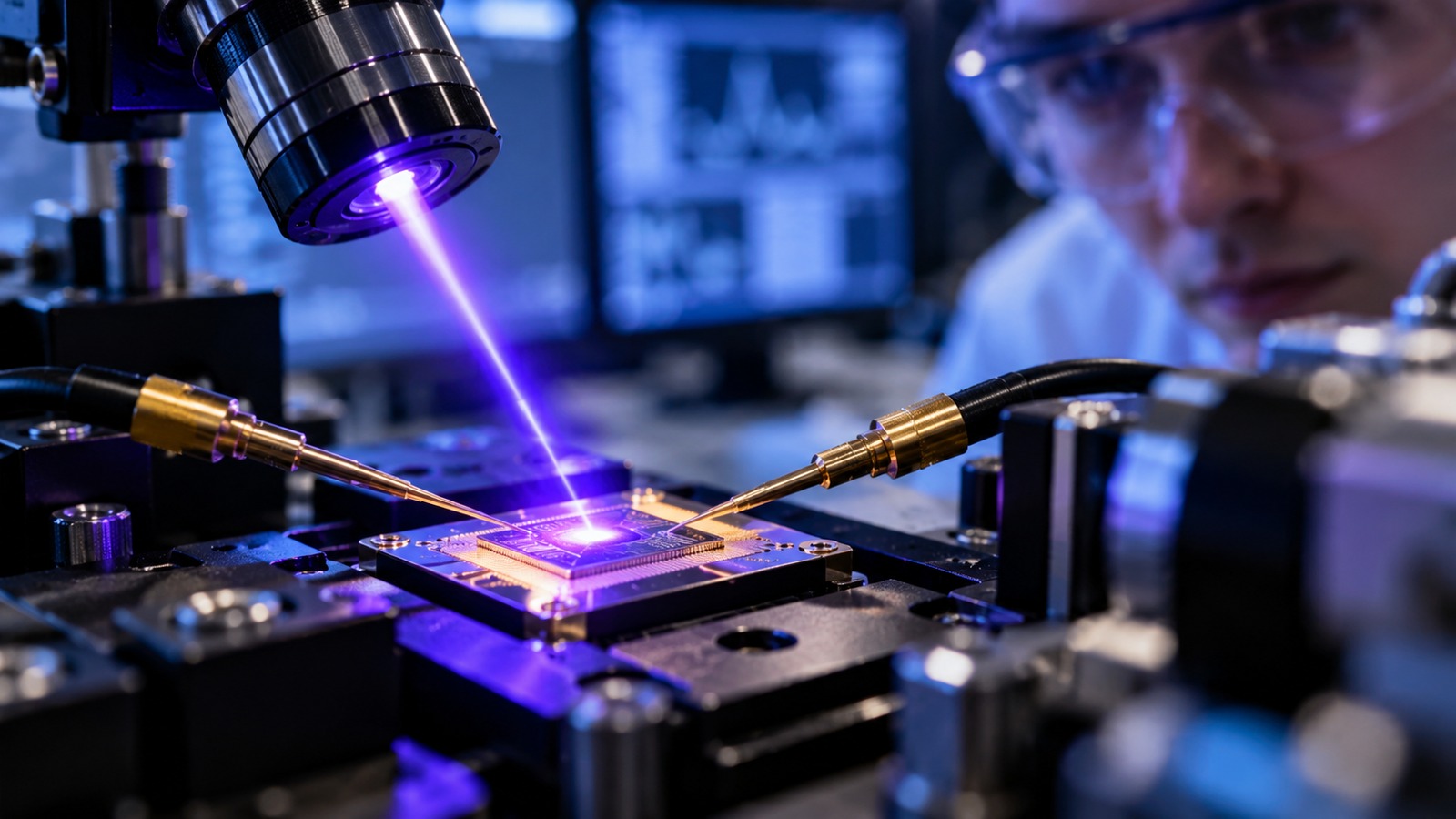
Polish scientists have developed an experimental light sensor that can briefly remember previous flashes, reproducing a basic feature of how connections between nerve cells process information.
Researchers from Wrocław University of Science and Technology and the Institute of Physics of the Polish Academy of Sciences demonstrated that their device responds differently to light depending on whether it has been illuminated moments earlier.
In one experiment, its response to a second light pulse was 47% stronger than its response to the first, revealing a form of short-term electronic memory.
- Find more news from Poland on our Homepage .
The findings, published in the scientific journal Advanced Functional Materials, could eventually contribute to a new generation of cameras and visual systems capable of processing some information directly within their sensors.
The research was first published on 17 September 2026 and attracted wider attention in Poland following an explanation of the findings by PAP Science in Poland on 13 October.
A sensor that remembers what it has just seen
To understand why the research matters, consider how an ordinary digital camera works.
Its image sensor converts incoming light into electrical signals, which are subsequently processed to form pictures or video.
When a system needs to recognise movement, it typically compares information from successive images.
For example, identifying the direction of a moving cyclist requires analysing how the cyclist’s position changes over time.
That process involves transferring information from the sensor to memory and processing hardware.
Polish researchers are investigating whether some of that work could eventually begin inside the sensor itself.
Their experimental device retains a temporary physical trace of earlier illumination, allowing the next flash to produce a different electrical response.
The effect resembles a behaviour found in biological synapses — the connections through which nerve cells communicate.
In certain synapses, repeated stimulation over a short period can strengthen the response to the next signal.
Scientists call this paired-pulse facilitation.
The Polish team has demonstrated a related effect using semiconductor materials and light rather than nerve cells.
The result is not an electronic brain or a device capable of remembering pictures.
Instead, it is a light-sensitive component whose electrical behaviour depends partly on its recent exposure to light.
How the Polish researchers achieved the effect
The team developed a structure containing extremely thin layers of zinc oxide and a related semiconductor incorporating cadmium, deposited on a silicon substrate.
The materials were also modified by adding small amounts of europium, a chemical element that changes their electrical behaviour.


The researchers discovered that adjusting the europium concentration could significantly alter the device’s function.
With relatively high europium doping, the structure could work as an extremely fast light detector.
With lower europium concentration, it demonstrated the short-term memory effect.
The underlying process involves electrically charged particles generated when light strikes the material.
Some of these charges become temporarily trapped within the semiconductor structure.
Even after the illumination stops and the measurable current falls, the trapped charges can remain for a short period.
When another flash arrives, they influence how electricity flows through the device, strengthening its response.
The material therefore retains information about the previous flash through its temporary electrical state.
As the trapped charges are gradually released, the effect fades and the device returns to its initial condition.
This is why the researchers describe the behaviour as a form of short-term memory.
A response in less than a thousandth of a second
The experiments also demonstrated that the effect can operate extremely quickly.
The researchers used pulses of violet light lasting just 100 microseconds, equivalent to one ten-thousandth of a second.
The pulses were separated by intervals of 500 microseconds.
Despite these brief periods, the device continued to produce distinguishable electrical responses.
Under one set of experimental conditions, the second pulse produced a response 147% as large as the first — a 47% increase.
This measurement was reported as a paired-pulse facilitation index of 147%.
The result is significant because many previously investigated artificial optoelectronic synapses have relied on considerably longer light pulses.
The Polish research demonstrates that this type of short-term memory behaviour can persist even when the stimulus lasts less than a millisecond.
The team also demonstrated the effect without applying an external operating voltage.
Under those conditions, the light itself supplied the energy needed to generate the electrical response.
In additional experiments, a small voltage was applied to allow the researchers to read the stored electrical state more directly.
That distinction is important: the demonstrated light-driven operation does not establish that an entire future camera could function without external electrical power.
Nevertheless, the combination of fast responses and temporary memory makes the technology an interesting candidate for further investigation.
Polish scientists behind the research
The findings were published under the title Sub-1 ms Optoelectronic Synapse Based on {ZnCdO/ZnO} Multilayer Structure for High-Speed Neuromorphic Vision Systems.
The four authors are:
- Igor Perlikowski, Wrocław University of Science and Technology
- Eunika Zielony, Wrocław University of Science and Technology
- Adrian Kaim, Wrocław University of Science and Technology
- Ewa Przeździecka, Institute of Physics of the Polish Academy of Sciences in Warsaw
The research combined expertise in experimental physics, semiconductor materials and optoelectronics.
According to the published study, the team demonstrated two possible functions within the same general semiconductor platform.
Depending on how the material was prepared, it could operate as a fast photodetector or an artificial light-activated synapse.
This flexibility could prove useful when developing specialised electronic components for future sensing and computing systems.
The work received support through Polish research funding, including grants from the National Science Centre.
Could future cameras process images as they see them?
One possible application lies in a field known as neuromorphic vision.
The term describes electronic systems designed to imitate selected principles of biological information processing.
Rather than treating image capture and image processing as entirely separate tasks, researchers are exploring sensors that can respond to patterns and changes as light reaches them.
For example, an advanced imaging system might eventually use the recent history of light falling on individual sensors to help detect motion or other changing visual information.
Such capabilities could be useful in robotics, machine vision and other technologies requiring rapid responses to changing surroundings.
Processing some information at the point where it is captured might also reduce the amount of data that needs to be transferred elsewhere.
However, there are substantial steps between a laboratory demonstration and a functioning imaging system.
The Polish researchers have demonstrated the behaviour of experimental semiconductor structures, not a complete camera with an array of working pixels.
Future development would need to establish whether many such components could operate reliably together and whether their memory properties provide measurable advantages when analysing actual images.
The overall energy requirements of any future system would also depend on its readout electronics, processing hardware and other components.
For now, the achievement is more fundamental.
Scientists working at two Polish institutions have shown that a light-sensitive electronic component can briefly retain a trace of what it has detected and alter its response to the next signal — all within fractions of a millisecond.
It is a small but intriguing step towards electronic vision systems that do more than simply record light.