Poland’s Minister of Funds and Regional Policy, Katarzyna Pełczyńska-Nałęcz, has announced that she is leaving Prime Minister Donald Tusk’s government and stepping down as leader of the centrist Poland 2050 party following a parliamentary dispute over local election rules. Her decision, announced on Thursday evening, 22 October, exposes divisions within Poland’s governing coalition and comes after months of turmoil in the party founded by former parliamentary speaker Szymon Hołownia. Although the resignation creates a new political challenge for Tusk, Poland 2050 has confirmed that its parliamentary group will remain in the coalition.
Pełczyńska-Nałęcz, who has overseen European Union funding and regional development policy since December 2023, announced her decision in a statement on X shortly after parliament voted against removing term limits for mayors and other directly elected municipal leaders.
The minister had strongly supported retaining the restrictions. However, she criticised coalition partners who attempted to abolish them, including members of her own party.
- Find more news from Poland on our Homepage .
In her statement reproduced by 300polityka, she declared that values mattered more to her than government positions. She also announced that she was leaving the leadership of Poland 2050 to its founder, Szymon Hołownia, whose return to a prominent parliamentary role had already intensified speculation about another leadership contest.
Hołownia subsequently described her decision as unexpected and said party members would choose their next leader through an internal election. The announcements mark another development in a political organisation that entered government less than three years ago but has since lost much of its original parliamentary unity.
Why did the minister resign if she won the vote?
The immediate dispute concerned a proposed amendment to Poland’s Electoral Code. Under legislation introduced in 2018, directly elected municipal executives — village and rural commune heads (wójts), town mayors and city presidents — are limited to two terms in office. Each term lasts five years.
The Polish People’s Party (PSL), a member of Tusk’s governing coalition, proposed removing the two-term restriction. Supporters of the proposal argued that local voters should be able to re-elect experienced municipal leaders rather than being prevented from choosing someone who had already served two terms.
Opponents defended the limit as a safeguard against the concentration of local political power and argued that it encouraged leadership changes.
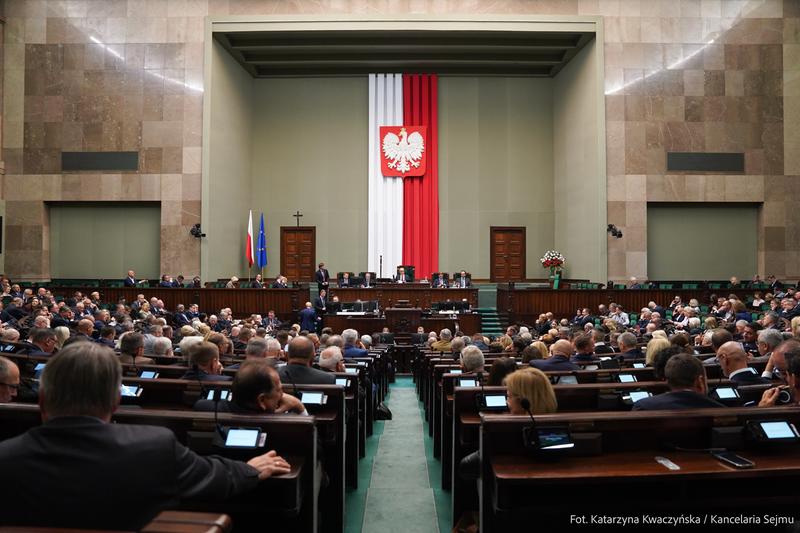
On Thursday, the Sejm, Poland’s lower house of parliament, rejected the proposal by a narrow margin.
| Sejm vote, 22 October 2026 | Votes |
|---|---|
| For abolition of term limits | 213 |
| Against abolition | 215 |
| Abstentions | 9 |
The proposal was rejected, and the existing two-term limit remains in place. The figures were confirmed by the Polish Press Agency’s local government service, which also detailed how individual parliamentary groups voted.
Pełczyńska-Nałęcz welcomed the legislative outcome but argued that it had been achieved despite the votes of much of the governing coalition.
Of the participating Civic Coalition MPs, 145 supported removing the limits and four opposed it. All 31 participating PSL deputies backed abolition. The governing Left was divided, with 12 MPs voting in favour and six against.
Even Poland 2050 was split. Six of its MPs supported the change, three opposed it and three abstained. The opposition Law and Justice party overwhelmingly opposed the proposal.
The result therefore depended on an unusual alignment across party lines rather than agreement among the governing parties.
For Pełczyńska-Nałęcz, the decisive issue was not that the legislation had passed — it had failed — but that coalition partners had attempted to overturn a rule she considered an important democratic safeguard.
The existing restrictions remain in place, meaning many municipal leaders who have served consecutive terms since the 2018 reform could be ineligible to stand again at the next regular local elections, expected in 2029.
Who is Katarzyna Pełczyńska-Nałęcz?
Pełczyńska-Nałęcz has served as Poland’s Minister of Funds and Regional Policy since Tusk’s coalition government took office on 13 December 2023.
Her ministry plays a central role in coordinating EU cohesion funding, regional development programmes and Poland’s National Recovery and Resilience Plan, known domestically as the KPO. The portfolio is significant because European funding supports infrastructure, transport, energy, digital investment and regional development projects throughout Poland.
Before entering government, Pełczyńska-Nałęcz worked as a sociologist, foreign-policy specialist and diplomat. She served as Poland’s deputy foreign minister from 2012 to 2014 and as ambassador to Russia from 2014 to 2016. She was also associated with the Centre for Eastern Studies, a Warsaw-based research institution specialising in Eastern Europe and international affairs.
Her official government biography confirms that she joined the government as a representative of Poland 2050.

Within the party, she became associated with proposals involving housing affordability, public-sector accountability, taxation and the use of EU funding. She repeatedly called for the party to establish a clearer political identity rather than simply supporting decisions made by its larger coalition partners.
Her departure now raises questions about who will lead the ministry and whether the post will remain under Poland 2050’s political control.
Who governs Poland? The coalition explained
For international readers, understanding the resignation requires examining the unusual structure of Poland’s government. Donald Tusk returned to power in December 2023 after parliamentary elections ended eight years of government led by the conservative Law and Justice party (PiS).
Tusk’s administration is often called the 15 October coalition, after the date of the 2023 parliamentary election. It brings together parties with different political traditions that share several broad objectives, including maintaining close ties with the European Union, strengthening national security and reforming state institutions.
The original partners signed a coalition agreement published by the Prime Minister’s Office, which set out their common commitments on security, judicial reform, public services and other policies.
Civic Coalition (KO) — Tusk’s principal governing force
Civic Coalition is the largest component of the government. Led by Donald Tusk, it brings together Civic Platform and smaller liberal and centre-left partners.
Its broad orientation is pro-European and economically liberal, with an emphasis on strengthening Poland’s position within the EU, restoring judicial standards and modernising public institutions. Some of its component parties also support socially progressive policies.
The coalition occupies the political centre, with supporters ranging from moderate conservatives to social liberals.
Polish People’s Party (PSL) — agrarian and centre-right
PSL is one of Poland’s longest-established political parties. Led by Deputy Prime Minister and Defence Minister Władysław Kosiniak-Kamysz, it traditionally represents rural communities, farmers and smaller towns.
It combines agrarian interests with Christian-democratic and centre-right positions. The party generally emphasises local government autonomy, agricultural policy, regional development and business interests.
Its support for abolishing mayoral term limits reflected its longstanding relationships with municipal and regional politicians.
The Left (Lewica) — social democratic
The Left includes the New Left, which has roots in Poland’s post-communist social-democratic movement, alongside other left-wing political figures.
Its priorities include workers’ rights, housing, public services, social welfare and greater legal protections for women and minorities. The Left has frequently pressed the coalition to pursue more progressive social policies, although implementation has required agreement with more conservative partners.
Poland 2050 — centrist reform movement
Poland 2050 entered government as a newer alternative to Poland’s established parties. It combines centrist politics with environmental protection, institutional reform, public-service improvements and proposals for greater government accountability.
Its political identity has evolved as different figures have competed to determine the party’s direction. The organisation is now undergoing another leadership transition following Pełczyńska-Nałęcz’s announcement.
Unia Centrum — a new liberal-centrist coalition partner
A further political group emerged in 2026 after a split within Poland 2050. Led by Climate Minister Paulina Hennig-Kloska, the breakaway parliamentary club is known as Centrum, while the political party established by its supporters in July is called Unia Centrum.
Its programme emphasises business development, economic liberalism, environmental protection, public-sector efficiency and European integration. The group has remained part of Tusk’s parliamentary support base despite its separation from Poland 2050.
The new party’s founding announcement explicitly committed it to remaining within the governing coalition.
These differences help explain why coalition members can cooperate on broad government policy while disagreeing sharply over individual laws. Thursday’s term-limit vote exposed one such division.
What is Poland 2050, and why was it created?
Poland 2050 began as a political movement established by Szymon Hołownia following his independent campaign in the 2020 presidential election. Hołownia was already nationally known as a journalist, television presenter and public commentator.
His campaign sought to appeal to voters dissatisfied with the longstanding competition between Civic Platform and Law and Justice. The name Poland 2050 reflected a long-term vision of the country’s future rather than a specific election year.
The movement sought to develop a political programme based on modernising state institutions, improving public services, environmental protection and encouraging greater civic participation.
Its own statement of principles presents a vision of Poland as democratic, environmentally sustainable, secure and socially inclusive.
After establishing itself as a political party, Poland 2050 formed an electoral alliance with PSL before the 2023 parliamentary election.
The alliance was called Third Way (Trzecia Droga), a reference to its ambition to offer voters an alternative to both PiS and Civic Coalition.
Third Way received approximately 14.4% of the vote and won 65 seats in the Sejm, allowing it to become an important component of the parliamentary majority supporting Tusk. Hołownia became speaker of the Sejm, while Poland 2050 secured ministerial positions.
The partnership with PSL subsequently ended as an electoral arrangement in June 2025, although both parties remained in government. Poland 2050’s own problems continued to intensify over its leadership and political direction.
Why did Szymon Hołownia stop leading the party?
Hołownia’s departure from the leadership was originally presented as an orderly succession rather than a forced removal.
In September 2025, he announced that he would not seek another term as party chairman. He argued that the organisation needed to choose someone who could prepare it for the next parliamentary election in 2027.
The decision was recorded in an official Poland 2050 announcement.
It followed a difficult period for the party, including Hołownia’s disappointing performance in the 2025 presidential election, when he received approximately 5% of the first-round vote.
He also ceased serving as speaker of parliament in November 2025. That departure was separate from his decision not to seek re-election as party leader.
Under the 2023 governing coalition agreement, Hołownia was expected to hold the speakership during the first half of the parliamentary term before handing it to a representative of the Left.
He formally submitted his resignation as speaker on 13 November 2025, with the change taking effect on 18 November.
Włodzimierz Czarzasty, a leading politician from the New Left, succeeded him. Hołownia subsequently remained involved in parliamentary politics as a deputy speaker. He did not, however, immediately return to the top position in Poland 2050.
A bitter leadership contest splits Poland 2050
The contest to replace Hołownia developed into a struggle between two senior government ministers: Katarzyna Pełczyńska-Nałęcz and Paulina Hennig-Kloska, the minister responsible for climate and environment.
The process became troubled when a January 2026 electronic vote had to be repeated following technical problems. A new vote was conducted on 31 January.
According to the party’s official electoral commission resolution, Pełczyńska-Nałęcz defeated Hennig-Kloska by 350 votes to 309.
The result left a substantial minority of participating party members supporting her rival. Within weeks, the internal disagreement became a formal political split.
In February, Hennig-Kloska and other parliamentarians left Poland 2050 to establish the Centrum parliamentary club.
The division produced two groups of approximately 15 MPs each, both continuing to support the governing coalition. Hennig-Kloska subsequently helped establish Unia Centrum as a separate party in July 2026.
The split weakened Poland 2050’s parliamentary representation and created competition between two centrist groups appealing to overlapping voters. It also revealed differences over leadership style, economic priorities and the party’s relationship with Tusk’s larger Civic Coalition.
Although both groups remained in government, their politicians increasingly pursued separate political strategies.
Hołownia returns to a leadership role
In September 2026, Hołownia was elected chairman of Poland 2050’s parliamentary club.
The party announced the appointment on 17 September, saying he would replace Paweł Śliz following an internal agreement.
This was a leadership position within the parliamentary group, not the chairmanship of the political party. Pełczyńska-Nałęcz therefore remained party leader while Hołownia led its MPs.
The arrangement raised questions about whether the founder might eventually seek to regain the party chairmanship.
Following Thursday’s resignation, Pełczyńska-Nałęcz suggested that she was leaving the organisation’s future in Hołownia’s hands. But that statement did not itself make him the new party leader.
Hołownia’s subsequent response made clear that members would need to elect a successor in accordance with the party’s rules. The formal leadership outcome therefore remains unresolved.
Hołownia says Poland 2050 will stay in government
Hołownia responded to Pełczyńska-Nałęcz’s announcement late on Thursday. He said that members of Poland 2050 had learned of her decision through media reports rather than being informed beforehand.
He described the resignation as unexpected and acknowledged that losing a recently elected chairwoman created a serious organisational challenge.
Nevertheless, he emphasised that the parliamentary group would remain part of Tusk’s governing coalition.
His comments were reported by RMF24, which reproduced his public response. Hołownia also confirmed that a new leader would be chosen by party members.
The distinction is significant. Pełczyńska-Nałęcz’s departure from government does not automatically require Poland 2050’s MPs to withdraw their support for Tusk. Nor does an internal leadership contest necessarily remove the party from the coalition.
For now, Hołownia has explicitly rejected that outcome.
Were there other reasons for the resignation?
Although Pełczyńska-Nałęcz publicly linked her departure to Thursday’s vote and differences over political principles, some Polish media have reported additional tensions.
According to Onet’s reporting, citing sources familiar with the political situation, the minister had been considering leaving government before the vote.
The outlet reported that two other issues had influenced her position: Hołownia’s efforts to return to the leadership of Poland 2050 and Tusk’s decision to promote Finance and Economy Minister Andrzej Domański rather than Pełczyńska-Nałęcz to a deputy prime ministerial role.
She had previously sought the deputy premiership, arguing that Poland 2050 should have greater influence within the government. Those additional motivations have not been independently established and should be distinguished from her public explanation.
The confirmed reason she gave was the disagreement over coalition values and the local-election vote.
What happens next for Tusk’s government?
Several decisions remain outstanding. The first concerns the Ministry of Funds and Regional Policy.
Under Article 161 of Poland’s Constitution, changes to the composition of the government are formally made by the president at the prime minister’s request.
The presidential office’s explanation of the appointment procedure makes clear that a public resignation announcement is distinct from the formal constitutional process of removing and replacing a minister.
As of the latest verified information on 23 October, no presidential dismissal decision or confirmed replacement for Pełczyńska-Nałęcz had been identified.
The ministry continues to have serving senior officials, including deputy ministers Jacek Karnowski and Jan Szyszko. However, neither has been independently confirmed as the government’s selected successor.
The second issue is the future of Poland 2050. Hołownia has said that members will select a new leader, but the timing, candidates and internal arrangements remain to be clarified.
The party also faces the challenge of competing for voters with Unia Centrum, the group established by former colleagues earlier this year.
The third issue concerns the governing coalition itself. Tusk’s administration depends on cooperation among groups that differ over taxation, housing, environmental policy, social reform and local government.
Those disagreements have not prevented the government from remaining in office, but Thursday’s vote demonstrates how coalition partners can find themselves on opposite sides of a significant legislative issue.
For the time being, Hołownia’s commitment to remaining in the coalition means that the resignation does not constitute an announced withdrawal of parliamentary support. There has been no verified loss of the government’s majority as a direct consequence of Pełczyńska-Nałęcz’s decision.
The larger question is whether Poland 2050 can establish stable leadership and a distinct political direction ahead of the parliamentary election scheduled for 2027.
After a contested leadership election, a party split and now the announced departure of another leader, the organisation faces a further test of its ability to remain united.
For Tusk, the immediate task is to manage the ministerial transition while maintaining cooperation among the parties supporting his government.