Rainwater washing off roads and car parks often carries a mixture of oil, chemicals, heavy metals and road salt. Much of it eventually disappears into drains, ditches and retention ponds.
Now, Polish engineers have developed a portable device designed to treat that contaminated water and potentially make it useful again — an invention that has earned them a gold medal at an international exhibition in Warsaw.
The device, developed by researchers at Lublin University of Technology, received gold at the 20th International Warsaw Invention Show (IWIS 2026), held from 7 to 9 November at the Copernicus Science Centre.
- Find more news from Poland on our Homepage .
The university presented the technology publicly on 16 November, explaining how the mobile system could eventually allow water collected from roads, car parks and vehicle-washing facilities to be reused for purposes such as watering greenery or flushing toilets.
Although further testing and assessment are needed before wider deployment, the invention offers a practical approach to a familiar environmental problem.
Turning polluted runoff into a useful resource
The project was developed by three researchers at Lublin University of Technology: professors Beata Kowalska and Dariusz Kowalski from the Department of Water Supply and Wastewater Disposal, and Jarosław Bartnicki from the Department of Metal Forming.
The team worked with engineering colleagues and an external company that supported the device’s construction. Development received funding through the Inkubator Rozwoju 2025 programme.
Their central challenge was to find a way of treating contaminated rainwater without requiring a large, permanent treatment installation at every location.
Water running off busy roads is significantly different from rainwater collected directly from a roof.
As vehicles move, substances from tyres, brakes, road surfaces and engines accumulate on the pavement. Rain then carries those pollutants into drainage systems and surrounding land.
Winter road maintenance adds another complication: salt.
The researchers’ portable device uses a process known as cavitation to help break down complex contaminants.
Cavitation occurs when rapid pressure changes within a liquid create tiny vapour bubbles that subsequently collapse, generating intense localised physical effects.
The Polish team uses this process to break some long-chain chemical compounds into smaller substances that can be more readily broken down through biological processes.
According to the university’s explanation of the technology, the system can be connected to a pump, which circulates collected rainwater through the treatment unit and returns it to a storage tank.
The researchers envisage using appropriately treated water for non-drinking purposes, potentially reducing reliance on higher-quality mains water where drinking-water standards are unnecessary.
A mobile solution for roads and car parks
One of the device’s principal advantages is that it can be moved between locations.
Along motorways and expressways, retention ponds often collect rainwater from roads, parking areas and service stations. These reservoirs fill intermittently, depending on rainfall.
Rather than constructing a separate permanent treatment facility at every site, operators could potentially transport a single mobile unit between several locations.
This could be particularly useful for motorway service areas, car parks and other facilities where large volumes of runoff are collected.


The researchers have also identified possible applications at car washes and industrial premises that need to treat wastewater before reuse or further processing.
Professor Dariusz Kowalski said the university had already received preliminary enquiries about possible applications, including from businesses in the Lublin area.
Interest has also been expressed in whether the technology could help treat water in ponds at Lublin’s Botanical Garden.
These discussions remain preliminary and do not establish that the device has entered routine commercial use.
A gold medal for Polish engineering
The invention attracted recognition at IWIS 2026, the 20th edition of the International Warsaw Invention Show.
The event provided a platform for inventors and research institutions to present technological developments and have their work assessed.
The university’s Faculty of Environmental Engineering and Energy confirmed on 10 November that the team’s mobile rainwater-treatment device received a gold medal.
The award recognises the completed invention presented at the exhibition, although it is not evidence of commercial readiness or independently certified treatment performance.
The recognition comes as researchers in Lublin pursue a wider programme of work examining how polluted rainwater from transport infrastructure might be recovered.
A second technology tackles salt and heavy metals
Alongside the award-winning cavitation device, researchers from the universities of technology in Lublin, Rzeszów and Białystok are investigating a separate water-treatment method based on electrodialysis.
This technique uses an electric field and specialised membranes to separate dissolved ions from water.
Although electrodialysis is already widely used for removing salts, the Polish researchers are examining whether it can also remove heavy metals from runoff collected near roads.
Laboratory results reported by Lublin University of Technology found that salt could be removed almost completely, while heavy-metal removal exceeded 90% in most of the experiments described.
Professor Małgorzata Iwanek explained that higher voltage and temperature improved treatment effectiveness but also increased energy consumption.
The researchers identified operating conditions of 20 volts and 20°C as offering a favourable balance in their experiments.
Those figures relate to the *separate electrodialysis research*, not the gold-medal-winning cavitation device.
The electrodialysis work remains at the laboratory stage, with further real-world testing required.
From award-winning prototype to practical use
The engineers’ achievement is tangible: they have constructed a portable treatment device, demonstrated its operating principle and secured recognition at an international invention exhibition.
The next challenge is establishing how reliably and economically it can perform outside controlled research conditions.
That includes assessing its effectiveness against different pollutants, energy requirements, operating costs and whether treated water meets the standards needed for its intended use.
The researchers have not announced a commercial rollout or established that the device produces drinking water.
Nevertheless, the potential application is easy to understand.
Water that currently accumulates beside roads could, after suitable treatment and testing, become a useful resource for nearby facilities instead of being treated solely as waste.
For the Lublin engineers, the Warsaw gold medal marks an encouraging step towards turning that possibility into a practical technology.
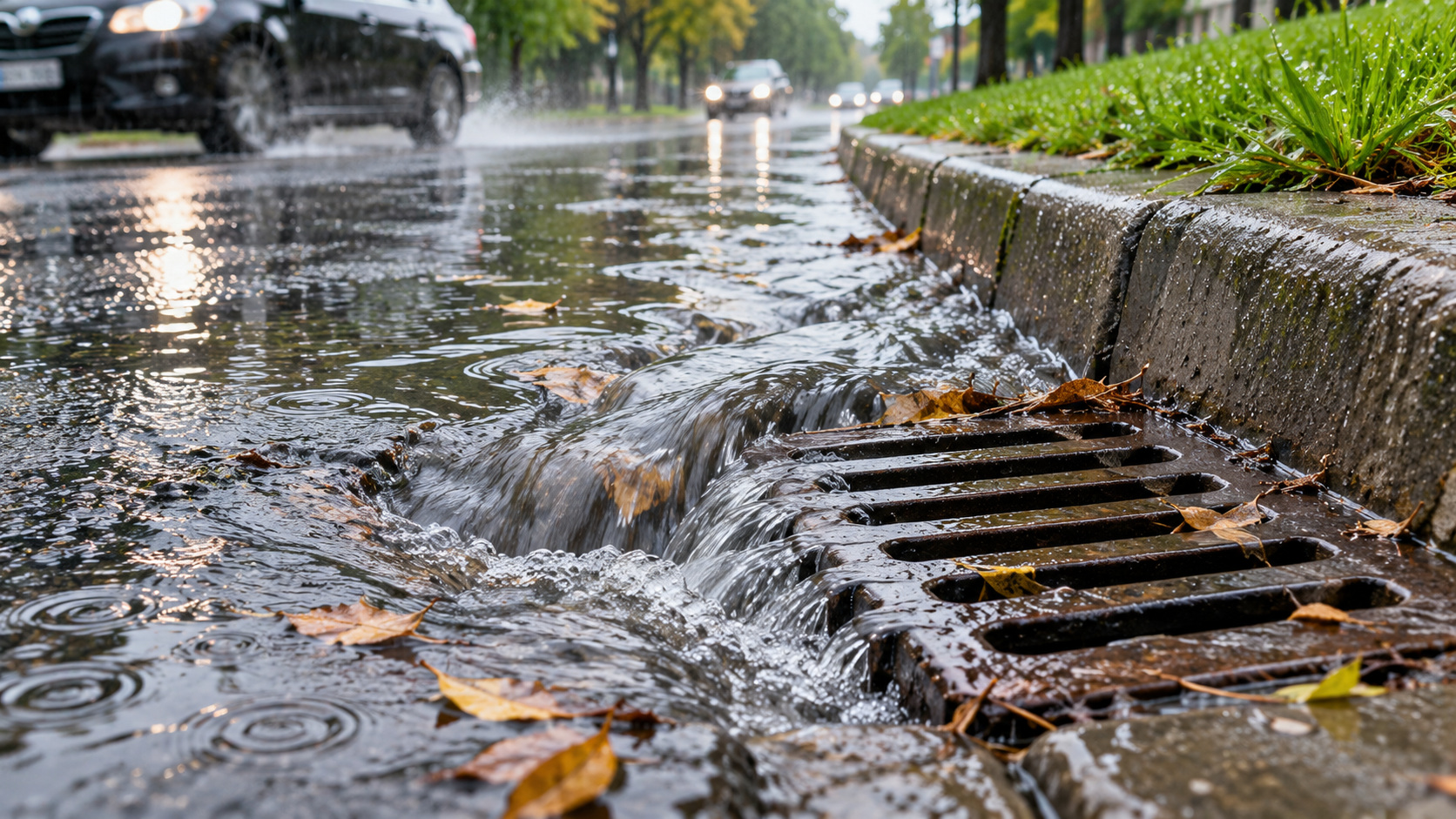
Featured image: AI-generated editorial illustration of rainwater entering a roadside drain. It does not depict the invention or an actual treatment installation in Poland.