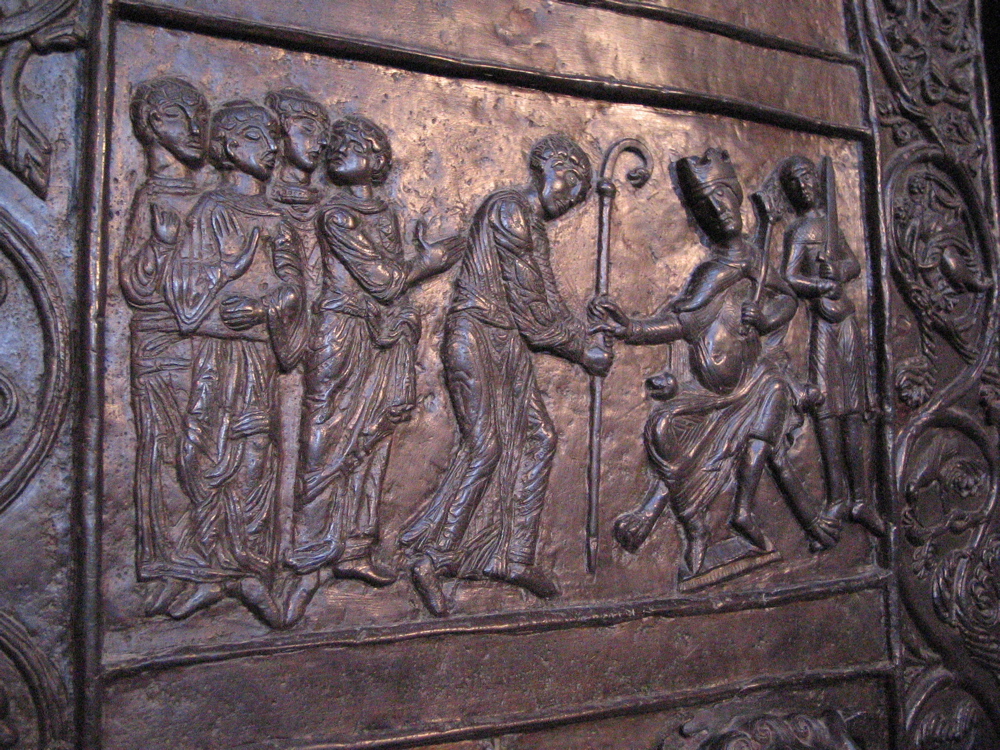
Nearly 850 years ago, medieval craftsmen created an extraordinary work of art for a cathedral in Poland: two enormous bronze doors that tell an entire life story through 18 sculpted scenes.
The Gniezno Doors, known in Polish as Drzwi Gnieźnieńskie, remain one of the most important surviving examples of Romanesque metalwork in Europe.
Created in the second half of the twelfth century, probably around 1175, the doors depict the life, religious mission and death of St Adalbert, known in Poland as Święty Wojciech.
- Find more news from Poland on our Homepage .
Each bronze leaf contains nine carefully arranged scenes, surrounded by elaborate decorations featuring people, animals, mythical creatures and intertwining plants.
Together, the panels transform an ordinary architectural object into a remarkable piece of medieval visual storytelling.
And the way the story unfolds is almost as fascinating as the craftsmanship itself.
A medieval story that begins at the bottom
Unlike a modern illustrated book, the Gniezno Doors are not read from the top left towards the bottom right.
Instead, their narrative follows an unusual route.
The story begins at the bottom of the left-hand door, moves upwards through nine scenes, then continues from the top of the right-hand door down to the final panel.
The first scenes depict Adalbert’s birth, childhood and education.
Born into a noble family in tenth-century Bohemia, in what is now the Czech Republic, Adalbert was educated in Magdeburg before eventually becoming Bishop of Prague.
The bronze panels show episodes associated with his early life, including his parents dedicating him to religious service after an illness, his education and his appointment as bishop.
Other reliefs depict events described in medieval accounts of his life, including religious visions and miraculous incidents.
These are representations of medieval religious traditions, rather than independent proof that every event occurred as shown.
The final scene on the left-hand leaf portrays an episode associated with Adalbert’s time in a monastery in Rome.
From there, the story continues across the second door.
Its nine panels depict his missionary journey among the pagan Prussians, his preaching and his death in 997.
The concluding scenes show his body being recovered, transported to Gniezno and buried.
For a medieval audience, the arrangement provided a complete visual account of a saint’s life.
Today, it also offers an unusually detailed glimpse into how religious stories were communicated through sculpture during the Middle Ages.


How the enormous bronze doors were made
The doors are impressive even before their individual scenes are examined.
Both are more than three metres tall.
The left leaf measures approximately 328 centimetres in height and 84 centimetres in width, while the right is slightly smaller at 323 by 83 centimetres.
According to the Archdiocese of Gniezno, each weighs approximately 600 kilograms.
Their construction reveals remarkable technical differences.
The entire left-hand leaf was cast as a single piece, using a technique associated with lost-wax casting.
This involved creating a model, forming a mould around it and pouring molten metal into the space left by the removed modelling material.
Producing such a large, detailed bronze casting required considerable technical expertise.
The right-hand leaf, however, was assembled from 24 separately cast sections joined together.
These included its nine narrative panels, decorative border sections and surrounding structural elements.
The difference is still visible in the depth and quality of the reliefs.
The left-hand sculptures generally project further from the bronze surface, while those on the right are flatter.
Researchers have also identified differences in the composition of the metal alloys used.
The doors are surrounded by richly decorated borders containing leaves, animals, human figures and fantastic creatures.
Among the most recognisable details are two large lion-head knockers.
These decorations are not merely incidental. They form part of a sophisticated Romanesque artistic composition that continues to attract scholarly attention.
The mystery of the medieval craftsmen
Despite extensive research, historians cannot identify the doors’ creators with certainty.
Their precise place of manufacture and original patronage also remain subjects of scholarly discussion.
The City of Gniezno’s historical account explains that earlier researchers dated the doors to the first half of the twelfth century.
Subsequent research shifted the generally accepted dating to the second half of that century.
Some scholars have proposed that Duke Mieszko III the Old, who ruled parts of Poland during this period, commissioned the work.
Others have suggested that the initiative came from one of Gniezno’s archbishops, including Zdzisław or his successor Bogumił.
There is no universally accepted answer.
The identity of the craftsmen is similarly uncertain.
Art historians have identified influences from Central and Western European artistic traditions, including manuscript illumination and metalworking associated with regions beyond medieval Poland.
This reflects the interconnected nature of European religious art during the Romanesque period.
Although the doors were created for an important Polish cathedral, the expertise and artistic ideas behind them may have drawn on traditions extending across several regions of medieval Europe.
Why Gniezno and St Adalbert mattered
The choice of subject was closely connected to Gniezno’s significance in early Polish history.
Gniezno was one of the principal political and religious centres of the early Piast state.
St Adalbert, originally from Bohemia, became closely associated with Poland after receiving support from the Piast ruler Bolesław I, later known as Bolesław the Brave.
In 997, Adalbert was killed during a missionary journey among the Old Prussians, a Baltic people living east of the emerging Polish state.
Bolesław subsequently arranged for his remains to be brought to Gniezno.
The saint’s burial became an important focus of Christian pilgrimage.
In the year 1000, Holy Roman Emperor Otto III travelled to Gniezno, an event remembered as the Congress of Gniezno.
The meeting was closely associated with the establishment of an independent Polish ecclesiastical province centred on Gniezno, strengthening the religious position of the early Piast monarchy.
The bronze doors were created roughly 175 years after Adalbert’s death.
They therefore reflect not only his medieval religious cult but also the enduring importance of his story to Gniezno and the Polish Church.
By presenting the events of his life in monumental bronze, the creators gave the cathedral a powerful visual expression of that heritage.
A story preserved for more than eight centuries
Today, the doors remain at the southern entrance of Gniezno Cathedral, incorporated into a Gothic portal constructed after the original Romanesque period.
The National Heritage Institute identifies them as among the cathedral’s most significant artistic treasures and an outstanding example of European Romanesque metalworking.
Their significance extends beyond religious history.
They reveal how medieval artists used gesture, composition, symbolic imagery and carefully ordered scenes to communicate complex narratives.
Although the doors were intended for a Christian religious setting, their artistic achievement can be appreciated independently of faith.
They represent extraordinary ambition in design, metal casting and visual communication.
The identity of the people who created them remains unknown, but their work has survived through centuries of political change, architectural rebuilding and cultural transformation.
More than eight centuries after their creation, the Gniezno Doors still tell the story their makers intended — one sculpted scene at a time.