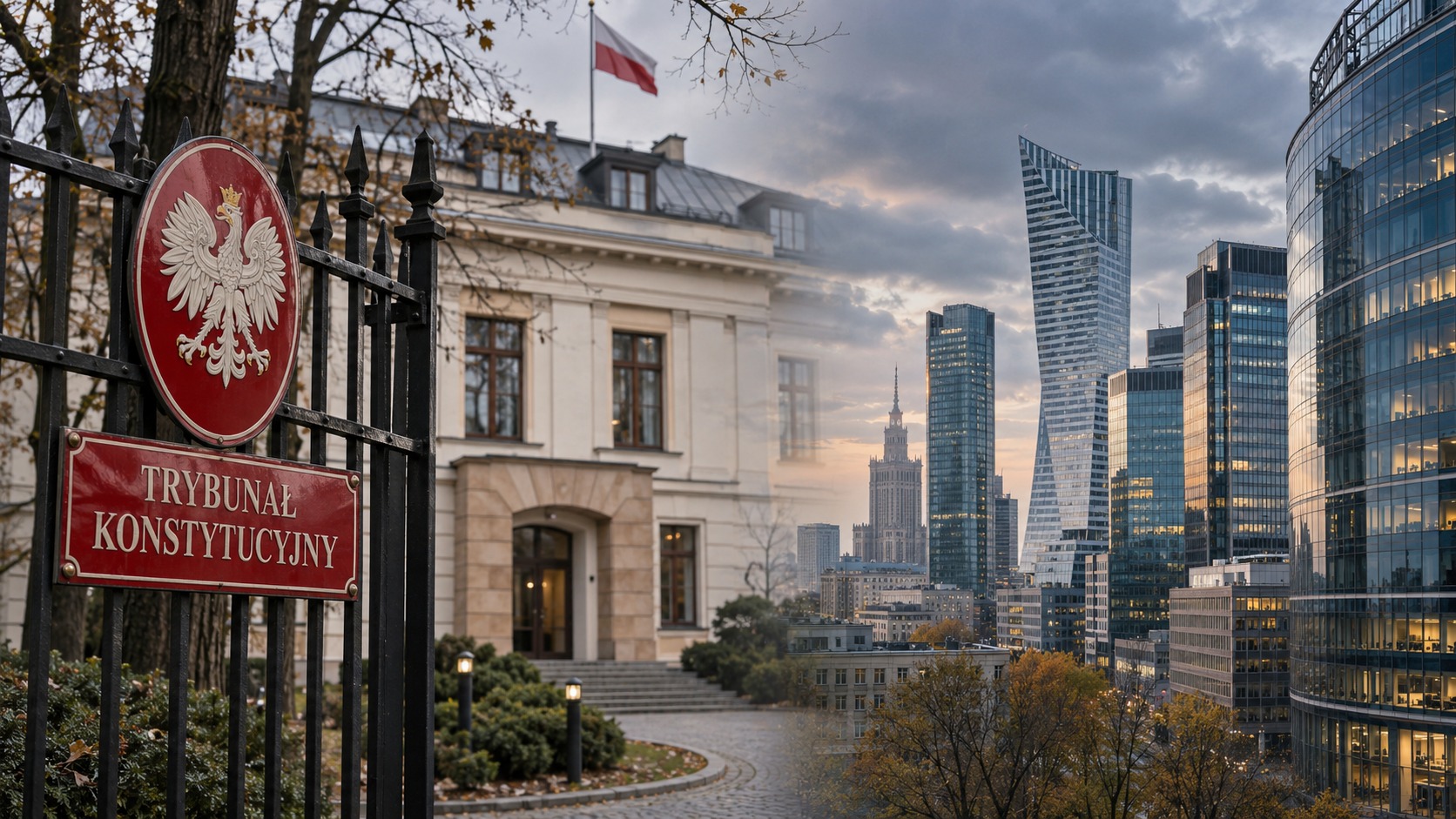
Nine of Poland’s largest business and employers’ organisations have urged the country’s political leaders to end the escalating Constitutional Tribunal crisis, warning that prolonged legal uncertainty could undermine investor confidence and raise the cost of financing businesses. In a joint appeal published on Monday, 2 November, the organisations called for urgent talks involving President Karol Nawrocki, Prime Minister Donald Tusk, parliament and representatives of all political parties.
The appeal marks a significant intervention by the Polish business community in a constitutional dispute that has intensified dramatically in recent days.
The statement was issued by the Rada Przedsiębiorczości, or Entrepreneurship Council, a forum bringing together nine major organisations representing employers and businesses across Poland.
- Find more news from Poland on our Homepage .
According to the council, its member organisations collectively represent nearly 330,000 employers whose companies employ more than eight million people.
The signatories include the Polish Chamber of Commerce, Confederation Lewiatan, Business Centre Club, Employers of Poland, the Polish Bank Association and organisations representing small businesses, larger companies and business services.
In its joint statement published by Employers of Poland, the council said Poland needed an independent Constitutional Tribunal capable of fulfilling its responsibilities and protecting constitutional rights.
It stressed that its intervention was not intended to resolve the competing legal claims or assign responsibility for the crisis.
Instead, the organisations argued that the dispute’s continuation was becoming a concern for the wider economy.
Business leaders warn of damage to investor confidence
The council’s central concern is the potential impact of institutional instability on investment decisions, access to financing and Poland’s international reputation.
Businesses rely on predictable legislation, functioning courts and confidence that disputes over the constitutionality of laws can be resolved through recognised procedures.
The Constitutional Tribunal is responsible for reviewing whether legislation and other legal provisions comply with Poland’s Constitution.
Uncertainty surrounding its composition, leadership and ability to deliver authoritative judgments can therefore have consequences extending beyond the country’s political institutions.
According to the council, a prolonged crisis could make investors more cautious about committing capital to Polish projects.
It could also increase financing costs if lenders or other investors began to regard the country’s legal environment as less predictable.
These are potential risks identified by the business organisations, rather than documented economic losses directly attributed to the latest Tribunal confrontation.
The council did not provide figures showing that borrowing costs had already risen or investment projects had been cancelled because of the events of recent days.
Nevertheless, its message was clear: Poland’s economic progress depends partly on the stability of the institutions underpinning business confidence.
In their statement, the organisations drew attention to Poland’s economic transformation over recent decades, including rising living standards, expanding international investment and the country’s emergence as one of Europe’s major economies.
They argued that this progress had been achieved by businesses, employees and successive governments across the political spectrum.
But they cautioned that international confidence should not be treated as permanent.

“Trust built over decades can be lost within weeks,” the organisations warned, in a translation of their Polish statement.
Employers demand urgent political talks
The council presented three principal requests to Poland’s political leadership.
First, it called for a reduction in political rhetoric and an end to the escalation of tensions surrounding the Tribunal.
Second, it urged immediate negotiations involving the president, government, parliament and representatives of all political groups.
Those talks, it argued, should lead to practical arrangements restoring the Tribunal’s constitutional functioning, judicial independence and ability to protect fundamental rights.
Third, the council insisted that any measures taken during the dispute must remain within the law and respect the constitutional responsibilities of Poland’s institutions.
Importantly, the organisations made clear that lowering political tensions must not become a substitute for resolving the underlying problems.
They said their appeal did not amount to an endorsement of the Tribunal’s existing arrangements or a suggestion that reforms should be abandoned.
The council also offered to participate in or support initiatives aimed at achieving a negotiated resolution, including talks conducted through Poland’s established social dialogue mechanisms.
Constitutional Tribunal dispute reaches new stage
The appeal follows an extraordinary confrontation over the leadership and operation of Poland’s Constitutional Tribunal.
On 30 October, judge Anna Korwin-Piotrowska, who had been selected by the current parliament, announced that she was assuming responsibility for the institution’s work as its longest-serving judge.
She issued orders declaring a break in the official duties of Tribunal President Bogdan Święczkowski and Vice-President Bartłomiej Sochański.
However, the legal basis and effectiveness of those orders are disputed.
Święczkowski and Sochański reject the attempt to remove them from their functions, while President Nawrocki has challenged the legitimacy of the actions taken against the Tribunal’s existing leadership.
The confrontation is connected to the longer-running disagreement over judicial appointments, including the status of judges elected by the current Sejm whose oaths have not been accepted by the president.
Prime Minister Tusk maintains that judges properly elected by parliament should be allowed to take up their responsibilities.
Nawrocki and Święczkowski dispute the validity of the arrangements under which several of those judges have sought to begin exercising their functions.
The resulting disagreement has produced competing claims over who is entitled to exercise authority within the Tribunal.
The legal questions are not confined to the immediate participants.
On 31 October, the Helsinki Foundation for Human Rights, an independent Polish rights organisation, questioned the legal basis of the leadership suspension orders.
The foundation warned that the procedure could create a dangerous precedent, while also maintaining its position that judges lawfully elected by parliament should be permitted to perform their duties.
Poland-24 has previously examined the foundation’s assessment and the wider constitutional issues.
The latest appeal from business leaders adds another dimension to that debate: the consequences that sustained institutional uncertainty could have for the economy.
Critical Tribunal meeting scheduled for Tuesday
The council’s intervention came ahead of a meeting of the Tribunal’s General Assembly scheduled for Tuesday, 3 November, at 15:30 Polish time.
Korwin-Piotrowska called the meeting to address matters including the institution’s proposed budget for 2027.
However, the meeting itself is affected by disagreements over the Tribunal’s membership and the number of judges required for a valid quorum.
Święczkowski has rejected the authority of those seeking to convene the assembly, while Korwin-Piotrowska maintains that the institution must be able to continue functioning.
As of Tuesday morning, the meeting’s outcome remained uncertain.
For businesses and investors, the immediate question is not which political side gains control of the institution, but whether the conflict can be resolved in a way that provides durable legal certainty.
The Entrepreneurship Council has not endorsed a specific constitutional reform package or backed either side’s proposed route out of the crisis.
Instead, it has called for political leaders to establish a lawful, workable settlement that restores public confidence.
The appeal represents an unusually broad intervention by Polish employers, banks and business organisations in a dispute that has largely been dominated by politicians, judges and constitutional lawyers.
Its message is that the consequences of the crisis may eventually extend well beyond the walls of the Constitutional Tribunal.