A rare bronze helmet discovered in northern Poland is helping archaeologists uncover evidence of extensive trading connections between the Baltic region and Celtic societies more than 2,300 years ago. A newly published study suggests that an ancient fortified settlement in northern Mazovia may have been an important centre for amber trading, metalworking and ritual activity — and raises the possibility that people from Celtic communities travelled to the site centuries before such direct connections were previously thought likely.
The findings come from Łysa Góra, an archaeological site near the village of Bagienice in the Chorzele municipality, where researchers from the State Archaeological Museum in Warsaw and the University of Warsaw resumed excavations in 2024.
Their discoveries include an exceptionally rare bronze helmet associated with the La Tène culture, which flourished across parts of Central and Western Europe during the Iron Age.
- Find more news from Poland on our Homepage .
The helmet was discovered in 2024, but its wider significance is now being examined in a study published in the archaeological journal Antiquity on 14 October 2026.
The research, led by archaeologist Bartłomiej Kaczyński, presents Łysa Góra as far more than an isolated settlement on the margins of ancient Europe.
Instead, the authors argue, it may have formed part of an extensive network connecting communities in present-day Poland with regions south of the Carpathian Mountains.
A Celtic helmet far from its expected home
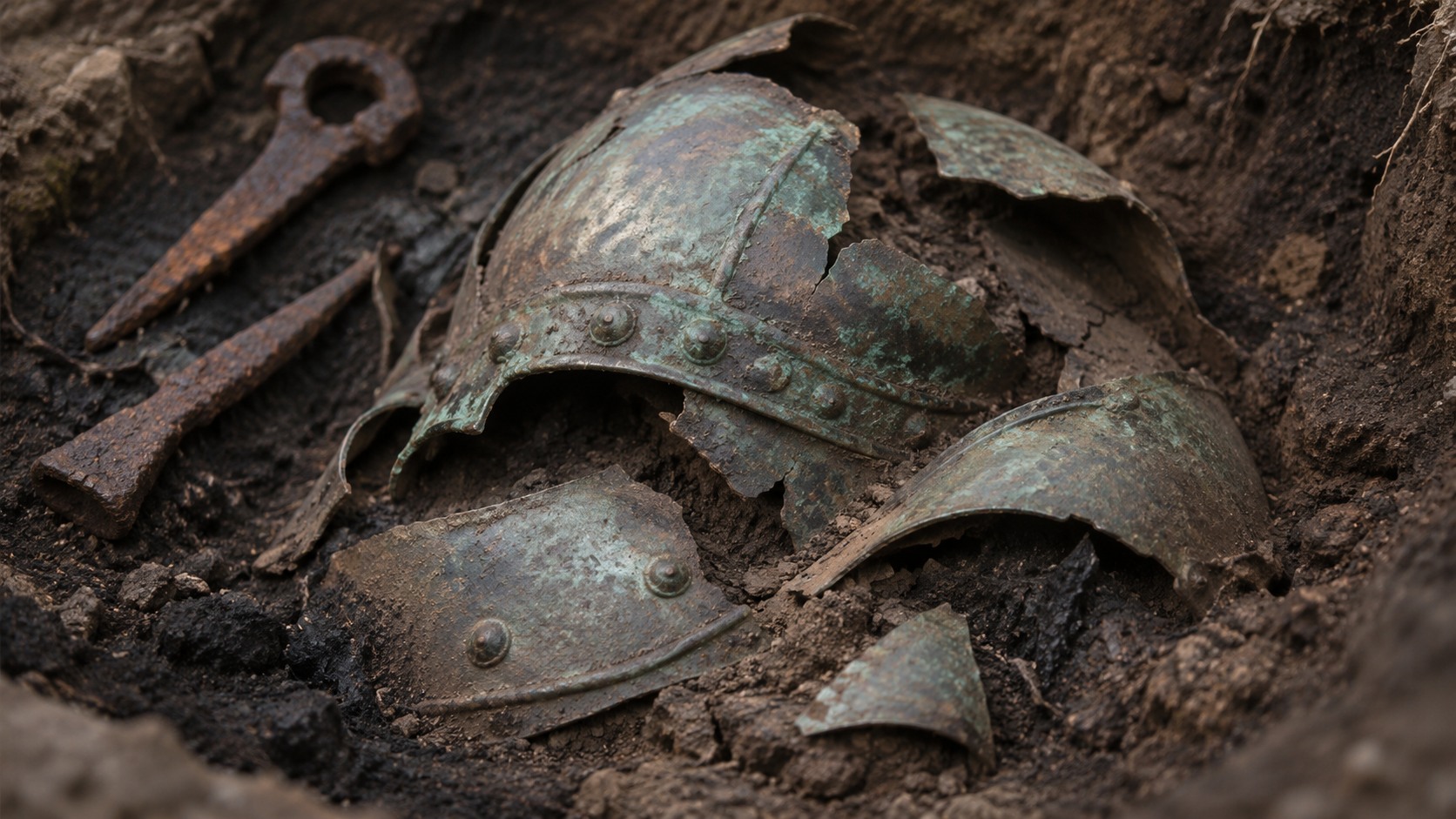
The most extraordinary discovery is a bronze helmet belonging to the Berru type, a distinctive form associated with the early La Tène cultural world.
Dating to approximately the fourth century BC, such helmets are linked with high-ranking members of Celtic warrior societies.
Similar examples have been discovered in places such as Dürrnberg in Austria, hundreds of kilometres south of the Polish site.
The Łysa Góra helmet, however, was found in an area whose inhabitants maintained cultural traditions very different from those associated with Celtic societies.
When the object was first uncovered, the archaeologists initially thought they might be looking at an unusual bronze vessel.
As more of its shape emerged, they recognised the distinctive features of an ancient helmet.
The object was heavily crushed and fragmented.
It lay inside a pit containing charred material, together with four iron adzes — woodworking tools — and an iron scythe.
The unusual combination has led researchers to consider whether the objects were deliberately deposited as part of a ritual.
The helmet was not necessarily an ordinary piece of battlefield equipment.
In an earlier University of Warsaw explanation of the discovery, archaeologist Andrzej Maciałowicz described such helmets as important markers of social prestige.
Their significance in the Celtic world makes the discovery especially puzzling in a region where archaeological evidence does not indicate the same forms of elite social hierarchy.
Nearly 350 metal artefacts reveal a thriving settlement
The helmet is only one part of a much larger archaeological picture.
Excavations at Łysa Góra have uncovered nearly 350 metal artefacts, alongside pottery, animal bones, cereal grains, cultivated plant seeds and charred wood.


Researchers have also identified evidence of extensive metalworking.
Among the finds are bundles of broken bronze ornaments that may have been prepared for remelting, together with earlier discoveries of ceramic crucibles used in casting metal.
The settlement also yielded 31 mostly fragmented brooches and ring ornaments associated with the early La Tène culture.
These objects provide further evidence of connections with communities much farther south.
Łysa Góra itself occupies a naturally defensive position.
The site stands on a glacial sand dune between the Orzyc River and an oxbow lake, surrounded by marshland.
Archaeological investigations have revealed traces of timber-and-earth fortifications, including an embankment, palisade and defensive ditch.
A second timber-built defensive structure has also been identified.
Researchers have not yet determined whether both defensive systems were in use simultaneously.
Taken together, the findings indicate that Łysa Góra was a substantial settlement with activities extending beyond agriculture and everyday domestic life.
The researchers interpret it as a fortified centre associated with production, exchange and ritual practices.
Could Łysa Góra have been part of the ancient Amber Route?
One of the study’s most significant conclusions concerns the settlement’s possible role in the European amber trade.
Amber, fossilised tree resin prized for its colour and decorative qualities, was an important commodity in ancient exchange networks.
The Baltic region was a major source of the material, which travelled south through a series of trade connections linking northern Europe with the continent’s interior.
The term Amber Route is commonly used to describe these networks, although it should not be understood as one permanently fixed road.
Łysa Góra’s location may have made it particularly important.
The settlement lies close to the amber-rich Kurpie region, while routes extending northwards connected the area with the Sambian Peninsula on the Baltic coast.
Researchers have uncovered amber beads and an unfinished amber ring at the site.
These finds, alongside the imported metal objects, suggest that the settlement participated in long-distance exchange.
Its defensive structures and evidence of craft production indicate that it may have served several functions at once: protecting a strategically placed settlement, producing valuable objects and facilitating the movement of goods.
In their Antiquity paper, the archaeologists argue that Łysa Góra was likely an important centre within this northern section of the amber-trading network.
The suggestion is particularly interesting because it places sophisticated connections between northern and southern European communities much earlier than some previous interpretations had assumed.
Were Celtic people actually living there?
The helmet also raises a more difficult question: did it arrive through trade, or was it brought to Łysa Góra by people from the Celtic cultural world?
The researchers consider direct contact a strong possibility.
The helmet was a prestigious object associated with a social elite rather than an everyday commodity.
Its presence, together with other La Tène artefacts, could indicate that visitors from southern communities participated in organising or maintaining the local trading network.
However, archaeological objects do not automatically identify the ethnicity or origins of the people who used them.
A helmet can change hands through trade, gift-giving or other forms of exchange without its original owner travelling with it.
The researchers acknowledge this possibility.
They nevertheless argue that the rarity and status of the helmet make simple indirect exchange a less convincing explanation than it would be for more ordinary ornaments.
The settlement’s inhabitants are archaeologically associated with the West Balt Barrow Culture, a name used for a distinctive set of material traditions found in north-eastern Poland.
That classification should not be taken as definitive proof of the inhabitants’ ethnicity or spoken language.
The evidence therefore supports a picture of contact and cultural interaction, but it does not yet establish that a permanent Celtic settlement or military community existed at Łysa Góra.
Evidence of ritual activity adds another mystery
The site has produced evidence that its inhabitants did more than manufacture goods and participate in trade.
Archaeologists discovered two deposits in marshland below the settlement’s south-western slope.
These contained bronze ornaments, earrings decorated with glass beads and a spiral armlet with elaborate incised decoration.
One ornament showed traces of an earlier repair, indicating that it had been used before being deposited.
The researchers interpret these finds as evidence of ritual activity.
The helmet’s discovery in a separate pit containing charred remains and iron tools may represent another form of deliberate deposition.
Exactly what these practices meant to the people involved remains unknown.
Without written records explaining the actions, archaeologists must rely on the location, arrangement and condition of the objects to develop possible interpretations.
Further research could reveal where the helmet was made
Although the study provides a substantial new interpretation of Łysa Góra, several questions remain unresolved.
Researchers plan further metallurgical investigations, including lead-isotope analysis, to help identify possible sources of the metals used in the recovered objects.
Comparisons with artefacts from regions such as Bohemia could help establish whether the finds share manufacturing traditions or raw-material origins.
Additional non-invasive surveys, including magnetic and electrical-resistivity methods, are also planned to clarify the settlement’s defensive layout.
These investigations may help researchers understand how the site developed and whether its different structures and activity areas were in use at the same time.
Łysa Góra has been known to archaeologists since 1957 and was excavated intermittently between 1971 and 1992.
However, much of the earlier material was never comprehensively analysed or published, limiting wider understanding of the settlement.
The renewed research is now bringing that neglected evidence together with discoveries made since 2024.
For archaeologists, the significance of the Celtic helmet extends well beyond the rarity of the object itself.
It offers a tangible indication that communities living in what is now northern Poland were connected to wider European cultural and commercial networks during the Iron Age.
And while the precise nature of those relationships remains uncertain, the findings suggest that this part of ancient Poland was considerably more interconnected than its geographical location might imply.