

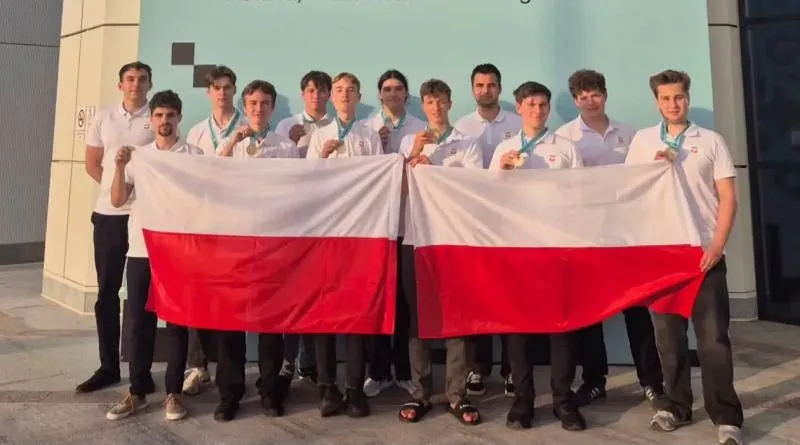
Poland finished third in the medal standings at the International Olympiad in Artificial Intelligence, with all eight members of its student team returning home with medals, organizers and Polish education officials confirmed.
The Polish delegation won four gold medals and four silver medals at the competition, trailing only Russia and China in the overall standings. The result marked a rare instance of a national team achieving a 100% medal rate, with every student sent to Kazakhstan earning recognition.
Competition Details
The third edition of the International Olympiad in Artificial Intelligence, known as IOAI, ran from August 2 to August 8, 2026, in Astana, the Kazakh capital. More than 500 students from over 100 countries participated in the event, according to organizers. IOAI, launched in 2024, has quickly become a proving ground for some of the world’s most talented young minds in artificial intelligence despite being one of the newest international science olympiads.
- Find more news from Poland on our Homepage .
Polish Medal Winners
Four Polish students won gold medals: Michał Masny, Krzysztof Rojek, Mikołaj Źrałek and Tomasz Kuczko. Four others earned silver: Marcel Kosmala, Jakub Ptaszkiewicz, Michał Karp and Maksym Kaminskyi.
The eight competitors were selected months earlier at the national final of the Polish Olympiad in Artificial Intelligence, held April 17-20 at Adam Mickiewicz University in Poznań. That event drew 45 students, with the top finishers earning the right to represent Poland in Astana.
Piotr Pawluć, deputy rector for personnel and doctoral schools at Adam Mickiewicz University, praised the students’ performance at the time, saying their success in artificial intelligence reflected well on Poland’s educational community and its academics.
Beyond Chatbot Skills
Organizers and academics have emphasized that the olympiad tests far more than familiarity with popular AI chatbots. Competitors face problems requiring mathematical, computer science and algorithmic knowledge, along with a practical understanding of how AI systems function.
Krzysztof Dyczkowski, dean of the Faculty of Mathematics and Computer Science at Adam Mickiewicz University, said the field requires competencies that go well beyond using existing AI tools. He said Poland needs specialists who are also responsible, critical thinkers aware of technology’s societal impact.
A separate competition, the European Olympiad in Artificial Intelligence held weeks earlier, featured tasks spanning neural network steganography, natural language processing, computer vision, AI model explainability and physical dynamics modeling — and Polish competitors swept the medals there as well.
Building on Past Success
This year’s result builds on Poland’s strong showing in 2025, when the country finished second overall in Beijing with three gold, three silver and one bronze medal among 285 participants from more than 60 countries.
Krzysztof Rojek, a student at the Adam Mickiewicz III General Education Lyceum in Wrocław, was one of the standout performers from that competition, winning the individual title outright the previous year before returning to the podium in Astana with gold. Michał Masny also arrived in strong form, having won gold and placed third individually at the European Olympiad in Artificial Intelligence in Cluj-Napoca, Romania, in July.
Broader Significance
Organizers view national olympiads as a pipeline for identifying young talent who could become AI scientists, engineers and entrepreneurs in the coming years. Poland’s system for selecting its national team is relatively young, developing alongside the international competition itself, though it has already produced competitors who regularly place among the world’s best. This year’s national final received support from Poland’s Ministry of National Education and the city of Poznań.
Officials cautioned against overstating the result’s economic implications, noting that a third-place finish in the medal standings does not mean Poland ranks third globally in AI industry development — but it does reflect strong potential among the country’s most talented students.