

Poland’s chargé d’affaires in Washington has demanded a public retraction and apology from Tucker Carlson after the US commentator argued that Adolf Hitler had reasons for invading Poland in 1939 and questioned Britain’s decision to enter the Second World War. Bogdan Klich accused Carlson of falsifying the historical record and said Nazi propaganda should not be rehabilitated “under the guise of free speech”.
Klich, who is currently Poland’s head of mission in the United States, issued the response in an open letter published by the Polish embassy on Monday, 5 October. Poland’s official diplomatic website confirms that he serves as chargé d’affaires a.i. in Washington.
The dispute stems from a 2 October episode of The Tucker Carlson Show featuring former British cabinet minister Sir Jacob Rees-Mogg. A discussion initially focused on Britain’s military preparedness and Russia later turned to whether the United Kingdom had been right to fight the Second World War.
- Find more news from Poland on our Homepage .
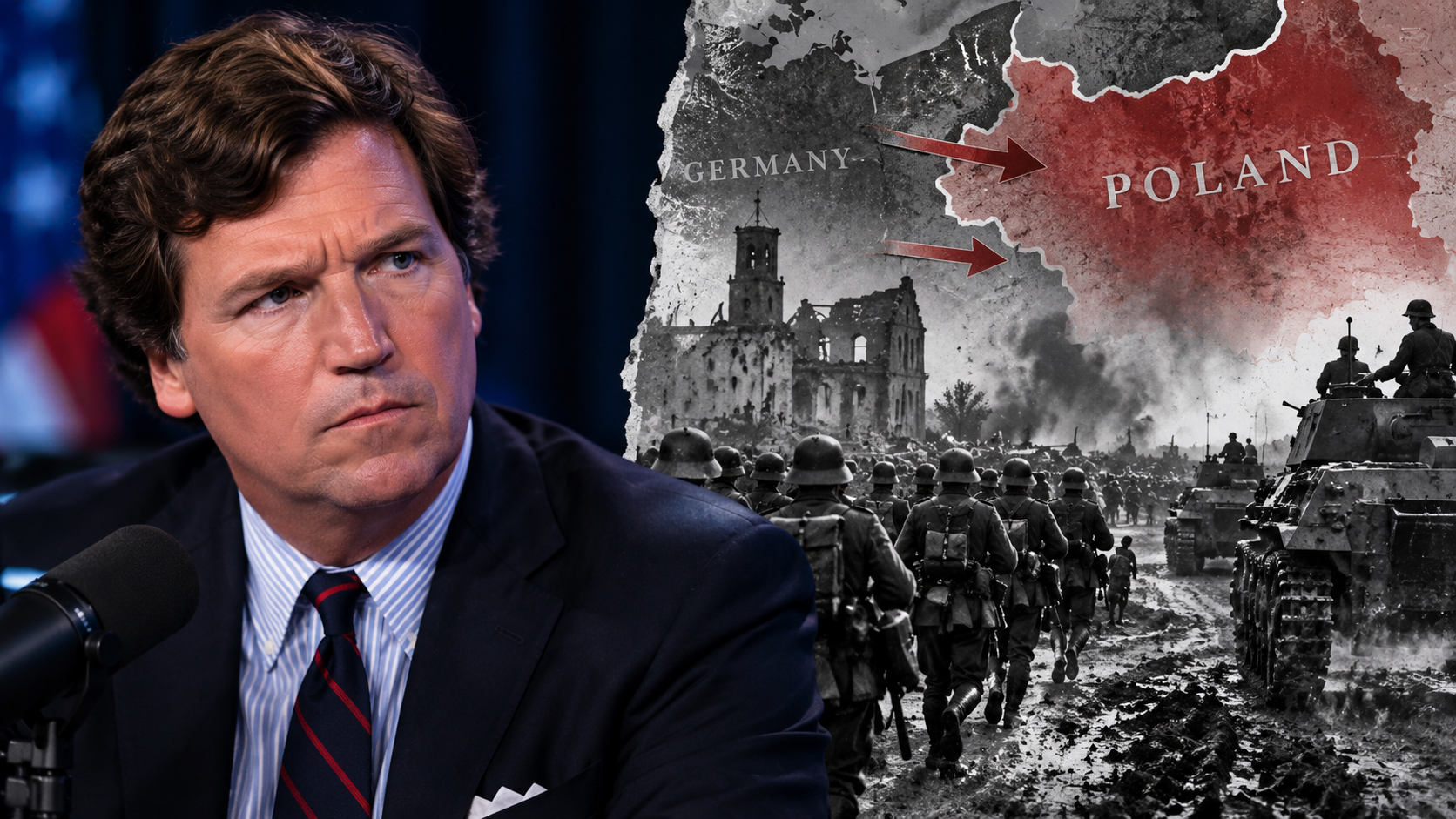
Carlson said he had “never understood why” Britain fought the war and argued that the idea Hitler had entered Poland without a reason was false. He referred to territories transferred from Germany following the First World War and said Hitler had argued that part of Poland had previously been German territory. Carlson then said Britain had “nothing to do with it” and had damaged itself by entering the conflict.
Rees-Mogg pushed back during the exchange, arguing that defeating Hitler had been the right decision and accusing Carlson of “verging on defending Hitler”. Carlson denied that this was what he was doing and said he was trying to examine the causes and consequences of the war.
In his letter, Klich said Carlson had used historical grievances over post-First World War borders to justify Nazi Germany’s aggression against Poland. He described the comments as a “colossal insult” to the victims of Nazism and accused Carlson of becoming an “apologist for Adolf Hitler”.
Klich demanded that Carlson publicly withdraw the statements and apologise, arguing that freedom of speech should not be used to distort the record of the Second World War. He also invoked the Holocaust and the millions killed during Nazi Germany’s occupation and war of conquest.
There is a historical basis for part of the territorial background Carlson referred to, but not for treating it as a sufficient explanation of Germany’s invasion.
The Treaty of Versailles transferred Poznań and much of West Prussia from Germany to the restored Polish state, creating Poland’s access to the Baltic Sea. However, the Free City of Danzig — today Gdańsk — was not simply transferred to Poland; it was placed under League of Nations protection with special Polish rights.
By early 1939, Hitler was demanding that Danzig be incorporated into Germany and that Berlin receive an extraterritorial road and rail connection across the Polish Corridor to East Prussia. Contemporary US diplomatic records show those demands escalating during the year. By 30 August, the American ambassador in France reported that Hitler was demanding not only Danzig and the Corridor but Polish territories including Pomerania and Silesia, while threatening to “crush Poland” if his demands were not met.
The wider historical record also goes beyond the border dispute. In August 1939 Nazi Germany signed the Molotov-Ribbentrop Pact with the Soviet Union, whose secret arrangements envisaged dividing Poland and other parts of Eastern Europe into German and Soviet spheres. Germany invaded Poland on 1 September, with Soviet forces entering from the east on 17 September.
The United States Holocaust Memorial Museum’s account of the invasion describes Germany’s attack as unprovoked and records how Nazi propaganda portrayed Germany as acting defensively. German authorities accused Poland of mistreating ethnic Germans, falsely claimed that Poland and its allies planned to encircle Germany and staged the Gleiwitz radio-station incident to provide an additional pretext for military action.
Britain and France declared war on Germany on 3 September after Germany invaded Poland, honouring guarantees they had given to the Polish state earlier that year. Their decision followed Hitler’s occupation of the Czech lands in March 1939, which had already violated the Munich settlement reached the previous year.
Klich’s intervention therefore centres not on whether unresolved territorial disputes existed after the First World War — they clearly did — but on whether those disputes can be presented as justification for Germany’s decision to invade, occupy and partition Poland.
As of Tuesday morning, Carlson had not publicly issued the apology demanded by the Polish embassy in the sources reviewed by Poland-24.