

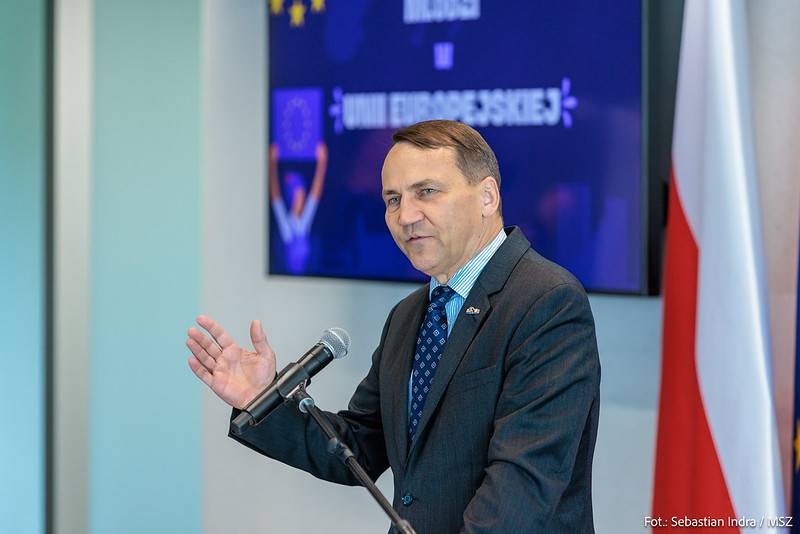
Polish Foreign Minister Radoslaw Sikorski warned that the rise of Germany’s far-right Alternative for Germany party alongside the country’s military buildup has revived historical concerns in Poland, which was invaded by Nazi Germany at the start of World War II.
In an interview with the German business newspaper Handelsblatt, Sikorski said Poland wants Germany, Europe’s largest economy, to play a strong role in shared security under democratic leadership.
But he said Poles remember “where a rearmed Germany in the hands of a far-right, pro-Russian party can lead,” describing the AfD in those terms.
- Find more news from Poland on our Homepage .
The remarks come as Germany increases defense spending and seeks to build what officials have described as Europe’s largest conventional military. The AfD’s electoral gains have amplified unease in neighboring Poland, where memories of the Nazi occupation remain central to public life and politics.
Germany invaded Poland on Sept. 1, 1939, launching World War II. The Soviet Union invaded from the east more than two weeks later, and Poland then endured more than five years of brutal German occupation.
For decades after the defeat of Adolf Hitler, Germany had no major far-right party. That has changed in recent years as the AfD expanded its support, particularly in eastern Germany.
The party won 33% of the vote in the 2024 Thuringia state election, according to the report. It also won Sunday’s election in Saxony-Anhalt with 44%, its strongest result yet in the state. The AfD came second in Germany’s 2025 federal election with 21% and became the country’s main opposition party.
Recent polls have placed the AfD at about 28% nationally, ahead of Chancellor Friedrich Merz’s Christian Democratic Union, which was at about 21%, the report said.
Polish concerns focus not only on the party’s growth but also on its approach to Germany’s Nazi past, relations with Poland and views toward Russia.
Some leading AfD figures have sought to minimize the importance of the Nazi era. In 2025, the AfD was the only parliamentary party not to support a proposal for a permanent Berlin memorial to Polish victims of German Nazi occupation.
The party’s positions on Russia have also caused alarm in Poland, a NATO member that has repeatedly warned of Russian aggression in Europe.
AfD co-leader Tino Chrupalla said last year that he did not see a present Russian threat to Germany and suggested Poland could also pose a threat. Earlier this year, senior AfD figure Kay Gottschalk called for Poland to pay Germany 1.3 billion euros, or about $1.4 billion, over alleged Polish complicity in the 2022 sabotage of the Nord Stream gas pipelines.
Polish Prime Minister Donald Tusk responded sharply after the Saxony-Anhalt result, saying that only “idiots or traitors” in Poland would celebrate an AfD victory. He said some supporters of the country’s two main right-wing opposition groups, Law and Justice and Confederation, had welcomed the result.
Reactions from those parties have been mixed.
Law and Justice lawmaker Malgorzata Golinska said the AfD’s advance represented a “browning” of German politics, invoking the brown-shirted paramilitary forces that helped Hitler rise to power. She said Poland should not overreact emotionally but must not be naive about developments in Germany.
Another Law and Justice lawmaker, Jaroslaw Sellin, said his party and the AfD shared some positions on European Union climate and migration policy. However, he said that did not mean Law and Justice accepted the AfD’s positions on history, Poland or Russia.
Confederation, a broader right-wing alliance, has also delivered a divided response. Its New Hope faction works with the AfD in the European Parliament and shares its opposition to EU migration and climate policies. Still, a party spokesman said it rejects anti-Polish statements by AfD figures.
A lawmaker from Confederation’s National Movement faction said some AfD demands were unacceptable from Poland’s perspective, while noting common ground on issues including opposition to the euro.
The most enthusiastic response came from the Confederation of the Polish Crown, a radical-right, pro-Russian group that split from Confederation last year. Its deputy leader, Wlodzimierz Skalik, said the AfD result showed that “Europe is waking up” and predicted a return of a “Europe of nations.”
Sikorski’s comments underline how Germany’s changing political landscape is being closely watched in Poland, where security policy, the war in neighboring Ukraine and the legacy of World War II continue to shape relations with Berlin.