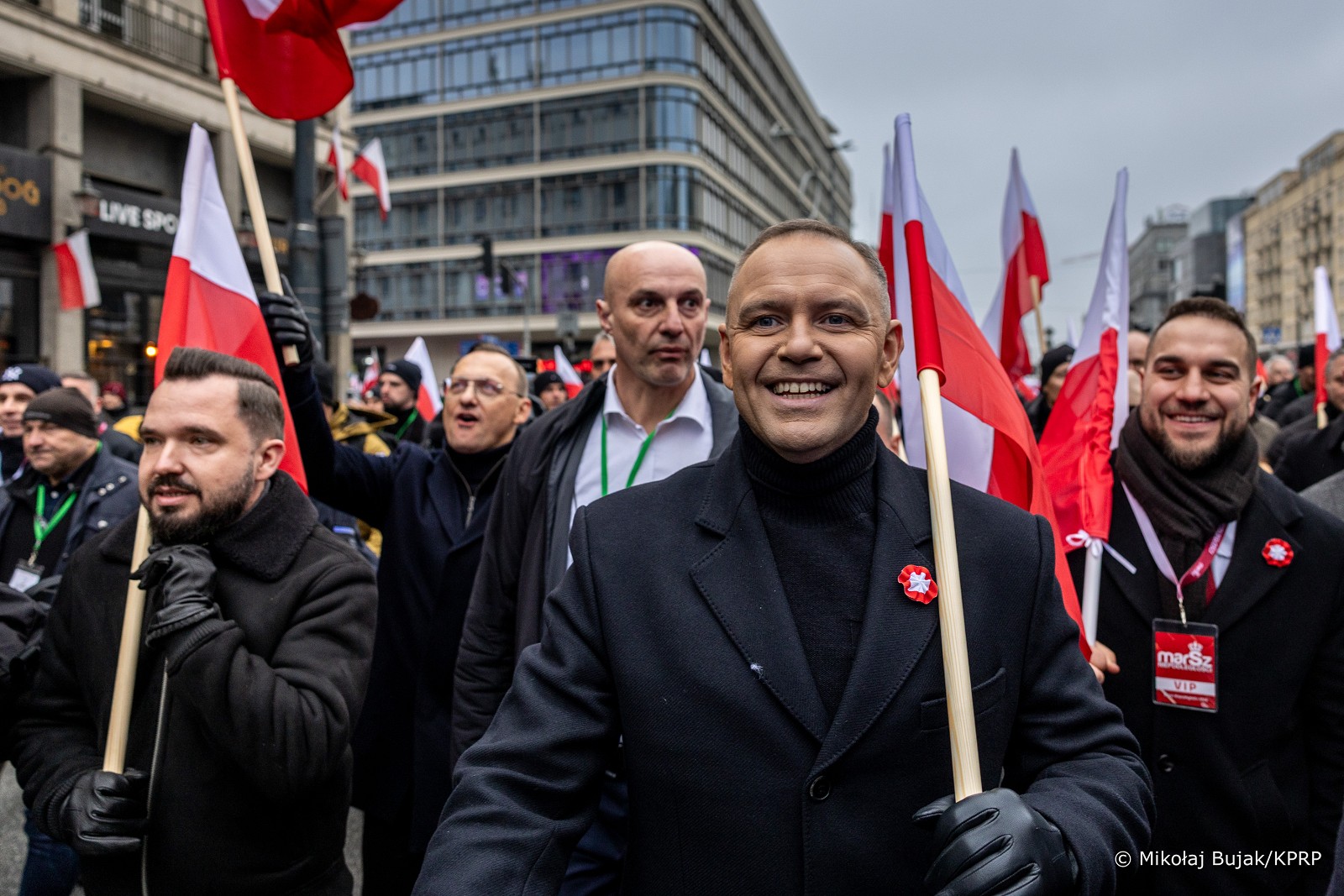
Polish President Karol Nawrocki joined a huge Independence Day march through central Warsaw on Wednesday, 11 November, carrying a white-and-red national flag as crowds filled the capital’s streets to mark 108 years since Poland regained its independence. The annual procession, organised by nationalist groups, took place under heightened security following the deadly Kraków shooting four days earlier.
The march began at Dmowski Roundabout shortly before 15:00, with participants proceeding along Aleje Jerozolimskie and across Poniatowski Bridge towards the National Stadium.
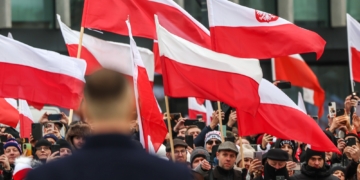
A sea of Polish flags filled the route, accompanied by banners, patriotic chants and the red smoke of flares set off despite a citywide prohibition on pyrotechnics.
- Find more news from Poland on our Homepage .
Nawrocki marched near the front of the procession alongside his elder son and senior presidential aides, before leaving the demonstration after crossing the bridge to Warsaw’s eastern side.
The front of the procession reached the National Stadium grounds by late afternoon, while participants farther back were still making their way through the city.
President Nawrocki carries Polish flag through Warsaw
Nawrocki’s appearance was one of the most prominent features of this year’s Independence March.
The president arrived at the gathering following the official state commemorations earlier in the day at the Tomb of the Unknown Soldier on Piłsudski Square.
Participants welcomed him with chants of Czołem, panie prezydencie — a traditional Polish military-style greeting meaning “Greetings, Mr President”.
The crowd also sang the Polish national anthem.
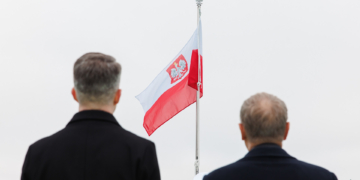
Nawrocki carried a Polish flag as he walked with the procession.
Accompanying him were several senior presidential officials, including Presidential Chancellery chief Zbigniew Bogucki, chief of staff Paweł Szefernaker, National Security Bureau head Bartosz Grodecki and international policy chief Marcin Przydacz.
The president was also accompanied by his elder son.
According to PAP’s account of Nawrocki’s participation, he crossed Poniatowski Bridge with the demonstrators before leaving the march on the Praga side of the Vistula River.
His participation followed his appearance at the country’s central Independence Day ceremony, where he delivered a speech addressing national sovereignty, political divisions and the Constitutional Tribunal.
Poland-24 has separately reported on Nawrocki’s Independence Day appeal for an independent Constitutional Tribunal, which formed part of his earlier state address.
Thousands of Polish flags fill the capital
The procession followed the traditional Independence March route through central Warsaw.
Participants gathered around Dmowski Roundabout, one of the capital’s major transport intersections, before setting off towards the eastern bank of the Vistula.
The march moved along Aleje Jerozolimskie, through the Charles de Gaulle Roundabout area and across Poniatowski Bridge.
Its destination was the open grounds beside the National Stadium, where organisers scheduled further activities.
Participants carried Polish national flags, wore white-and-red scarves and patriotic rosettes, and displayed banners identifying towns and communities from across Poland.
You May Also Be Interested In
Motorcycle groups, historical re-enactors and vintage tractors were also present near the front of the procession.
Earlier in the afternoon, participants gathered for prayers and speeches before singing the national anthem.
The 11 November account published by Euronews described the march as a broad gathering of patriotic and nationalist organisations, political groups and members of the public.
The demonstration was held under the slogan Polak w Polsce gospodarzem, which can be translated as “Poles are the hosts in Poland”.
Organisers presented the slogan as an expression of national sovereignty and the right of Poles to determine their country’s future.
It was also associated with their opposition to large-scale immigration and criticism of the government’s policies.
How many people attended the Independence March?
The number of participants became a subject of competing estimates as the procession moved through Warsaw.
Organisers claimed that approximately 500,000 people had joined the march, describing attendance as potentially record-breaking.
However, that figure had not been independently verified.
In an assessment published at 17:21, Onet estimated that approximately 120,000–160,000 people were present along the route at around 16:30.
Its journalists calculated the estimate using the approximate area occupied by demonstrators and observed crowd density.
The outlet also reported unofficial estimates attributed to security services suggesting that the total could have reached 200,000–250,000.
Those figures were not an official police attendance announcement.
Warsaw’s municipal authorities declined to provide their own estimate during the afternoon.
Jarosław Misztal, director of the city’s Security Centre, said that issuing a number while people were still moving through the streets would only encourage arguments over attendance.
He said the immediate priority was public safety.
The substantial differences between the figures mean that no single attendance total should yet be presented as established fact.
Nevertheless, contemporary reporting confirms that the demonstration drew a very large crowd stretching over several kilometres of central Warsaw.
Flares lit despite prohibition
As the procession moved through Warsaw, participants set off flares and smoke-producing pyrotechnics.
Their use was prohibited under restrictions introduced by the Mazovian provincial governor for Independence Day.
The ban covered carrying, transporting and using pyrotechnic products in public places across Warsaw on 11 November.
The Interior Ministry also introduced a temporary prohibition on carrying weapons or transporting them unloaded within the city.
Drones and other aircraft were subject to additional flight restrictions over the capital.
The Interior Ministry’s official security announcement explained that the restrictions were intended to reduce risks during the national celebrations.
Despite the measures, red flares and smoke were visible along the march route.
City officials indicated that police had intervened in some cases involving suspected breaches of the pyrotechnics ban.
However, the number of interventions and any resulting penalties had not been established in a final police report.
Heightened security following Kraków shooting
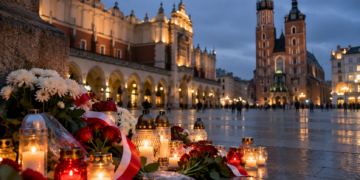
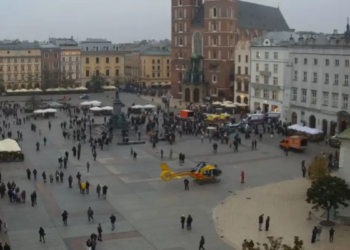
Security arrangements were particularly prominent this year following the mass shooting in Kraków on 7 November.
Six people were killed when a gunman opened fire around the city’s historic Main Market Square.
More than a dozen others were injured, including police officers who confronted and stopped the attacker.
The gunman subsequently died in hospital.
The attack prompted heightened security preparations for Independence Day events in Warsaw and elsewhere.
In a statement published on 10 November, Warsaw Metropolitan Police confirmed that additional officers from other regions had been deployed to reinforce the capital’s police.
The operation involved public-order officers, criminal investigators and traffic police, alongside other security services.
Police also reported that eight people had been detained before Independence Day over online activity allegedly intended to create fear surrounding the celebrations.
Those pre-event detentions should not be confused with arrests during the march itself.
Additional security measures included concrete barriers and intensified monitoring of public spaces.
City authorities report no major disturbances
Despite the use of flares, Warsaw authorities reported that the march was proceeding without major public-order disturbances during the afternoon.
Warsaw Mayor Rafał Trzaskowski said that the city’s services were maintaining contact with police and monitoring the situation.
He acknowledged the pyrotechnics violations but said that no serious disturbances had been recorded at the time of his remarks.
As Radio ZET reported from the city’s security briefing, Trzaskowski expressed hope that the remaining demonstrations would also proceed peacefully.
Security Centre director Misztal gave a similar assessment.
The front of the Independence March reached the National Stadium grounds during the late afternoon.
This was not yet confirmation that all associated gatherings had concluded or that the day’s final police assessment was complete.
Nationalist organisers and political figures among marchers
The Independence March is organised by the March of Independence Association, which developed from Poland’s nationalist movement.
Since its beginnings in 2007, it has grown into one of the country’s largest annual Independence Day gatherings.
Its participants include nationalist activists, right-wing political groups, families and other members of the public who attend to celebrate Polish independence.
The demonstration has also been politically controversial because of its nationalist organisers, anti-immigration messaging and instances of extremist symbolism or violence at previous events.
Those controversies do not mean that everyone participating shares the same ideology.
This year’s march included prominent politicians from the opposition Law and Justice party and the Confederation political movement.
Among those reported attending were Law and Justice leader Jarosław Kaczyński, former prime minister Mateusz Morawiecki, Confederation politicians Krzysztof Bosak and Sławomir Mentzen, and several other right-wing figures.
Bosak, a deputy speaker of the Sejm, addressed participants before the procession, highlighting what he described as the event’s broad representation of different political and social groups.
Some demonstrators also carried banners opposing immigration and criticising Prime Minister Donald Tusk’s government.
The march provided an opportunity for right-wing parties and nationalist organisations to express political positions, alongside participants whose principal reason for attending was to celebrate the national holiday.
The event was not an official government-organised ceremony and should be distinguished from the state commemorations held earlier in the day.
Tusk attends separate Independence Day celebrations
Prime Minister Donald Tusk did not join the Independence March.
Instead, he attended a ceremony in Szczecin, where the Polish flag was raised aboard the newly built Bursztyn Unity passenger and freight ferry.
During that event, Tusk made a public appeal for political reconciliation and invited President Nawrocki and his family to his home in Sopot before Christmas.
The prime minister’s invitation came amid continuing disagreements between the government and presidency over Poland’s Constitutional Tribunal.
Poland-24 has covered Tusk’s invitation and its political background in a separate report.
The different appearances of Poland’s two senior political figures illustrated how the country’s Independence Day was marked through both official state ceremonies and separately organised public gatherings.
Why Poland’s Independence Day matters
Poland celebrates National Independence Day on 11 November to commemorate the restoration of its statehood in 1918.
The country had been divided between neighbouring powers for 123 years, following partitions by Russia, Prussia and Austria.
Its return to independence followed the collapse of the partitioning empires during the First World War and generations of political, cultural and military efforts by Poles.
The date is associated with Józef Piłsudski assuming command of Polish military forces in November 1918.
The national holiday was restored in 1989 following the end of communist rule.
For international readers, Poland-24’s historical overview of the country’s road to independence explains why 11 November remains one of the most important dates in the Polish calendar.
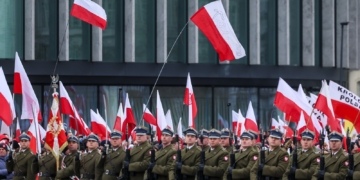
Across the country, the anniversary was marked by military honours, wreath-laying ceremonies, church services, concerts and public celebrations.
In Warsaw, President Nawrocki attended the central ceremony at the Tomb of the Unknown Soldier before joining the afternoon march.
A separate Poland-24 report covers the national military ceremony and wider 2026 Independence Day commemorations.
One holiday, different expressions of Polish identity
The Independence March remains one of the most visible, and politically debated, events associated with Poland’s national holiday.
For many participants, it represents public celebration of Polish identity, history and sovereignty.
For critics, its nationalist organisers and political messaging raise concerns about exclusionary nationalism and the use of Independence Day for partisan mobilisation.
This year’s procession brought those different interpretations into focus as huge crowds marched through Warsaw beneath white-and-red flags.
President Nawrocki’s presence gave the event additional political prominence, while police concentrated on maintaining security following the Kraków tragedy.
By late afternoon, the front of the procession had reached its destination and municipal authorities were reporting no major disturbances beyond the documented pyrotechnics violations.
The final number of participants and the complete police assessment remained to be established.