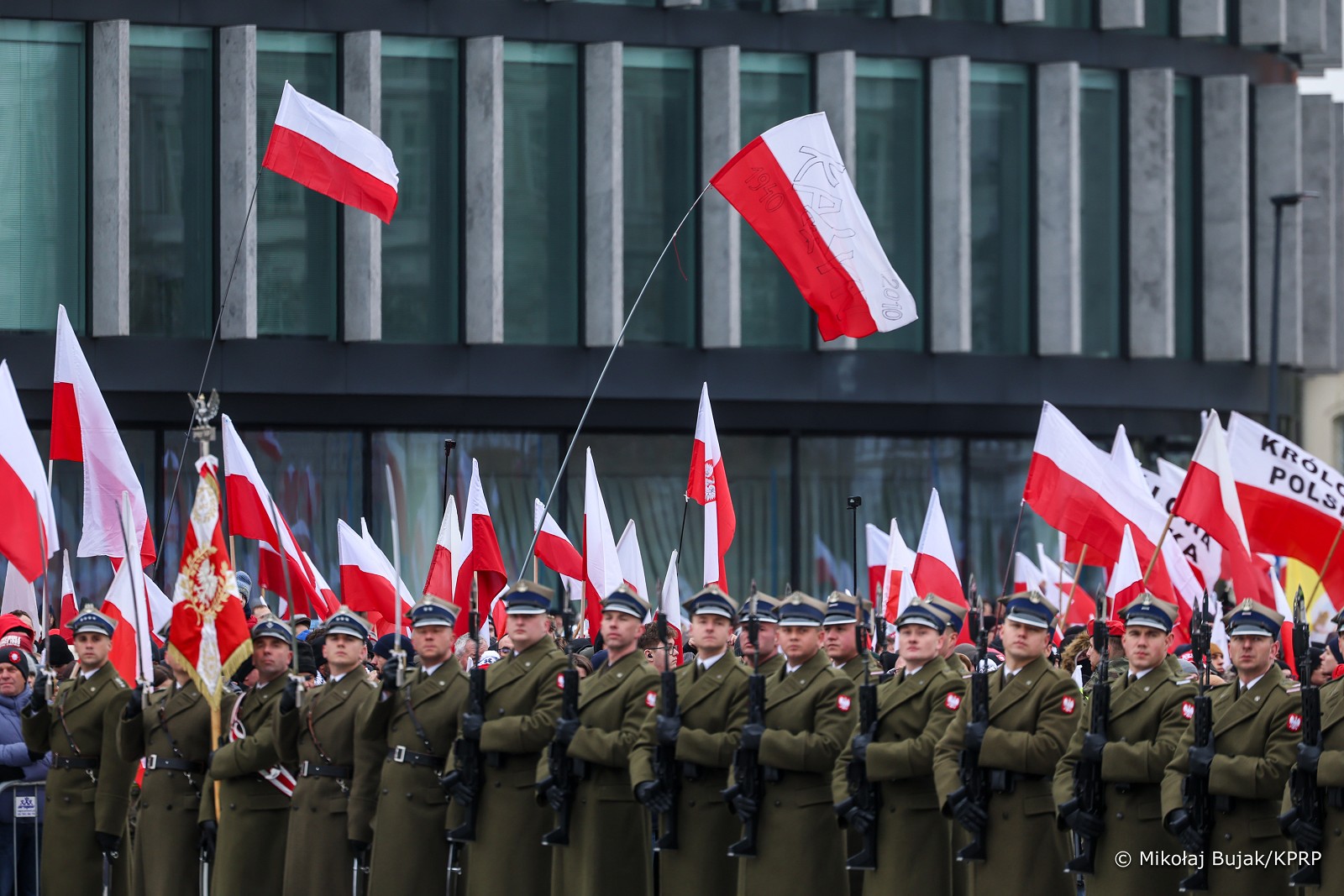
Poland marked the 108th anniversary of regaining its independence on Wednesday, 11 November, with a solemn military ceremony at the Tomb of the Unknown Soldier in Warsaw, bringing together the president, senior government officials and commanders of the Polish Armed Forces. The celebrations included ceremonial military honours, the national anthem and promotions for senior officers, while Prime Minister Donald Tusk attended a separate Independence Day ceremony in Szczecin, where the Polish flag was raised aboard a newly built Baltic ferry.
The main state commemoration began at noon on Marshal Józef Piłsudski Square in central Warsaw, one of Poland’s most important sites of national remembrance.
President Karol Nawrocki, accompanied by First Lady Marta Nawrocka, attended alongside Deputy Prime Minister and Defence Minister Władysław Kosiniak-Kamysz, Foreign Minister Radosław Sikorski, senior military commanders and representatives of state institutions.
- Find more news from Poland on our Homepage .
The gathering combined the country’s military traditions with remembrance of the generations who fought to restore and defend Polish independence.
Military honours at the Tomb of the Unknown Soldier
The centrepiece of the Warsaw commemorations was the ceremonial changing of the guard, known in Polish as uroczysta odprawa wart, at the Tomb of the Unknown Soldier.
The ceremony brought military formations to Piłsudski Square to honour Polish servicemen and women who died in defence of their country.
Under the official Independence Day programme published by the Ministry of National Defence, the noon proceedings combined military ceremonial duties with speeches and the presentation of general-officer promotions.
The military elements included the formal report by the ceremonial commander, the playing and singing of Poland’s national anthem, Mazurek Dąbrowskiego, and a roll call of remembrance.
The roll call, known as Apel Pamięci, honours individuals and generations who fought for Poland’s freedom and sovereignty.
An artillery salute was also included in the programme, while military musicians and honour guards provided the ceremonial accompaniment.
The changing of the guard symbolises the continuing responsibility of Poland’s armed forces to protect the state and preserve the memory of those who served before them.
The ceremony also included the laying of wreaths at the Tomb of the Unknown Soldier and associated monuments on Piłsudski Square.
The national broadcaster TVP’s account of the ceremonial programme identified the anthem, remembrance roll call, artillery salute and military honours as central elements of the 2026 commemoration.
Ten Polish military officers receive promotions
The ceremony was also an occasion to recognise senior officers of the Polish Armed Forces.
President Nawrocki, acting in his constitutional capacity as commander-in-chief, presented acts of appointment to ten officers promoted to general ranks.
Among them was Major General Ireneusz Nowak, the Operational Commander of the Armed Forces, who was promoted to lieutenant general, a three-star rank.
Brigadier General Rafał Miernik, head of the General Staff’s training directorate, was promoted to major general.
Eight colonels also received promotions to brigadier general, including Piotr Bieniek, commander of the 6th Airborne Brigade, and pilot Krzysztof Kwiatkowski, commander of the 1st Army Aviation Brigade.
The Presidential Chancellery published the complete list of ten promotions on 10 November, ahead of the formal presentation during the Independence Day ceremonies.
Nawrocki also handed General Wiesław Kukuła his appointment document for a second term as chief of the General Staff of the Polish Armed Forces.
These appointments gave the commemoration an additional military significance, connecting the remembrance of Poland’s past with the leadership of its present-day armed forces.
President Nawrocki calls for unity and stronger institutions
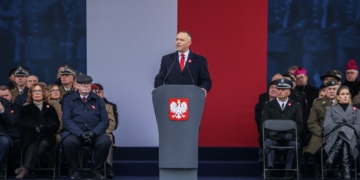
President Nawrocki used his address on Piłsudski Square to reflect on national sovereignty, Poland’s constitutional institutions and the responsibilities of political leaders.
He argued that independence should remain above party-political disputes and said that the country’s constitutional order needed to be protected.
One of the central themes of his speech was the continuing confrontation surrounding Poland’s Constitutional Tribunal.
The president called for the institution to be independent of political interference and police cordons, urging government and parliamentary leaders to work together to restore its credibility.
Poland-24 examines Nawrocki’s Independence Day address and his appeal for a constitutional court free from politics in a separate article, including the background to the dispute between the presidency and the government.
His remarks came against the backdrop of an institutional confrontation that has dominated Polish politics in recent weeks.
Defence minister urges Poles to remain united
Defence Minister Władysław Kosiniak-Kamysz also addressed those gathered on Piłsudski Square.
His speech focused on national unity and the historical lesson that Poland’s internal divisions have sometimes weakened its ability to withstand external threats.
The minister was met with whistles and booing from some people in the crowd.
Responding to the interruption, he invoked independence-era political leader Wojciech Korfanty, arguing that Poland was built through work rather than shouting.
He warned that political divisions could ultimately benefit hostile foreign powers.
According to PAP’s report from the ceremony, Kosiniak-Kamysz said that national unity had been essential to Poland’s historical achievements and remained necessary for its future security.
The remarks reflected the role of the Armed Forces during the holiday: honouring the country’s history while emphasising the importance of defending its independence today.
Warsaw’s commemorations began earlier in the morning
The noon military ceremony was preceded by a series of commemorative events across Warsaw.
Shortly after 8:00, President Nawrocki laid wreaths at monuments dedicated to six prominent figures associated with the restoration of Polish independence: Wincenty Witos, Ignacy Jan Paderewski, Ignacy Daszyński, Roman Dmowski, Wojciech Korfanty and Józef Piłsudski.
At 9:00, the president and first lady attended a Mass for Poland at the Temple of Divine Providence.
The service was led by Warsaw Archbishop Adrian Galbas, while the military bishop, Wiesław Lechowicz, delivered a homily emphasising freedom, truth, justice and the common good.
Before the service, Nawrocki lit the historic Independence Candle, presented to Polish church leaders by Pope Pius IX in 1867, when Poland remained partitioned.
The Archdiocese of Warsaw confirmed the ceremony and its participants, including prayers for the victims of the recent tragedy in Kraków.
Later that morning, the president also presented state decorations at the Presidential Palace.
The combination of military, religious and civic observances reflected the different traditions associated with Independence Day in Poland.
Polish flag raised aboard new ferry in Szczecin
While the central military commemoration took place in Warsaw, Prime Minister Donald Tusk joined Independence Day celebrations in Szczecin, on Poland’s Baltic coast.
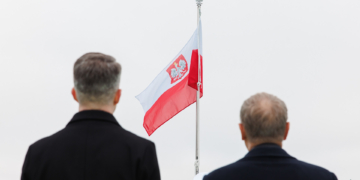
At the historic Wały Chrobrego waterfront, the newly built Bursztyn Unity ferry was officially christened and the Polish merchant flag raised aboard the vessel.
The ceremony was accompanied by military honours and music, including the participation of an honour guard and military band.
The nearly 196-metre passenger and freight ferry was constructed in Gdańsk and is preparing to enter commercial service between Świnoujście and Ystad in Sweden.
The government presented its Polish registration as a milestone for the country’s maritime sector, describing it as the return of a major passenger-cargo vessel to the Polish flag after a 22-year gap.
The significance of the ship’s construction, its Polish registration and its planned Baltic operations is examined in Poland-24’s report on the Independence Day flag-raising aboard Bursztyn Unity, which also explains the broader programme to modernise Poland’s ferry fleet.
The decision to hold the ceremony on 11 November connected the traditional symbols of Polish statehood with a modern industrial achievement.
Tusk makes personal appeal to President Nawrocki
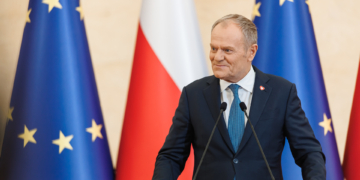
During his Szczecin speech, Tusk also made an unexpected public appeal to President Nawrocki.
The prime minister invited the president, his wife and children to his home in Sopot for a meeting before Christmas.
He suggested that they share the traditional Polish Christmas wafer, known as opłatek, and discuss the future of the country despite their political disagreements.
The invitation came amid continuing tensions between the government and presidency over the Constitutional Tribunal.
As Poland-24 reported in its article on Tusk’s invitation to Nawrocki for pre-Christmas talks, no meeting date or acceptance had been confirmed when the invitation was made.
The two leaders therefore marked Independence Day in different cities, but both made public appeals touching on national unity and cooperation.
Why the Tomb of the Unknown Soldier is central to Poland’s national ceremonies
The Tomb of the Unknown Soldier has been one of Poland’s most important places of national remembrance for more than a century.
Established on 2 November 1925, it contains the remains of an unidentified Polish soldier who died during the fighting for Lwów in 1918.
Originally situated beneath the colonnade of Warsaw’s Saxon Palace, the tomb survived the destruction of most of the building by German forces during the Second World War.
Today, the remaining arches stand on Piłsudski Square, where an eternal flame burns and soldiers maintain a permanent honour guard.
The Polish Ministry of Culture’s history of the monument explains its role as a place of remembrance for those who died defending the country’s independence.
The tomb’s 101st anniversary fell just nine days before this year’s Independence Day celebrations.
The monument honours not one identifiable individual but the many Polish soldiers whose sacrifices made the country’s survival and independence possible.
That symbolism explains why the annual military ceremony is held there, rather than at a government building or an ordinary public square.
Why Poland celebrates independence on 11 November
Poland’s Independence Day commemorates the restoration of Polish statehood in 1918, following 123 years during which the country had been partitioned between Russia, Prussia and Austria.
On 11 November 1918, the Regency Council transferred command of Polish military forces to Józef Piłsudski.
That date also coincided with the armistice ending the fighting on the Western Front in the First World War.
Poland’s independence was not restored by one declaration or military victory alone. It emerged through the collapse of the partitioning empires, the efforts of Polish political leaders and military formations, and the work of generations who had preserved Polish national identity.
Piłsudski subsequently assumed broader authority as the foundations of the new state were established.
The anniversary became an official public holiday in 1937. The communist authorities abolished it after the Second World War, and it was restored as a national holiday in 1989.
For a fuller account of the partitions, uprisings, First World War and re-establishment of the Polish state, see Poland-24’s historical overview of Poland’s road to independence, which traces the developments leading to the events of November 1918.
A national celebration extending beyond Warsaw
Although the Tomb of the Unknown Soldier remains the focus of Poland’s official state commemoration, Independence Day is observed throughout the country.
Cities and towns hold their own wreath-laying ceremonies, military honours, religious services, concerts, historical events and community celebrations.
In Warsaw, additional activities were organised along Krakowskie Przedmieście, while a special Independence Day concert, Wspólna Niepodległa 2026, was scheduled for the Warsaw Citadel.
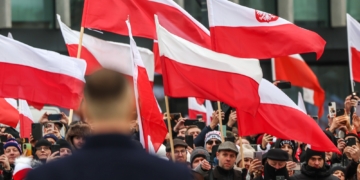
Other events included the annual Independence March, which is organised separately from the central state ceremony.
Across Poland, public buildings and streets were decorated with the national white-and-red colours, reflecting the holiday’s significance beyond political institutions and official ceremonies.
The events in Warsaw and Szczecin illustrated two different aspects of the same anniversary.
At the Tomb of the Unknown Soldier, military personnel and state representatives honoured those who fought for Poland’s freedom.
On the Baltic coast, the raising of the Polish flag aboard a new ferry provided a different symbol of contemporary Polish statehood and industrial ambition.
Together, the commemorations marked 108 years since Poland’s return to the map of Europe, connecting historical remembrance with the country’s present-day institutions, armed forces and achievements.