Poland has raised its national merchant flag aboard a new Baltic ferry during Independence Day celebrations, marking what the government describes as the return of a large passenger-cargo vessel to the Polish flag after 22 years. The Polish-built Bursztyn Unity was officially christened in Szczecin on Wednesday, 11 November, ahead of its planned entry into service between Poland and Sweden.
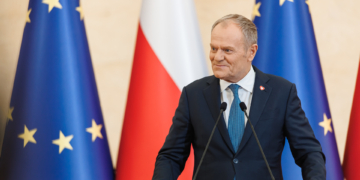
The ceremony took place at Wały Chrobrego, Szczecin’s historic waterfront, with Prime Minister Donald Tusk and Infrastructure Minister Dariusz Klimczak attending alongside representatives of the maritime industry, local authorities and the ship’s crew.
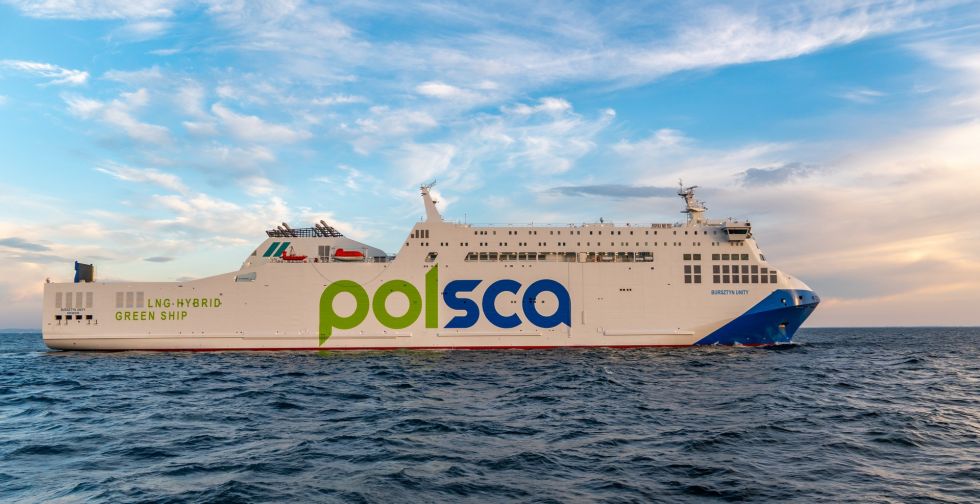
Built in Gdańsk, the nearly 196-metre ferry is the second vessel in a programme intended to modernise Poland’s Baltic ferry fleet and strengthen its domestic maritime industry.
- Find more news from Poland on our Homepage .
The occasion carried additional symbolism because it coincided with Poland’s National Independence Day, commemorating the restoration of the country’s independence in 1918.
Polish flag raised aboard Bursztyn Unity in Szczecin
The ceremony began with the traditional christening of the ferry.
Zofia Gałka, a long-serving employee of the Polish Steamship Company who has been involved in overseeing the construction of new vessels, served as the ship’s godmother.
She formally christened Bursztyn Unity by breaking a bottle against its starboard side.
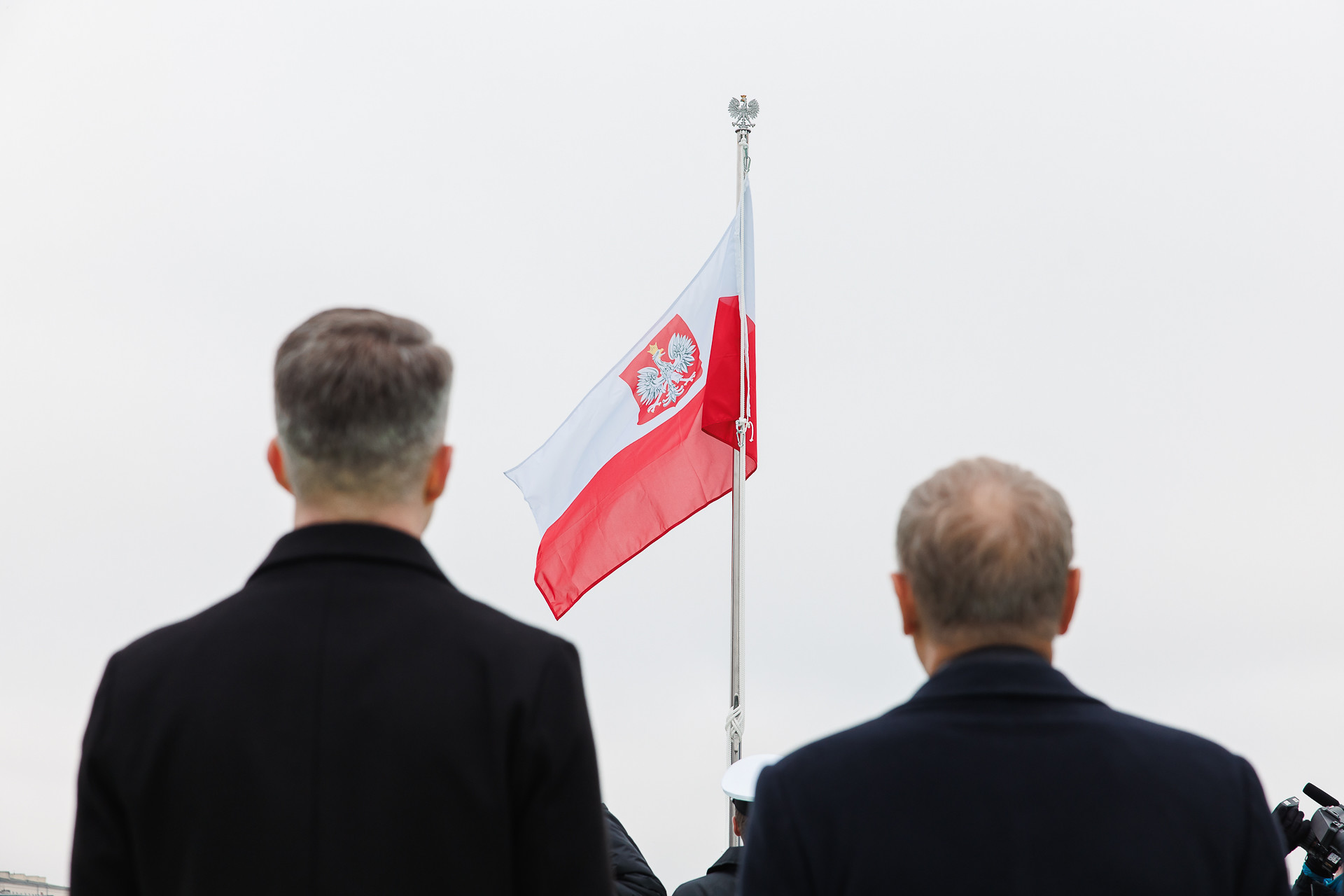
During the subsequent flag-raising ceremony, Tusk presented the Polish merchant flag to the ferry’s captain, Wojciech Żukowski.
The flag was then hoisted aboard the vessel.
The maritime industry publication PortalMorski confirmed the christening and flag-raising, including the participation of the prime minister, captain and ship’s godmother.
Klimczak described Independence Day as a particularly appropriate occasion to raise the Polish flag on a newly built ship.
Tusk, meanwhile, characterised the ferry as an example of Polish industrial capabilities and a symbolic Independence Day achievement.
Speaking at the waterfront ceremony, he said the vessel demonstrated the skills and ambitions of Polish designers and shipbuilders.
Why the return of the Polish flag matters
The government’s central claim is that Bursztyn Unity is the first large passenger-cargo vessel associated with the Polish Steamship Company to return to the Polish flag after a 22-year gap.
This does not mean that Poland has lacked Polish-registered merchant vessels of every type throughout that period.
Rather, the milestone concerns the registration of a major vessel within a particular segment of the Polish-owned commercial fleet.
A ship’s flag represents its country of registration, determining which state exercises primary regulatory jurisdiction over the vessel.
Polish-owned shipping companies have frequently registered ships in other countries, including Cyprus, for commercial and regulatory reasons.
The Prime Minister’s Office highlighted the 22-year gap in its announcement of the ceremony, describing the return of Polish flags to ships owned by Polish operators as one of the objectives of the government’s maritime programme.
The distinction is illustrated by Jantar Unity, the sister vessel introduced earlier in 2026, which operates under the Cypriot flag.
You May Also Be Interested In


According to maritime industry reporting on the new registration arrangements, the operator hopes that Bursztyn Unity will help establish a path for registering more ships under the Polish flag.
The company has indicated that other vessels could follow, although further changes have not yet been completed.
A modern ferry built in Gdańsk
Bursztyn Unity was constructed at Gdańska Stocznia Remontowa, part of Poland’s Remontowa shipbuilding group.
The vessel was developed by Polish designers and built with the participation of domestic shipyard workers, engineering companies and suppliers.
Following construction and sea trials, it was formally handed over to its owner on 23 October 2026.
The ferry departed Gdańsk on 28 October and subsequently travelled to Świnoujście before arriving in Szczecin for its Independence Day ceremony.
According to the operator’s official technical specifications, the ferry has the following characteristics:
| Specification | Bursztyn Unity |
|---|---|
| Length | 195.6 metres |
| Width | 32.2 metres |
| Maximum passengers | 400 |
| Crew | 50 |
| Vehicle loading lanes | 4,100 metres |
| Maximum speed | 19 knots |
| Normal service speed | 14 knots |
The vehicle loading capacity is particularly important to the ferry’s commercial role.
The ship is designed to carry passengers alongside freight vehicles, including lorries and trailers, making it a Ro-Pax ferry — a vessel combining roll-on, roll-off freight transport with passenger accommodation.
The ferry also contains passenger cabins, seating areas, catering facilities and accommodation designed for travellers with disabilities.
Its propulsion system combines four dual-fuel engines capable of operating on liquefied natural gas (LNG) or conventional marine fuel with battery-assisted hybrid technology.
The system is designed to improve efficiency and reduce certain emissions compared with older vessels, although LNG propulsion is not emissions-free.
Second of three new Polish ferries
Bursztyn Unity belongs to a series of three modern ferries ordered for Polish maritime operators.
Its sister ship, Jantar Unity, entered regular Baltic service earlier in 2026.
The third vessel, Amber Unity, is still under construction, with delivery currently planned for 2029.
The ships form part of a government-backed ferry renewal programme initiated in 2017.
The construction contract was signed with the Gdańsk shipyard in November 2021.
The programme has experienced delays and financing challenges. In 2025, the government announced additional funding of approximately PLN 1.3 billion to support completion of the series.
According to Gdańsk’s official report on the ferry’s completion, around 860 kilometres of cables were installed aboard Bursztyn Unity, together with more than 15,000 devices.
The shipyard’s leadership estimated that approximately 10,000 people contributed to the construction project at different stages.
The new vessels are intended to operate under the POLSCA Baltic Ferries brand, which brings together major Polish ferry operators, including Unity Line, Polferries and Euroafrica.
The initiative is aimed at strengthening their position in the competitive Baltic Sea passenger and freight market.
When will Bursztyn Unity start carrying passengers?
Bursztyn Unity is being prepared to operate between Świnoujście in north-western Poland and Ystad in southern Sweden.
The route is important for both passenger travel and the movement of goods between Poland and Scandinavia.
The operator has indicated that the ferry’s first commercial sailing is planned for 18 November 2026, following additional technical preparations and a positioning voyage.
That remains a planned start date, rather than confirmation that the service has already begun.
Before leaving Szczecin, the ship is being opened to the public.
According to Unity Line’s published visitor arrangements, guided tours are planned for 12 and 13 November, although advance reservations for those dates have already closed.
A free public open day is scheduled for Saturday, 14 November, from 10:00 to 16:00.
Visitors will be admitted in groups, without advance reservations.
The ferry is then scheduled to leave Szczecin on 15 November before completing final preparations for regular operations.
A symbolic moment for Poland’s maritime industry
The Independence Day ceremony brought together several elements of Poland’s maritime ambitions: a domestically designed and built ship, investment in Baltic transport links and the decision to register a major new vessel under the Polish flag.
The return of the national flag is a symbolic milestone, but the ferry’s commercial importance will ultimately depend on its performance once it begins regular operations.
For Poland’s shipbuilding industry, the completion of Bursztyn Unity also demonstrates the ability of domestic yards to deliver large, technically complex passenger and freight vessels.
With a third ferry still under construction, the project represents a continuing investment in Poland’s role in Baltic Sea transport rather than a one-off ceremonial achievement.