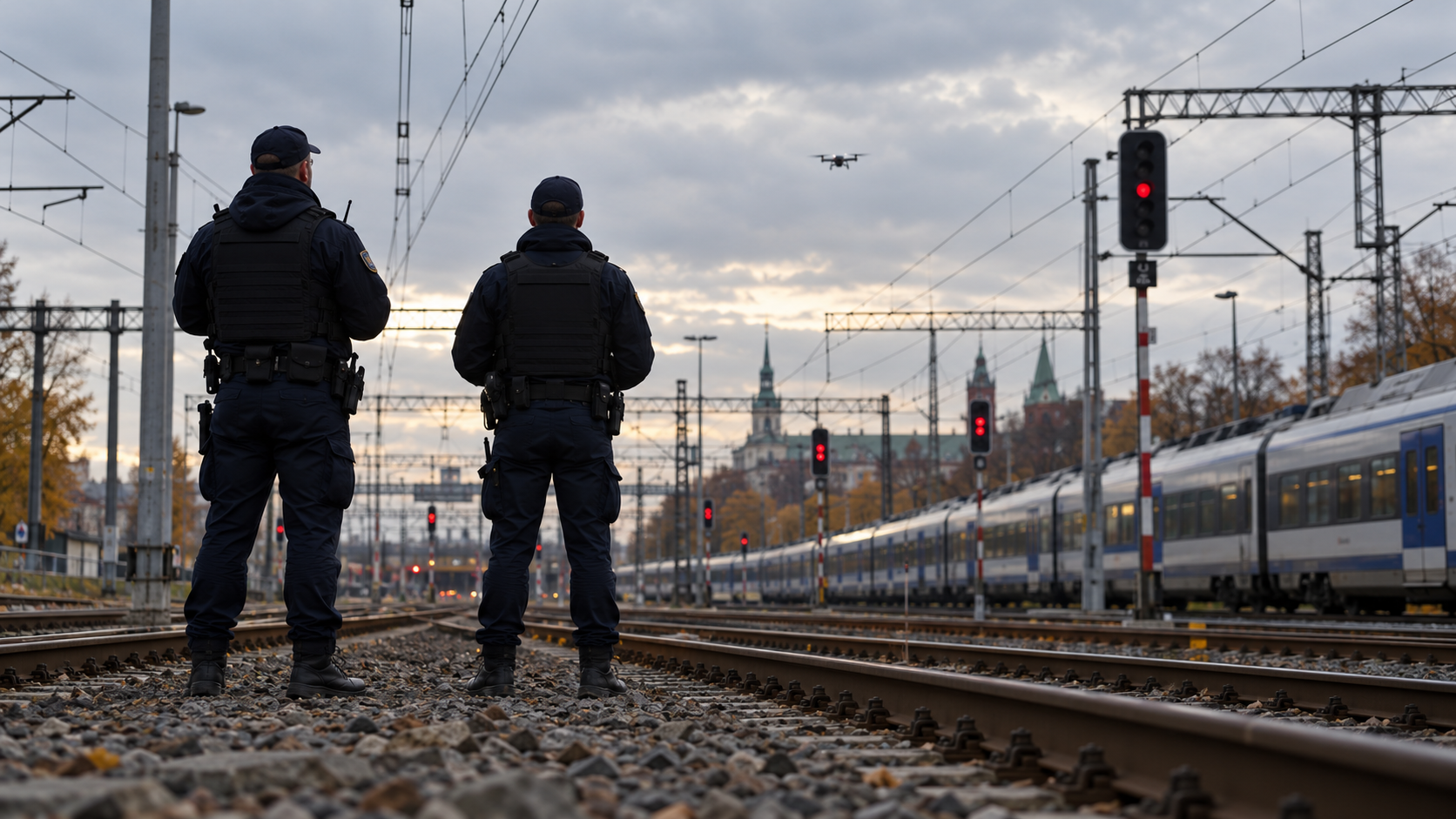
Poland is preparing to give its railway security officers powers to shoot down or otherwise neutralise drones threatening the country’s rail network under proposed legislation intended to strengthen the protection of critical infrastructure. The changes would also expand officers’ authority to search people and vehicles, carry out surveillance and cooperate with military and intelligence agencies as Poland responds to the threat of sabotage linked to Russia’s war against Ukraine.
A draft amendment to Poland’s Rail Transport Act entered interministerial coordination and consultation with relevant institutions on Friday, 16 October 2026, under government project number UD455.
The legislation, prepared by the Infrastructure Ministry, would significantly expand the powers of the Railway Protection Guard, known by its Polish abbreviation SOK (Straż Ochrony Kolei).
- Find more news from Poland on our Homepage .
According to the official government legislative record, officers would gain access to equipment capable of destroying or immobilising unmanned aircraft, or taking control of their flight.
The proposal would also extend the circumstances in which SOK personnel may use firearms, including for neutralising drones under conditions specified in Polish aviation legislation.
The changes come after attacks against Polish railway infrastructure in November 2025 that prosecutors attributed to suspects allegedly acting on behalf of Russian intelligence.
The new powers are not yet in force. The legislation remains a government proposal and has not completed the parliamentary process.
The 16 October development represents the publication and advancement of a detailed draft for review, rather than final approval of the measures. The government’s original legislative intentions were registered in August.
Railway guards could destroy or intercept threatening drones
The proposal would give SOK officers new powers to respond to unmanned aircraft operating unlawfully or posing a threat to railway facilities.
Under the amendments, officers could be equipped with devices intended to destroy drones, immobilise them or take control of their flight.
The legislation would also expand the situations in which officers may discharge firearms, including the destruction or immobilisation of drones in circumstances permitted under Poland’s Aviation Law.
However, the proposal does not create unrestricted permission to shoot at any drone flying near railway tracks.
The use of firearms would remain subject to statutory conditions, while the separate category of new anti-drone equipment expressly excludes systems that interfere with electronic, telecommunications or information-technology systems.
This distinction matters because the proposal does not simply authorise railway personnel to use every available form of electronic jamming.
The government also wants SOK officers to operate their own surveillance drones, helping them monitor railway infrastructure and identify possible threats.
That would provide the force with both additional aerial observation capabilities and new means of responding to potentially dangerous unmanned aircraft.
The national railway infrastructure operator PKP Polskie Linie Kolejowe explained in August that the changes were being developed with the Infrastructure Ministry to address evolving threats to passengers and railway infrastructure.
Government responds to suspected Russian-backed railway sabotage
The proposed reforms follow serious security incidents on Poland’s railway network in November 2025.
During that month, explosives damaged railway tracks near the village of Mika, southeast of Warsaw, while another incident involved damage to overhead electrical equipment and the placement of metal obstacles on railway tracks near Gołąb.
Both incidents occurred on a strategically important railway route connecting Warsaw with eastern Poland and the Ukrainian border.

In a statement issued on 19 November 2025, Poland’s National Prosecutor’s Office announced criminal allegations against two Ukrainian nationals suspected of carrying out the attacks on behalf of Russian intelligence.
Prosecutors said the evidence indicated that the operation had created a direct danger of a train derailment, potentially threatening passengers and railway workers.
The suspects were reported to have left Poland before they could be detained.
The allegations remain part of criminal proceedings and should not be described as established convictions.
Following the incidents, the government strengthened security around railway infrastructure, involving police, railway guards, intelligence agencies and the armed forces.
The Interior Ministry subsequently announced Operation Horyzont, under which approximately 10,000 military personnel were assigned to assist with protecting critical infrastructure.
The government’s current legislative record specifically identifies the 2025 railway sabotage incidents as part of the justification for strengthening SOK powers.
Although the draft introduces new anti-drone capabilities, the earlier attacks described by prosecutors involved explosives and physical interference with railway infrastructure. They were not established as drone attacks.
New powers to search passengers and inspect luggage
The draft legislation goes considerably further than the ability to counter drones.
It would give SOK officers additional authority to inspect people, luggage, vehicles and other property in specified circumstances.
The proposed measures include preventive security checks intended to identify dangerous items and reduce the risk of attacks or other incidents on railway premises.
Officers would also receive broader powers to investigate suspected offences, check identities, examine vehicle loads and conduct searches in accordance with the relevant criminal-procedure legislation.
The proposals additionally cover testing people for alcohol intoxication in specified railway settings.
For international readers, SOK is a specialised Polish railway security service responsible for protecting railway facilities, passengers, staff and train operations. It is not a military organisation.
Its officers already have certain enforcement powers, but the new legislation would expand their responsibilities substantially.
The changes could affect how security operations are conducted at railway stations, on trains and around railway infrastructure.
They would not create a general right to search every passenger without a legal basis. The circumstances and procedures governing different types of checks would be set out in the proposed legislation.
Body cameras and wider surveillance capabilities
Railway security officers would also gain wider authority to record video and audio during their work.
The proposal provides for the use of body-worn cameras during interventions and broader monitoring of railway areas, trains and passenger facilities.
Surveillance drones could be used to observe locations that are difficult to monitor from the ground.
Officers would also be permitted to continue certain operations beyond railway property when necessary, including moving across privately owned land during an immediate pursuit if using public roads would prevent or substantially hinder the operation.
These provisions would give SOK greater operational flexibility when responding to security incidents.
At the same time, the expanded powers raise questions about how surveillance information will be collected, stored and used.
The government proposal includes provisions governing information processing and oversight of officers’ activities.
Importantly, it would also broaden the range of actions that individuals can challenge through complaints submitted to the relevant public prosecutor.
This would extend an existing form of external procedural oversight to additional SOK activities.
The effectiveness of those safeguards would depend on the precise wording of the legislation ultimately adopted and how the new powers are implemented.
Closer cooperation with the military and intelligence agencies
Another central element of the proposal concerns coordination between railway guards and Poland’s national security institutions.
Under the amendments, SOK would be required to cooperate more closely with the Polish Armed Forces and the Internal Security Agency (ABW).
Cooperation would also be expanded to the State Protection Service, fire services and the Prison Service.
The government argues that improved coordination would allow these institutions to respond more effectively to emergencies, attempted sabotage and other threats involving critical infrastructure.
Such cooperation is particularly important because railway lines, bridges, stations and logistics facilities can have significance extending beyond ordinary passenger transport.
Poland’s railway network plays an important role in moving commercial goods and supporting international connections with Ukraine.
Rail disruption can therefore have consequences for civilian travel, freight deliveries and broader national security.
The government is seeking to ensure that railway guards can exchange information and coordinate operations with institutions equipped to respond to threats beyond the railway service’s existing responsibilities.
The proposed changes do not make SOK part of the armed forces or transfer ordinary military command powers to railway security officers.
Railway crossing enforcement would also be expanded
The draft includes provisions unrelated to sabotage but intended to improve everyday railway safety.
SOK officers would receive additional authority to control road traffic at railway crossings and within designated railway areas.
These powers would include stopping vehicles, checking drivers and conducting sobriety tests in circumstances covered by the legislation.
Officers could also issue fines for relevant traffic offences.
The government says these changes would help reduce dangerous behaviour at level crossings, where road vehicles and trains can come into conflict.
The proposals also address the use of automated enforcement equipment and the funding of railway-crossing safety measures.
Although these provisions are less directly connected to the security threat posed by drones, they form part of the same broader reform of the railway guard’s responsibilities.
When will the new powers take effect?
The legislative process remains at an early stage.
The government’s original plans were entered into its legislative programme in August 2026, while a more detailed draft dated 13 October entered the coordination and opinion-gathering stage on 16 October.
The proposal is registered as UD455, with the Infrastructure Ministry responsible for preparing it.
It must complete the relevant government legislative procedures before any parliamentary consideration, followed by the remaining steps required for a bill to become law.
The proposed powers could also be amended during that process.
As of 17 October, no final parliamentary approval or presidential signature had been established for the measures contained in this draft.
The legislation therefore does not yet give SOK officers the additional authority described in the proposal.
If adopted, the reforms would represent a significant expansion of Poland’s railway security capabilities, combining anti-drone measures, surveillance, additional enforcement powers and closer cooperation with national security agencies.
For the government, the stated objective is to strengthen the protection of railway infrastructure against threats ranging from everyday safety incidents to deliberate acts of sabotage.
The immediate development is the advancement of the draft legislation, not the operational deployment of new weapons or an announcement that railway guards have already been authorised to shoot down drones.