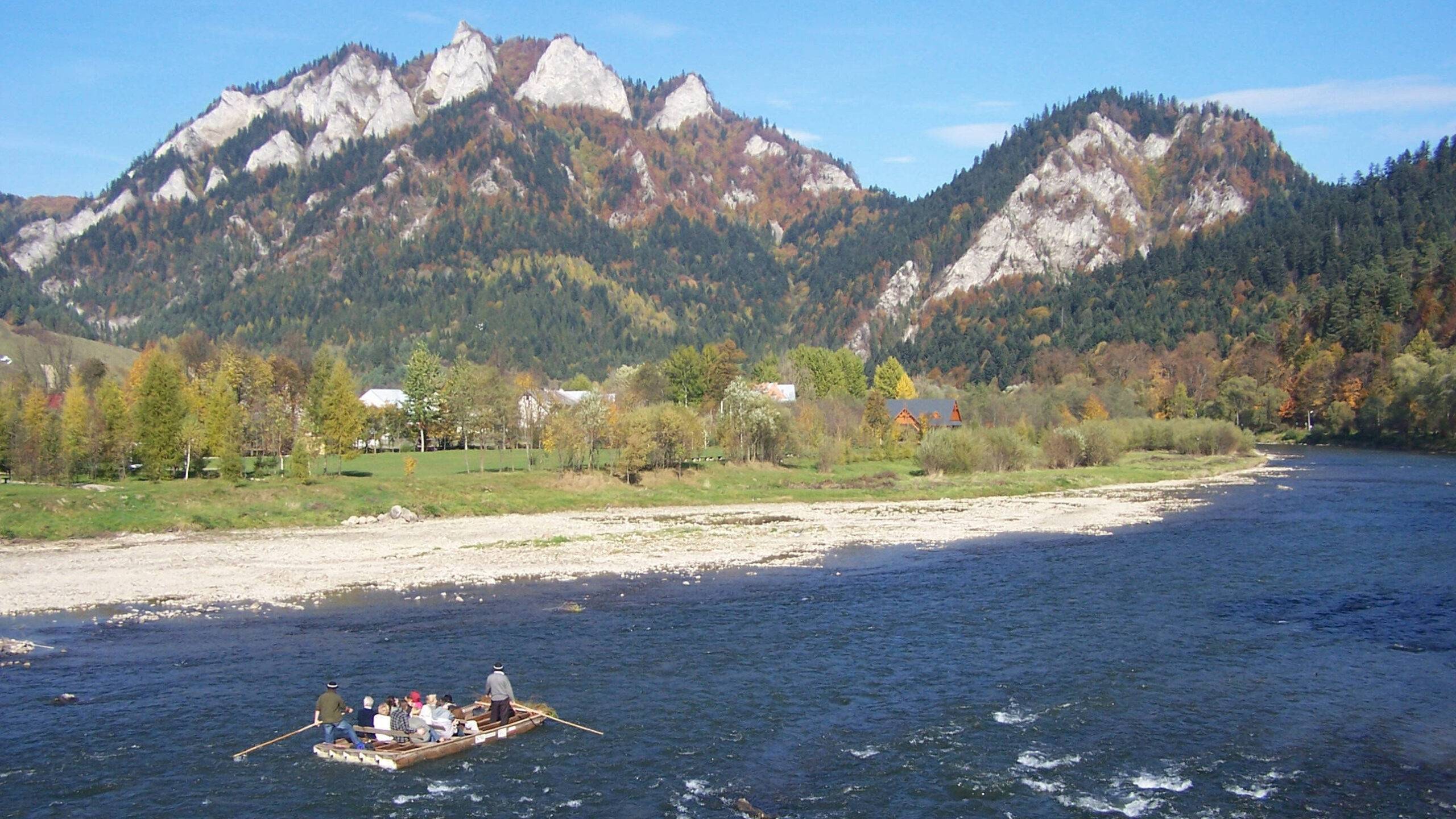
In southern Poland, a remarkable river journey still takes place much as it did generations ago: passengers sit aboard traditional wooden rafts while men in regional highlander clothing guide them between towering limestone cliffs using long wooden poles.
The setting is the Dunajec Gorge, where the river winds through the Pieniny Mountains along the Polish-Slovak border. The tradition of carrying visitors through this extraordinary landscape stretches back nearly 200 years, and the 2026 rafting season is approaching its scheduled conclusion on 31 October.
Known locally as spływ Dunajcem, the journey is one of the Pieniny region’s defining cultural attractions.
- Find more news from Poland on our Homepage .
It is also a rare combination of traditional craftsmanship, local knowledge and protected natural scenery. While the surrounding mountains rise steeply above the river, the wooden vessels are still guided by flisacy — raftsmen whose skills are closely associated with the communities of the Pieniny.
A river journey through limestone mountains
The journey begins at the rafting harbour in Sromowce Wyżne-Kąty, with an additional boarding point at Sromowce Niżne.
From there, the Dunajec carries passengers into a landscape shaped by water cutting through limestone over geological time.
Forested mountain slopes rise above the river. Bare rock faces interrupt the greenery, while the water follows sharp bends between the cliffs.
The gorge forms part of the landscape protected by Pieniny National Park, established in 1932. The river also runs alongside Slovakia, making the journey an encounter with a mountain region shared by two countries.
Among the most recognisable landmarks are Trzy Korony, or Three Crowns, a limestone massif whose highest summit, Okrąglica, reaches 982 metres above sea level, and Sokolica, another prominent Pieniny peak.
The gorge’s rocky walls can rise to around 300 metres above the river, creating dramatic views from water level.
There are two principal destinations.
The journey to Szczawnica covers approximately 18 kilometres and normally takes around two hours and 15 minutes. Passengers continuing to Krościenko nad Dunajcem travel approximately 23 kilometres, with a typical journey of around two hours and 45 minutes.
The precise duration depends on river conditions.
Unlike white-water rafting, where participants often paddle through rapids, this traditional journey is guided by experienced raftsmen using poles to steer the vessels along the current.
The raftsmen who keep the tradition alive
The distinctive craft used on the Dunajec is built from several narrow wooden boat sections joined together.
Earlier tourist vessels were made using hollowed-out tree trunks, often of poplar or spruce, which were fastened together to accommodate passengers. Modern rafts have developed from those designs while retaining their characteristic joined wooden construction.
A typical vessel is guided by two raftsmen, who manoeuvre it with long wooden poles.
Their work requires more than simply keeping the raft moving downstream.
The Dunajec changes direction repeatedly through the gorge, and its flow and depth vary with the weather. Raftsmen must understand the river’s currents, recognise obstacles and keep their vessels on a safe course.
The profession is traditionally associated with Pieniny highlander communities, particularly Szczawnica, Krościenko, Czorsztyn, Sromowce Niżne and Sromowce Wyżne.


According to the Małopolska regional tourism authority, becoming a master raftsman involves years of supervised training and examinations.
The journey also preserves another element of regional culture. Raftsmen traditionally entertain passengers with local stories, legends and explanations of the mountains surrounding them.
The result is something more personal than an ordinary sightseeing excursion: visitors experience the landscape through people whose knowledge of the river forms part of the region’s identity.
From nineteenth-century excursions to a living tradition
Organised tourist rafting on the Dunajec was already being recorded in the nineteenth century.
Pieniny National Park identifies 1840 as the year of the first documented organised river excursion, while descriptions from 1842 refer to flotillas comprising between 10 and 15 boats.
The activity developed alongside Szczawnica’s growing popularity as a spa resort.
One particularly influential figure was Józef Szalay, who helped develop Szczawnica during the nineteenth century and turned excursions through the gorge into elaborate social occasions.
These were very different from today’s regular tourist trips.
Historical accounts describe flotillas travelling downstream with decorated vessels, musicians and passengers singing songs. Some excursions included ceremonial flag-bearing boats, while guests arriving in Szczawnica were welcomed by highlander music.
The organised tradition acquired a more permanent structure in 1934, when the Polish Association of Pieniny Raftsmen on the Dunajec River was established.
The association brought greater order to passenger transport and helped establish rules for the raftsmen operating through the gorge.
Its role has continued into the present day.
The organisation now oversees traditional rafting services, training and the preservation of regional customs, including highlander dress, music and stories.
The earlier history of transporting people and goods on the river is distinct from the organised tourist tradition, which developed in the nineteenth century.
A tradition shaped by nature
The Dunajec Gorge is more than a picturesque backdrop.
Its protected status means tourism must take place within rules intended to safeguard the river and surrounding habitats.
Pieniny National Park restricts where boats may travel and prohibits landing along protected sections of the gorge except in emergencies.
The traditional rafting season runs from 1 April until 31 October, with scheduled holiday exceptions. Individual journeys may also be affected by adverse weather or unsuitable water conditions.
For visitors arriving in October, the mountains offer a different appearance from the summer season.
Deciduous trees on the surrounding slopes begin turning yellow, orange and red, contrasting with the pale limestone and darker evergreen forests.
The final weeks of the season therefore provide an opportunity to see the gorge against an autumn landscape before traditional rafting pauses for winter.
But what makes the Dunajec journey distinctive is not simply the scenery.
It is the continuation of a practice that developed alongside nineteenth-century spa tourism, became organised through the raftsmen’s association in 1934 and still depends on local expertise.
Nearly two centuries after visitors first began taking organised excursions through the Pieniny, wooden rafts continue to follow the river’s bends — with long poles, experienced hands and limestone mountains rising overhead.