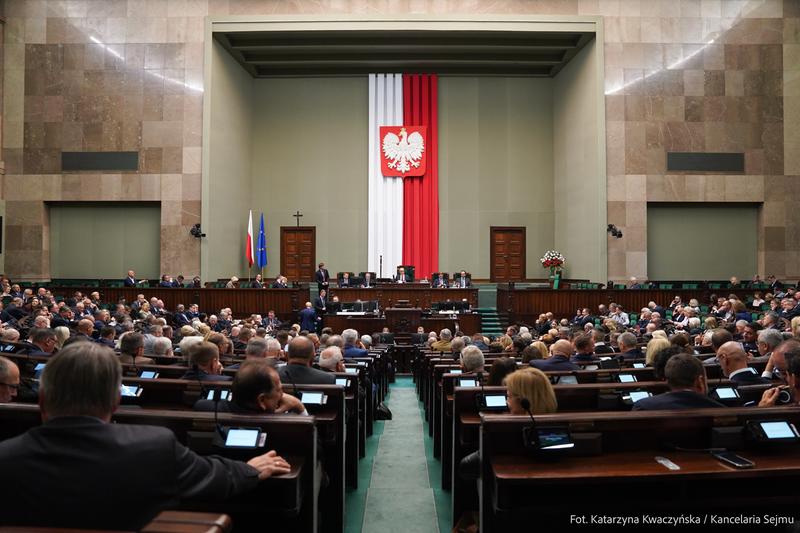
Poland’s parliament has approved two bills that would ease the country’s restrictive abortion laws, including changes to criminal penalties for abortion-related assistance and the restoration of a legal ground for terminating pregnancies involving severe foetal abnormalities.
The votes took place in the Sejm, Poland’s lower house of parliament, on Tuesday evening, 20 October 2026.
The first bill, amending the Criminal Code, passed by 217 votes to 213, with three MPs abstaining. A separate proposal restoring abortion access in cases involving severe foetal abnormalities received 233 votes in favour, 203 against and one abstention.
- Find more news from Poland on our Homepage .
Both voting totals are confirmed in the official Sejm roll-call record for its 67th sitting.
The decisions represent an important development in Poland’s long-running debate over abortion legislation, although neither measure has yet become law.
Both bills must proceed through the Senate and the remaining legislative process before reaching President Karol Nawrocki, who has previously expressed opposition to liberalising abortion restrictions.
The parliamentary outcome was also reported by Reuters and several Polish news organisations covering Tuesday’s proceedings.
The votes also expose continuing differences within Prime Minister Donald Tusk’s governing coalition, whose parties have struggled to agree on the extent of abortion reform.
First bill passes by just four votes
The closest vote concerned amendments to the Criminal Code designed to reduce criminal liability associated with abortion-related assistance.
The legislation was supported by 217 MPs, against 213 who opposed it, with three abstentions.
According to the Polish Press Agency’s account of the vote, the amendment includes provisions addressing assistance in obtaining an abortion and the circumstances in which medical professionals can face criminal responsibility.
Under Poland’s existing Criminal Code, Article 152 establishes criminal penalties for performing an abortion contrary to statutory conditions and for helping or encouraging a woman to obtain one unlawfully.
These offences are distinct from the position of a pregnant woman who terminates her own pregnancy, which is not generally criminalised under that provision.
The Sejm committee’s official legislative text, parliamentary print 3202, repeals Article 152(2), which criminalises helping or encouraging an unlawful abortion.
It also proposes explicit protections for doctors, nurses and midwives carrying out certain medical procedures necessary to protect a pregnant woman’s life or health, or where specified serious foetal conditions are identified.
The adopted committee wording retains Article 152(1), concerning unlawful performance of an abortion. The Sejm’s voting record shows MPs voting on the motion to reject the bill and then on its passage in full, without a separate plenary amendment vote on this proposal.
The measure therefore represents partial, rather than unrestricted, decriminalisation of abortion-related conduct.
Second bill restores abortion ground removed in 2021
The second measure addresses the legal circumstances in which pregnancy may be terminated.
It would restore the possibility of abortion where medical examinations indicate a high probability of severe and irreversible foetal abnormalities or an incurable condition threatening the foetus’s life.
That legal ground existed in Poland until the Constitutional Tribunal ruled against it in October 2020.


The ruling was published and took effect in January 2021, removing one of the previously permitted grounds for abortion.
The decision triggered large demonstrations in Warsaw and other Polish cities, becoming one of the country’s most significant political controversies of recent years.
Tuesday’s proposed reversal was supported by a larger parliamentary majority than the criminal-law amendment.
According to Polish public broadcaster TVP, the bill passed with 233 votes in favour, 203 against and one abstention.
MPs also approved two amendments submitted by Poland 2050 concerning psychological support in connection with abortion procedures.
These changes were considered during Tuesday’s committee and plenary proceedings.
The restoration of the foetal-abnormality ground would not introduce abortion on request for every pregnancy.
It would re-establish a specific medical ground that previously existed under Polish law.
How restrictive are Poland’s current abortion laws?
Poland has one of the most restrictive abortion frameworks in the European Union.
Currently, abortion is generally permitted where continuing the pregnancy threatens the woman’s life or health, or where there is a justified suspicion that the pregnancy resulted from a criminal offence, such as rape or incest.
The criminal-offence ground is subject to a 12-week limit.
Before January 2021, abortion was also permitted in cases involving specified severe foetal conditions.
That third ground was removed following the Constitutional Tribunal’s ruling.
The resulting legal framework has been criticised by reproductive-rights organisations, which argue that it creates uncertainty for patients and healthcare professionals.
Opponents of abortion liberalisation argue that restrictions are necessary to protect prenatal life and that the law should not be expanded to permit additional terminations.
The disagreement concerns both the legal status of abortion and how the existing exceptions operate in clinical practice.
The government has previously introduced administrative and medical guidance aimed at clarifying access to abortions permitted under current law.
However, those measures did not restore the foetal-abnormality ground or introduce abortion on request.
Tuesday’s parliamentary decisions do not immediately change the existing legal framework.
Governing coalition divided over reform
Abortion policy has been a difficult issue for the coalition led by Donald Tusk since it took office in December 2023.
Civic Coalition and the Left have supported liberalising existing restrictions, although their specific legislative priorities have differed.
Other members of the governing coalition have expressed more cautious positions.
The disagreement became visible during Tuesday’s vote on criminal liability.
According to TOK FM’s breakdown of parliamentary voting, the amendment received support from all participating MPs representing Civic Coalition and the Left, alongside members of several other parliamentary groups.
However, the Polish People’s Party was divided, with some MPs supporting the measure and others opposing it.
Deputy Prime Minister Władysław Kosiniak-Kamysz and Szymon Hołownia were among those who voted against the criminal-law amendment.
Their votes illustrate why the legislation passed by such a narrow margin.
The second bill received broader parliamentary support, including a larger proportion of MPs from groups that had been divided over decriminalisation.
The different outcomes highlight the distinction between modifying criminal penalties and restoring a previously recognised medical ground for abortion.
Previous attempt failed in 2024
Tuesday’s vote also follows an earlier unsuccessful attempt to pass legislation reducing criminal liability for abortion-related assistance.
In July 2024, a proposed decriminalisation measure failed to secure a parliamentary majority.
That defeat exposed tensions within Tusk’s coalition and prompted criticism from organisations seeking wider abortion access.
The latest vote reverses that earlier parliamentary outcome, but with only a four-vote margin.
Its passage through the Sejm is therefore significant, although it does not demonstrate a broad parliamentary consensus over abortion policy.
The new criminal-law proposal and the bill concerning severe foetal abnormalities are also more limited than a separate proposal to permit abortion on request during the first 12 weeks of pregnancy.
That wider proposal remains under parliamentary consideration.
Neither of Tuesday’s votes should be described as legalising unrestricted abortion on request.
President Nawrocki’s position creates uncertainty
The next major political question concerns President Karol Nawrocki.
Nawrocki has previously expressed opposition to liberalising Poland’s abortion legislation.
According to Reuters’ report on Tuesday’s decision, his stated position creates a potential obstacle to the bills becoming law.
Under Poland’s constitutional process, the president can sign legislation or return it to the Sejm through a veto.
Parliament can override a presidential veto with a three-fifths majority in the Sejm, provided the required quorum is present.
The majorities achieved on Tuesday were below that threshold.
However, a future veto-override vote would be a separate parliamentary decision, and its outcome cannot be inferred with certainty from Tuesday’s figures.
Nawrocki has not vetoed either of these bills. They have not yet reached the presidential decision stage.
Their final legal status will depend on the remaining parliamentary proceedings and the president’s formal response.
Supporters and critics react to the votes
The proposals reflect longstanding disagreements over reproductive rights, medical responsibilities and the protection of prenatal life.
Supporters of decriminalisation argue that removing penalties for assisting women would reduce the risk of criminal prosecution for family members, friends and others providing practical support.
Supporters of restoring the foetal-abnormality ground say it would allow patients and doctors greater scope to make decisions involving severe medical diagnoses.
Opponents argue that expanding the circumstances in which abortion can be performed would weaken protections for prenatal life.
Some organisations advocating broader abortion access have also criticised the legislation, but for different reasons.
Leah Hoctor, vice-president for Europe at the Center for Reproductive Rights, told Reuters that the reforms were limited and would not substantially improve access for many women seeking abortion care.
Her assessment reflects the organisation’s position that wider legal changes are necessary.
The competing responses illustrate why the bills remain politically contested despite securing majorities in the Sejm.
What happens next?
Both pieces of legislation must now proceed through the remaining parliamentary stages.
The Senate will be able to consider the bills, while any amendments could require further consideration by the Sejm.
Once the parliamentary process is complete, the legislation may be presented to the president.
If signed, the measures would still need to be officially published and reach their statutory commencement dates before taking effect.
The timing could therefore depend on further legislative decisions.
Tuesday’s votes represent an important development because two separate abortion-law changes obtained Sejm approval on the same day.
The first concerns criminal liability for abortion-related assistance and specified medical procedures. The second would restore a legal ground removed following the Constitutional Tribunal’s 2020 ruling.
Yet neither decision immediately changes what patients and medical professionals can lawfully do.
For now, Poland’s existing abortion restrictions remain in force, while the two bills move towards their next legislative stages.