


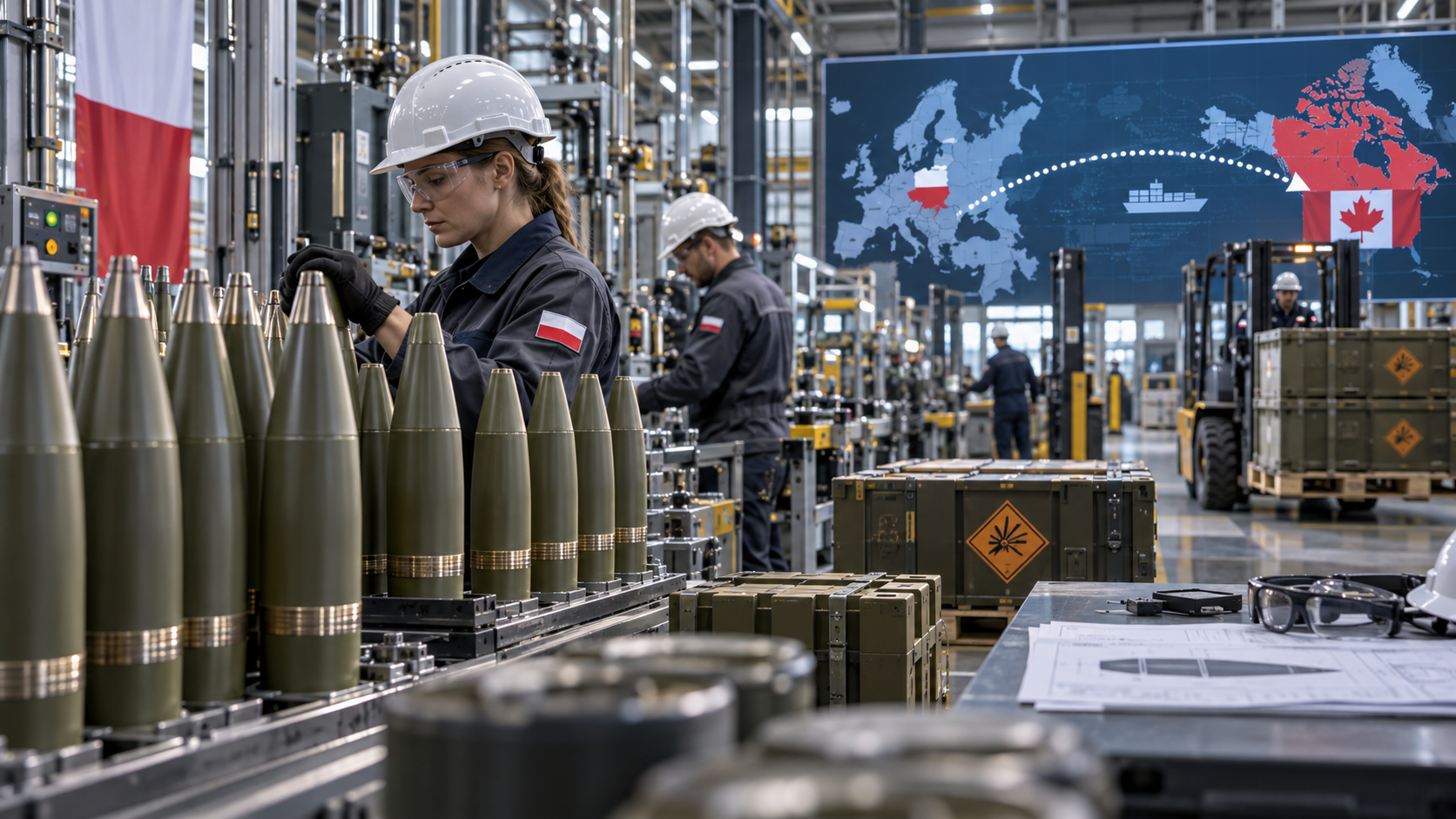
Poland’s state-owned defence industry is looking to expand one of its most strategically important capabilities beyond Europe, with PGZ in early talks over producing TNT and other explosives in Canada.
The significance lies not only in the proposed Canadian project, but in Poland’s starting position: PGZ subsidiary Nitro-Chem is already the largest producer of TNT in Europe and one of the largest in the world. The Bydgoszcz-based company is also a major exporter of explosives to NATO countries and a supplier to the US Army.
The Canadian talks therefore point to a broader shift in Poland’s defence industry. Rather than simply expanding domestic production to meet its own rearmament needs, PGZ is exploring whether Polish explosives expertise can be used to create production capacity inside allied countries.
- Find more news from Poland on our Homepage .
According to PGZ deputy chief executive Arkadiusz Bąk, discussions with Canada are still at an early stage and no final decision has been made on funding, location or ownership structure. TNT is the main product under discussion, but the talks also cover nitrocellulose and potentially RDX, also known as hexogen.
If approved, the project would take more than two years to develop, Bąk said.
Poland is already Europe’s TNT heavyweight
Nitro-Chem describes itself as Europe’s largest manufacturer of TNT and explosives, with customers across North America, Europe and other international markets. Its products are sold in countries including the United States, Canada, Germany, France, the United Kingdom, Norway, Sweden, Italy and Ukraine.
That position gives Poland an unusual role within NATO’s ammunition supply chain.
TNT is a basic filling explosive used in artillery shells, aerial bombs and other munitions. For years, production capacity across much of the West was reduced after the Cold War as defence budgets fell and environmental restrictions made explosives manufacturing more difficult.
Russia’s full-scale invasion of Ukraine reversed that trend.
Demand for artillery ammunition and other munitions has exposed limited Western production capacity, prompting governments to reopen or expand facilities for explosives, propellants and shell components.
Poland entered that race from a stronger position than many allies because Nitro-Chem had retained large-scale production capabilities.
Output in Poland set to double
The company is not relying on exports from its existing Bydgoszcz facilities alone.
PGZ plans to double TNT production in Poland to around 20,000 tonnes annually, according to Bąk, with a new production line expected within three to four years.
That expansion would reinforce Poland’s position as one of the most important suppliers of explosives to NATO ammunition producers.
At the same time, Nitro-Chem has been widening its domestic capabilities beyond TNT.
Earlier this month, it signed a strategic agreement with fellow PGZ company Mesko to establish Polish production capacity for HTPB, a key component used in solid rocket propellants. The company also agreed cooperation with the Łukasiewicz Institute of Industrial Organic Chemistry aimed at strengthening Polish independence in raw materials used for rocket fuels.
Those projects fit a broader Polish strategy of reducing reliance on imported defence inputs.
Canada could become first overseas production base
The Canadian discussions would take that strategy one step further.
Rather than exporting TNT from Poland, PGZ is considering production directly in Canada.
Bąk said the primary market would be Canadian demand, although output could potentially also be exported or supplied back to Poland.


That model reflects a wider trend across NATO, where governments increasingly want critical defence materials produced domestically or within trusted allied supply chains rather than imported from a small number of foreign plants.
Canada and Poland have already been deepening defence-industrial cooperation.
Nitro-Chem joined Canada’s Defence & Security Circle earlier this year following Polish government talks in Ottawa, with the company explicitly identifying explosives exports and industrial cooperation as areas for future development.
The Canadian TNT talks appear to be a concrete extension of that dialogue.
Britain is also part of Nitro-Chem’s expansion plans
Canada is not the only country where Poland’s explosives producer is looking beyond its own borders.
In July, Nitro-Chem signed a letter of intent with British defence company BAE Systems concerning the establishment of TNT production capacity in the United Kingdom.
That project, like the Canadian proposal, would shift Nitro-Chem’s role from being primarily an exporter to becoming a provider of production technology and industrial capacity inside allied countries.
Taken together, the British and Canadian initiatives suggest a more ambitious international strategy.
Poland would continue manufacturing explosives at home while also helping NATO partners rebuild manufacturing capabilities that had been allowed to shrink after the Cold War.
From supplier to strategic industrial partner
Nitro-Chem has long been an important exporter within the Polish defence sector.
The company says it is Poland’s leading arms-industry exporter of explosives and has more than 75 years of production experience. It supplies both military and civilian customers and carries out ammunition filling and processing alongside explosives manufacturing.
What is changing is the scale and strategic importance of that business.
The war in Ukraine has made explosives production a bottleneck in Western ammunition manufacturing.
Artillery shell factories can only expand if enough TNT, propellants, nitrocellulose and other energetic materials are available to fill the ammunition they produce.
That gives companies such as Nitro-Chem greater importance than their public profile might suggest.
A broader Polish defence-industry shift
Poland’s defence industry has expanded rapidly as Warsaw carries out one of Europe’s largest military modernisation programmes.
For much of that process, the focus has been on what Poland buys — tanks, aircraft, artillery and missile systems.
Nitro-Chem’s expansion illustrates the other side of that transformation.
Poland is increasingly trying to become not only a major defence customer, but also a producer of components and materials that other NATO countries need.
The proposed Canadian TNT facility remains at the discussion stage and could still change substantially before any investment decision is made.
But the direction is clear.
A Polish company that already occupies a leading position in European explosives production is looking to export not just TNT, but the ability to manufacture it.