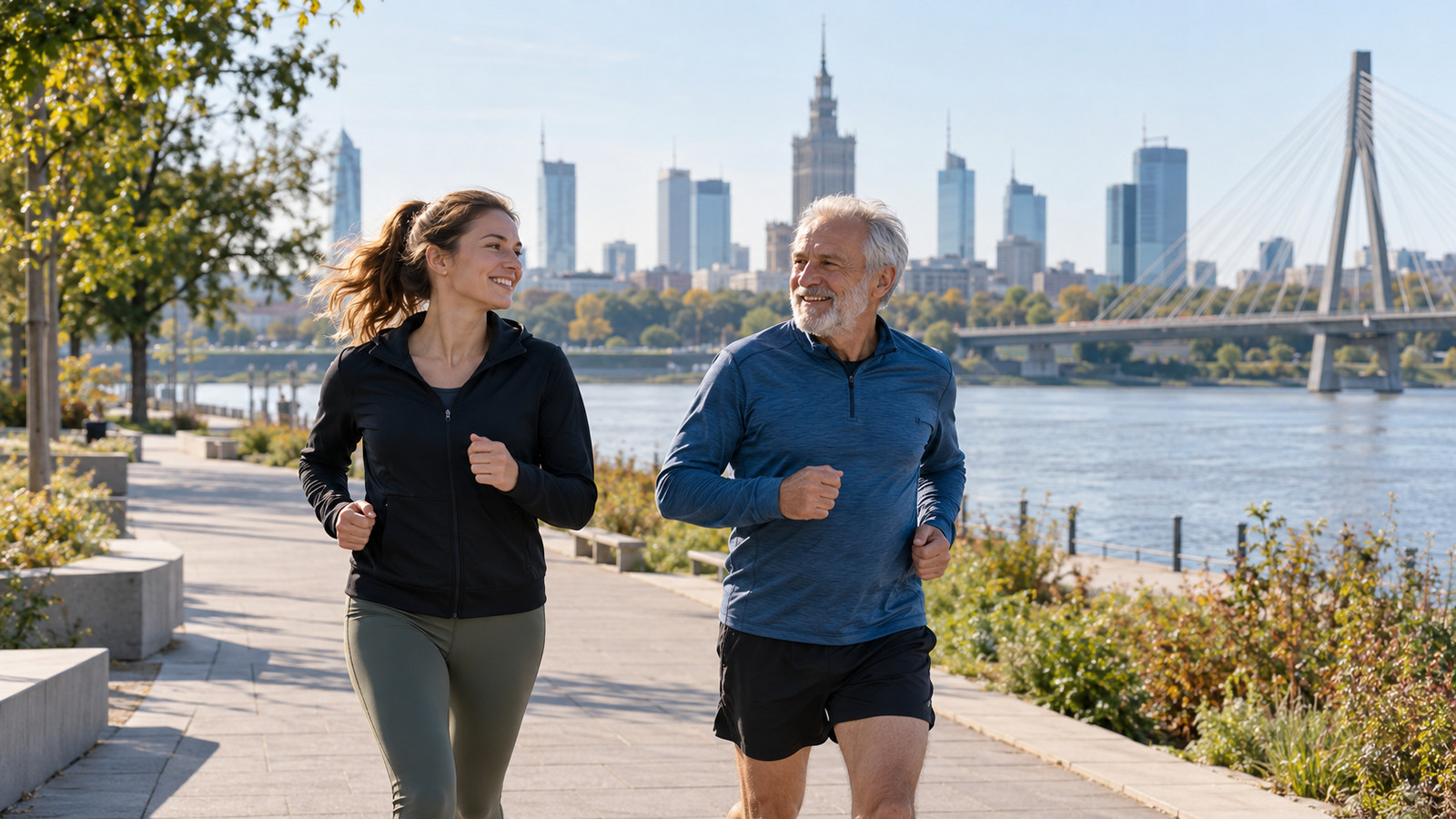
Poles are more likely than the average European Union resident to engage in physical activity outside work, according to new figures analysed by the Polish Economic Institute. In 2025, 18.2% of Polish adults reported no such activity, compared with an EU average of 26.4%. The findings suggest Poland performs relatively well in everyday physical activity, although other national research paints a more cautious picture of how often people exercise.
The figures were published by the Polish Economic Institute (PIE), a Warsaw-based public economic think tank, in its latest Economic Weekly, released on 22 October in Polish and 23 October in English.
The analysis uses data from Eurostat, the EU’s statistical office, covering physical activity outside working time.
- Find more news from Poland on our Homepage .
According to the institute’s original English-language analysis, Poland’s proportion of physically inactive adults was 8.2 percentage points below the EU average.
Only six EU countries recorded lower proportions of adults reporting no physical activity.
The findings also suggest an improvement since 2022, when Poland’s corresponding inactivity rate was more than six percentage points higher.
However, the institute cautioned that physical activity varies considerably between age groups, income levels and exercise frequency.
Young Poles among the most active
The strongest results were recorded among younger Polish adults.
Just 4.5% of Poles aged 16–24 reported no physical activity outside work, almost 11 percentage points below the EU average for the same age group.
The share of inactive young Poles was less than half its 2022 level.
PIE’s analysis also found that Poland’s inactivity rate was below the EU average in every age group examined.
That suggests Poland’s relative advantage was not limited to young people, although the differences were particularly pronounced among those under 25.
Northern European countries recorded some of the strongest results overall.
Denmark had the lowest reported inactivity rate, at just 2.8%, while Sweden and Finland were also among the better-performing EU countries.
The findings indicate that Poland compares favourably with much of the bloc, but remains some distance behind the leading Nordic countries.
More Poles report daily physical activity
The institute also examined how frequently adults engage in activity outside their jobs.
In Poland, 16.4% of adults reported physical activity every day during a typical week, compared with an EU average of 14.5%.
This places Poland modestly above the European average for daily activity.
However, Poland was slightly below the EU average among people engaging in physical activity several times a week without doing so daily.
That distinction matters because the headline inactivity rate does not reveal how much exercise people undertake.


The Eurostat dataset used by the researchers records the frequency of physical activity outside working time.
The underlying health survey distinguishes between people who are active daily, several times a week, less than once weekly or not at all.
Consequently, being counted outside the completely inactive category does not necessarily mean someone exercises regularly or achieves recommended activity levels.
Income makes a substantial difference
One of the clearest patterns identified by PIE concerns household income.
Among Polish adults aged 16 and over in the highest income quintile, 10.4% reported no physical activity outside work.
Among those in the lowest income quintile, the proportion was 24.9%.
That represents a difference of 14.5 percentage points between the highest- and lowest-income groups.
PIE found that inactivity generally declined as income increased.
The gap was nevertheless smaller than the corresponding EU-wide difference, which approached 20 percentage points.
The institute did not establish that income alone caused these differences.
Physical activity may also be influenced by working conditions, available leisure time, access to recreation facilities, age and other circumstances.
Interestingly, PIE reported that income differences were minimal among people who were active every day, both in Poland and across the EU.
The findings suggest that economic circumstances are associated with whether people participate in physical activity at all, but are less clearly connected with daily participation among those who maintain that habit.
Why another Polish study found much lower activity
The new figures appear encouraging, but they need to be understood alongside separate research from Statistics Poland.
In May 2026, the national statistics office, GUS, published findings showing that 43.7% of Polish residents participated in sport or physical recreation between October 2024 and September 2025.
The official Statistics Poland report found that 46.1% of men and 41.5% of women participated.
Cycling was the most frequently reported sporting or recreational activity.
At first glance, those findings seem difficult to reconcile with the Eurostat analysis showing relatively few completely inactive Polish adults.
However, the two surveys measure different things.
The Eurostat figures concern the frequency of physical activity outside work during a typical week. The GUS study examined participation in sport and defined recreational activities across a 12-month reference period.
The surveys also differ in population coverage, question wording and methodology.
Someone who engages in certain forms of everyday movement may therefore be counted as physically active under one definition without necessarily participating in the sports or recreational activities captured by the other.
The results should not be directly compared as though they were competing estimates of the same behaviour.
Most Poles still do not meet certain exercise recommendations
There is another important distinction between undertaking physical activity and doing enough of it to obtain the full health benefits of regular exercise.
In its July 2026 analysis of physical inactivity, the Polish Economic Institute cited Ministry of Sport and Tourism data indicating that only about 21% of people aged over 15 met World Health Organization activity recommendations through leisure-time exercise when walking was excluded.
The commonly cited WHO recommendations for adults include at least 150 minutes of moderate-intensity aerobic activity or 75 minutes of vigorous activity each week.
Because the ministry’s measure excluded walking and focused on leisure-time activity, it should not be treated as a complete assessment of all physical activity undertaken by Polish adults.
Nevertheless, it illustrates why the latest favourable European comparison does not automatically mean that Poland has solved the problem of insufficient exercise.
PIE also cited World Health Organization estimates from 2022 showing that around 37% of Polish adults had insufficient physical activity under a separate health-based measure.
Those WHO figures refer to a different year, population measure and methodology, and cannot be substituted for the latest Eurostat results.
Why physical activity matters to Poland’s economy
The Polish Economic Institute stressed that physical activity is not only a public-health concern.
Regular movement can help prevent illnesses associated with inactivity and support people’s ability to remain economically active.
The implications become more significant as Poland’s population ages.
According to research cited by PIE, physical inactivity worldwide could generate approximately $300 billion in additional costs between 2020 and 2030.
The institute argues that Poland should develop more accessible opportunities for physical activity, particularly among older people and those who currently exercise infrequently.
It highlighted local initiatives and public programmes that make physical activity easier to incorporate into everyday life.
Such measures could include accessible recreation spaces, cycling infrastructure, community exercise opportunities and activities suited to people with different levels of fitness.
The institute also cautioned that many Poles may overestimate their physical condition.
Earlier research found that a majority assessed their own fitness positively, despite relatively low participation in organised sport or regular exercise.
An encouraging comparison, with room for improvement
The latest Eurostat analysis places Poland in a relatively favourable position compared with much of the European Union.
A smaller proportion of Polish adults report complete inactivity outside work, daily activity is slightly more common than the EU average, and young Poles perform particularly well.
But the national data also show that participating in regular sport and achieving recommended exercise levels remain challenges.
The findings therefore tell two different but compatible stories.
Poland appears to perform better than the EU average on certain measures of physical activity, while still having considerable scope to improve the amount and regularity of exercise across its population.
For policymakers, the challenge is to build on the encouraging European comparison while making regular physical activity accessible to more people, regardless of their age or income.