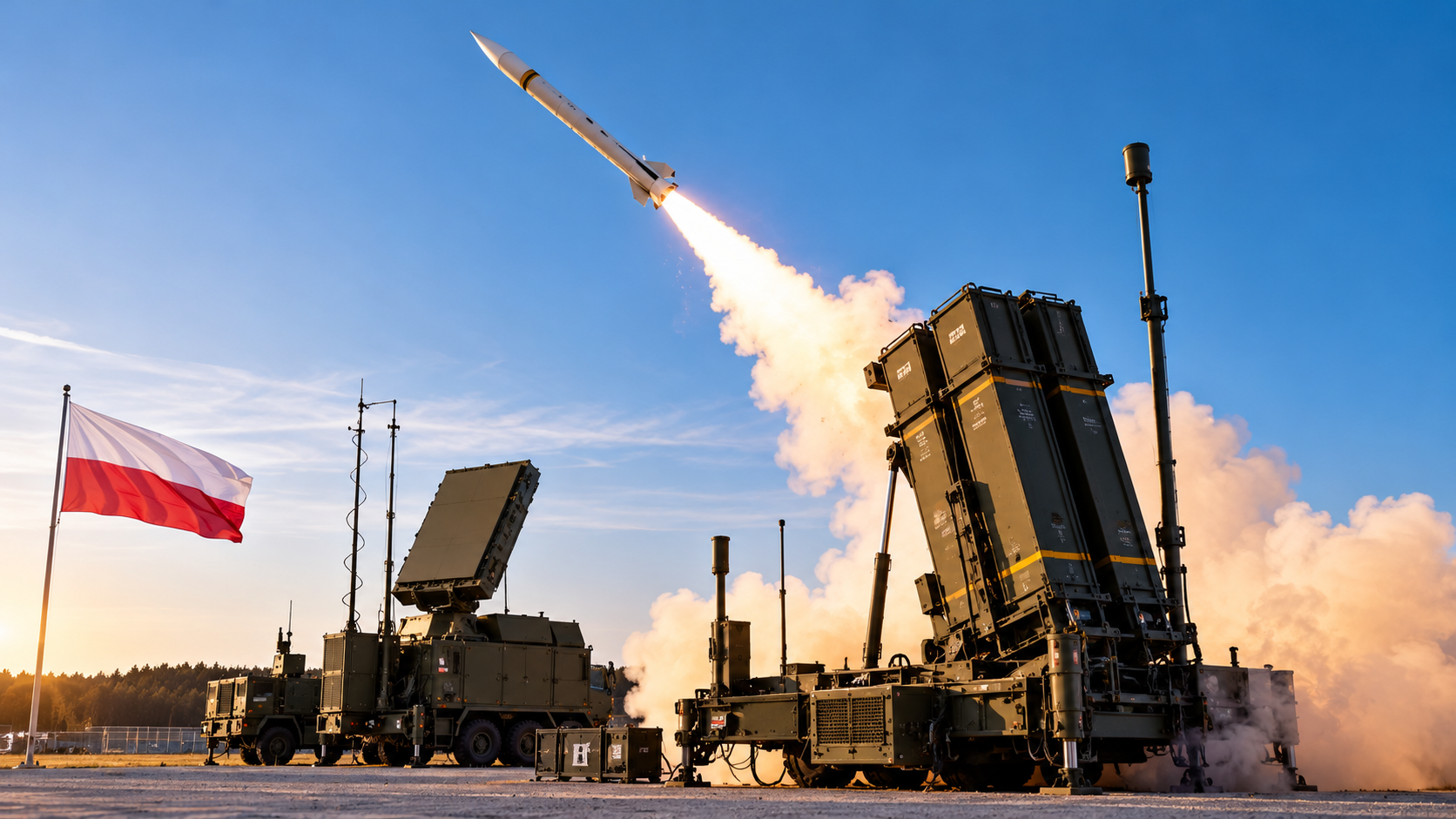
Poland is developing the industrial expertise to manufacture advanced air-defence missiles domestically through a major technology-transfer partnership with European defence manufacturer MBDA, according to a senior company executive. The cooperation, involving 11 Polish defence companies, is intended to give Poland greater control over the production and maintenance of weapons central to its expanding air-defence network.
Jim Price, MBDA’s group managing director for Poland, described the cooperation as an “unprecedented transfer of technology” in an interview with TVP World published on 15 October 2026.
Speaking at the Warsaw Security Forum, Price said the Narew programme was providing Polish industry with the expertise required for licensed domestic manufacturing of missiles and launchers, rather than leaving the country wholly dependent on imported finished equipment.
- Find more news from Poland on our Homepage .
The programme is being implemented with Polska Grupa Zbrojeniowa (PGZ), Poland’s state-owned defence group, and companies participating in the PGZ-Narew consortium.
The latest statements represent an update on the implementation of a technology-transfer agreement signed in November 2023, not the announcement of a new contract.
They come as Poland expands its domestic missile-manufacturing infrastructure and works with MBDA on additional weapons intended to counter drones and other aerial threats.
Poland to manufacture more than 1,000 air-defence missiles
The Narew programme is one of Poland’s largest military modernisation projects, intended to provide a mobile air-defence system capable of intercepting aircraft, helicopters, cruise missiles and other aerial threats.
Its principal weapon will be the CAMM-ER, an extended-range surface-to-air missile developed through cooperation between Britain and Italy.
According to MBDA’s original November 2023 agreement with PGZ, the technology-transfer arrangements are intended to enable Polish companies to manufacture more than 1,000 CAMM-ER missiles and over 100 launchers domestically.
The industrial agreement was valued at more than £4 billion, covering MBDA’s role in supporting PGZ’s delivery of the Narew programme.
The CAMM-ER missile is designed to engage targets at distances exceeding 40 kilometres, providing an important layer of protection between shorter-range weapons and higher-tier air-defence systems.
Poland’s objective is to establish the ability not only to assemble equipment locally but also to manufacture key components, maintain the missiles throughout their operational lives and develop domestic engineering expertise.
This would allow a greater proportion of the country’s air-defence requirements to be met by its own defence industry.
However, the planned production of more than 1,000 missiles should not be confused with missiles already manufactured in Poland. The programme involves a phased transfer of technology, construction of industrial facilities and the development of manufacturing capabilities.
The complete timetable for achieving full domestic production capacity has not been publicly established.
Polish factories preparing to manufacture missile components
Several Polish defence companies have already begun preparing the infrastructure needed to manufacture CAMM-ER components.
In April 2026, state-owned missile manufacturer MESKO signed an investment agreement with PGZ to establish production capabilities at its facilities in Skarżysko-Kamienna, south of Warsaw.
The investment covers rocket motors and fragmentation warheads, two important components of the CAMM-ER missile.
The Polish Ministry of Defence confirmed that the project would involve transferring rocket-motor production technology and developing domestic manufacturing capabilities for the warhead.
Deputy Defence Minister Paweł Bejda described the investment as an important step towards establishing missile-production expertise within Poland.


The total value of MESKO’s investment project is PLN 360.3 million, including PLN 304.4 million in support from the state’s Capital Investment Fund.
On 2 October, MESKO announced agreements for the first implementation phase of its Narew industrial project, involving construction contractors FB Antczak and EBS BUD.
The company’s investment schedule covers 2025 to 2030.
Another PGZ company, Wojskowe Zakłady Elektroniczne (WZE), is developing infrastructure for missile production, assembly and maintenance.
The Ministry of State Assets’ investment announcement identifies a separate WZE project worth approximately PLN 129.4 million, with completion planned for 2028.
Together, these investments show how the technology-transfer agreement is being translated into industrial projects across Poland.
They do not, however, establish that full-scale licensed CAMM-ER missile production has already begun.
MBDA opens its first industrial facility in Poland
The cooperation has also resulted in MBDA establishing its first dedicated industrial facility in Poland.
On 7 September, the company opened a service and technology centre in Czosnów, near Warsaw, extending its existing Polish operations.
According to MBDA’s announcement of the facility, the centre will support maintenance, technical services and training associated with Poland’s air-defence systems, particularly the Pilica+ programme.
It is also intended to provide a base for further engineering cooperation between MBDA, Polish defence companies and research institutions.
The company expects the site to create opportunities for Polish engineers and other specialists working on advanced missile technology.
The Czosnów facility is not described as the main production plant for Narew’s CAMM-ER missiles. Its present role is primarily technical support, maintenance and industrial cooperation.
The investment nevertheless represents a further step in establishing a permanent MBDA industrial presence in Poland rather than relying solely on support provided from facilities elsewhere in Europe.
Poland and MBDA developing a new low-cost anti-drone missile
Beyond Narew, MBDA is also working with Poland’s Military Institute of Armament Technology (WITU) on a separate missile project intended to counter drones at lower cost.
Known as the Counter Mass Interceptor (CMI), the proposed weapon is being developed to respond to large numbers of unmanned aircraft and other aerial threats.
The programme reflects a challenge highlighted by Russia’s war against Ukraine: defending against inexpensive drones using interceptor missiles that may cost substantially more than their targets.
CMI is intended to provide a comparatively affordable weapon that can be manufactured in large quantities.
In a joint announcement published in September, MBDA and WITU described the proposed weapon as a supersonic interceptor designed for engagements at ranges and altitudes exceeding six kilometres.
The companies completed field trials of the missile’s seeker technology at a Polish test range in September 2026, evaluating its performance against different representative drone targets.
Those were tests of a component, not a successful firing of the complete missile.
The partners intend to integrate the seeker with a Polish-designed prototype before beginning an initial missile-firing campaign in 2027.
In his latest TVP World interview, Price also highlighted the potential for this cooperation to expand Poland’s expertise in developing new weapons rather than exclusively manufacturing existing foreign designs.
The CMI project is distinct from Narew’s licensed CAMM-ER production arrangements. Its development and testing remain underway, and no operational deployment date has been confirmed.
Building a layered defence system for Poland
Narew forms part of a wider effort to develop an integrated national air-defence network capable of responding to different types of threats.
Poland’s strategy combines several complementary systems.
At the higher tier, the Wisła programme uses the American Patriot system to protect against aircraft, cruise missiles and certain ballistic missile threats.
Narew will provide another layer of protection, using mobile launchers and CAMM-ER missiles to defend military units, infrastructure and strategically important locations.
Shorter-range protection is provided by systems such as Pilica+, which combines guns, missiles, radars and command systems.
Poland has already received CAMM missiles and equipment for the initial Mała Narew system, developed to meet an urgent operational requirement.
MBDA also confirmed its first deliveries of CAMM missiles and launchers for Pilica+ in September 2025.
Narew’s planned domestic production capabilities would strengthen this broader network by creating manufacturing and maintenance expertise within Poland.
For an international defence partner such as Britain, the arrangement also demonstrates a model in which a major weapons producer shares selected technology and manufacturing responsibilities with an allied country’s industry.
Price argued that such cooperation can strengthen national capabilities while maintaining the benefits of joint European defence development.
For Poland, the longer-term significance lies in whether the programme can deliver the promised industrial expertise and manufacturing capacity.
Domestic production could make it easier to maintain stocks, service equipment and support future improvements to the country’s air-defence systems.
It would not automatically eliminate every dependence on foreign suppliers, technology rights or specialist components.
The next milestones will include further development of the CAMM-ER production facilities, continued transfer of manufacturing expertise and the planned 2027 test-firing campaign for the separate CMI interceptor.
Together, these projects demonstrate Poland’s ambition to move beyond purchasing advanced missile systems towards acquiring a greater role in producing and developing them.