

Poland and Lithuania are seeking greater European Union support to protect a strategic electricity connection between the two countries as planners incorporate military and sabotage threats into infrastructure once designed primarily to withstand accidents and natural hazards.
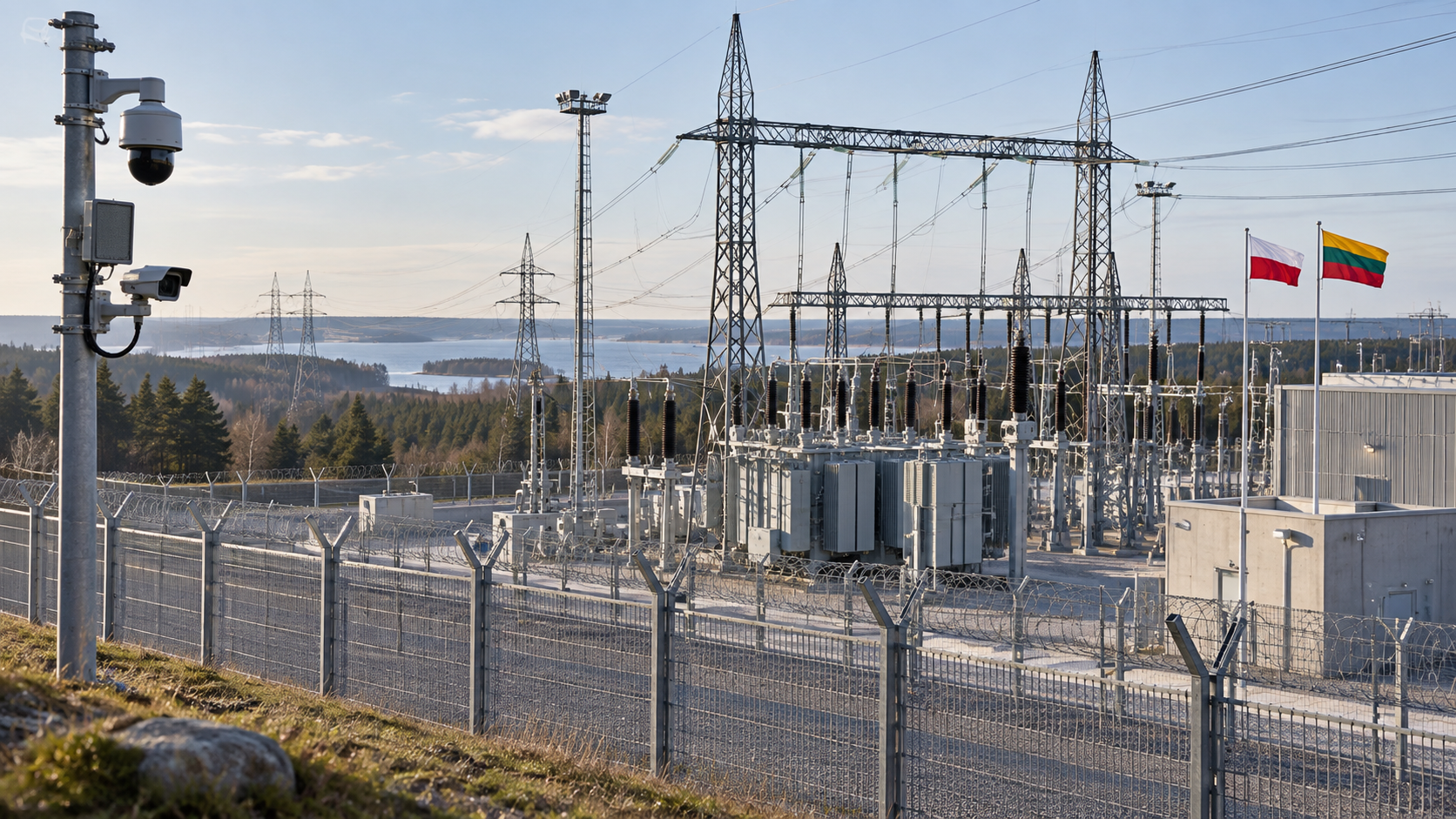
Lithuania’s transmission-system operator Litgrid is preparing a heavily protected transformer substation at Gižai, around 30 kilometres from Russia’s Kaliningrad exclave, that will form a central part of the planned Harmony Link electricity interconnection with Poland.
Litgrid chief executive Andrius Šemeškevičius told Reuters that protection planned for the site includes reinforced perimeter fencing, underground sensors intended to detect tunnelling, duplicated critical equipment and reinforced-concrete structures around transformers designed to limit damage from drone attacks.
- Find more news from Poland on our Homepage .
The additional precautions reflect a significant change in the assumptions behind electricity-grid construction in the region.
Šemeškevičius said Litgrid had previously designed infrastructure principally around natural disasters but was now considering both hybrid and conventional security threats. Lithuania’s military is advising the operator on protection of critical energy infrastructure, Reuters reported.
The security measures are also raising costs.
According to Litgrid figures cited by Reuters, the hardened Gižai installation is expected to cost at least €48 million more than previously planned. Lithuanian Energy Minister Lukas Savickas said his government intends to seek EU financing covering at least half of the substation’s costs.
Poland is making a similar argument at EU level.
Deputy Energy Minister Wojciech Wrochna, whose responsibilities include strategic energy infrastructure, told Reuters that Harmony Link should not become disproportionately expensive because Poland and Lithuania have to pay additional costs associated with their location on the EU and NATO eastern flank.
Wrochna called for greater European financing of infrastructure-security measures, arguing that the issue extends beyond Harmony Link to protection of the electricity system more broadly.
The dispute comes after Poland and the three Baltic states sought significantly more money than they ultimately received from the EU for protecting infrastructure associated with the Baltic electricity system.
Reuters reports that Poland, Lithuania, Latvia and Estonia jointly sought €382 million for protection of key parts of the existing grid.
The European Commission subsequently approved €112.58 million through the Connecting Europe Facility for the four-country Baltic Cooperation in Critical Synchronisation Infrastructure Protection project. The funding is intended for physical protection, cybersecurity and resilience against other threats.
Poland was allocated €21.5 million of that package.
Polish grid operator PSE said in February that its programme would include comprehensive threat-detection systems and stronger protection at strategic electricity substations. PSE also said the four transmission operators — PSE, Lithuania’s Litgrid, Latvia’s AST and Estonia’s Elering — had jointly developed measures responding to physical and cyber threats.
PSE has since expanded its cooperation with Poland’s Territorial Defence Forces on protecting electricity infrastructure. In July, the two organisations announced an agreement covering stronger physical protection of critical grid assets, with PSE saying it is developing layered security systems involving detection, prevention and threat neutralisation.
The security debate is especially significant because Harmony Link is intended to reinforce one of the most strategically sensitive parts of Europe’s electricity network.
Lithuania, Latvia and Estonia disconnected from the Russian-controlled IPS/UPS electricity system in February 2025 and synchronised with continental Europe through Poland. Their synchronous connection with the continental European grid currently relies on the existing LitPol Link connection between Poland and Lithuania.
The European Commission has described Harmony Link as the key remaining infrastructure investment in the Baltic synchronisation programme, noting that the additional interconnector would reduce reliance on a single electricity connection between the Baltic states and continental Europe.
The current Harmony Link design is a 700 MW, 220 kV alternating-current onshore interconnector jointly developed by PSE and Litgrid.


On the Polish side, the project includes approximately 100 kilometres of underground 220 kV cable between the Ełk Bis substation and the Lithuanian border, two new substations at Norki and Wigry, expansion of Ełk Bis and modernisation of the existing Ostrołęka-Ełk transmission line.
PSE’s latest timetable envisages construction beginning on the Norki and Wigry substations and the cross-border cable route in 2027, further work on the Ostrołęka-Ełk line from 2029 and energisation of the cross-border line in 2030.
On the Lithuanian side, Litgrid launched procurement for the Gižai substation in August. It is planned as the largest transformer substation in Lithuania, occupying about 35 hectares and converting the 220 kV electricity arriving from Poland into voltage levels used by Lithuania’s domestic network.
Litgrid says the wider Harmony Link project remains scheduled for completion by the end of 2030. When combined with the existing LitPol Link, the company expects electricity-transmission capacity between Lithuania and Poland to reach as much as 1,200 MW.
The project’s route through north-eastern Poland and south-western Lithuania also places it close to the narrow territory between Kaliningrad and Belarus commonly known as the Suwałki Gap — an area long regarded as strategically important for NATO’s connection with the Baltic states.
The new security requirements do not mean authorities have confirmed that Harmony Link itself faces an imminent attack. They instead show how the threat assumptions governing critical infrastructure have changed following Russia’s full-scale invasion of Ukraine, attacks on Ukrainian energy facilities and heightened concern across Europe over sabotage and hybrid operations.
For Poland and Lithuania, that change has created a financing question as well as an engineering one: whether the extra cost of protecting strategically important eastern-flank infrastructure should fall mainly on national grid operators and their customers, or be treated increasingly as a shared European security expense.