

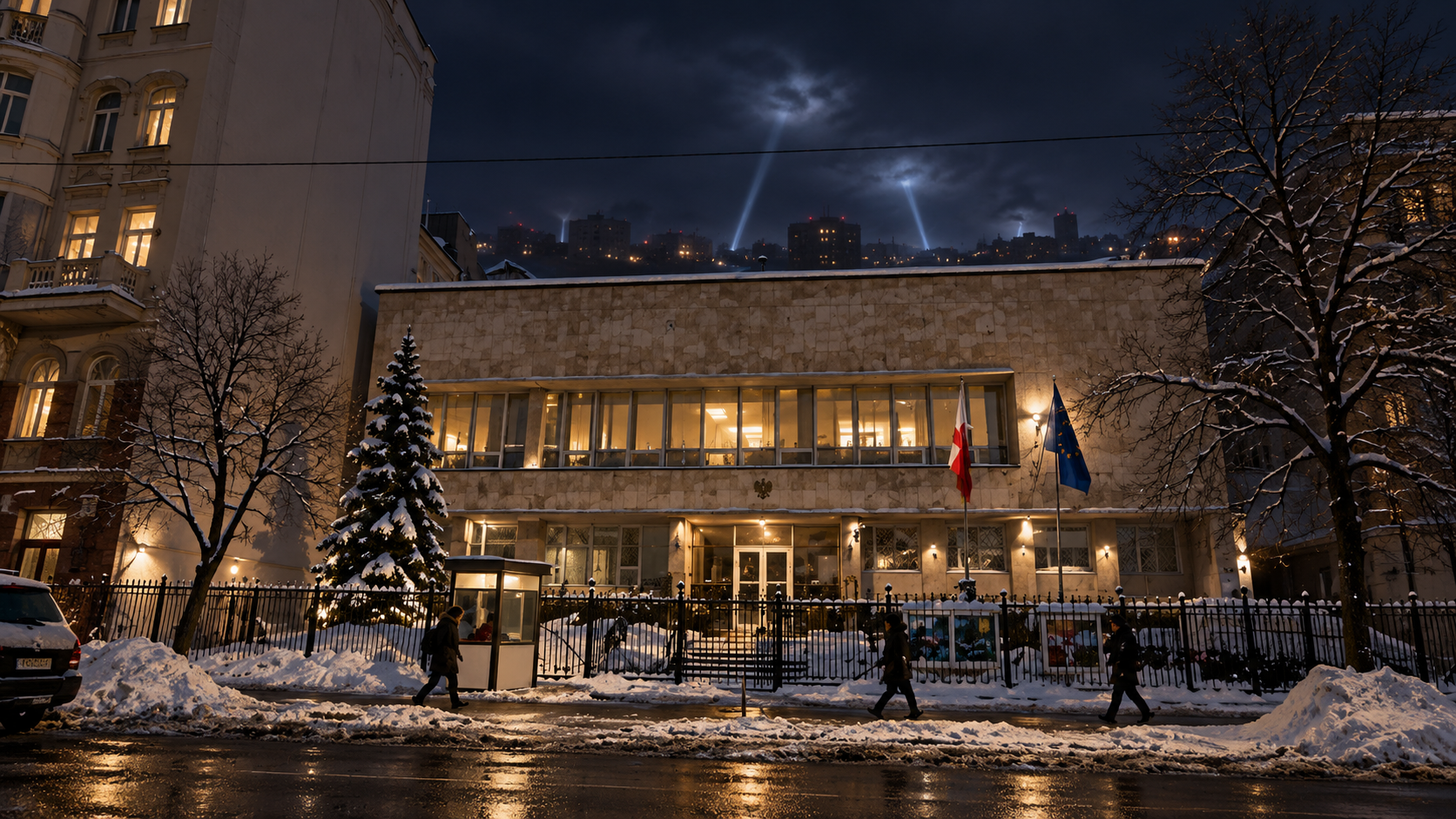
Poland says it will keep its embassy in Kyiv operating despite a renewed Russian warning urging foreign diplomats and other foreigners to leave Ukraine as Moscow intensifies its attacks on the capital. Warsaw has characterised the message as a threat intended to intimidate European governments, while Russia says those who ignore its warning will bear responsibility for any consequences.
The Russian Foreign Ministry issued the latest warning on 3 October, saying Russian forces would continue what Moscow described as large-scale “retaliatory” strikes against military targets in Kyiv and other Ukrainian cities.
It advised foreign citizens, including diplomatic personnel, against remaining in Ukraine or travelling there, and said responsibility for any adverse consequences would rest with those who disregarded the warning. Reuters reported that Moscow presented the strikes as retaliation for Ukrainian attacks on Russian civilians and infrastructure.
- Find more news from Poland on our Homepage .
Poland has rejected the pressure.
In an official statement issued on 4 October, the Foreign Ministry said Russia’s calls for diplomats to leave Kyiv showed that the Kremlin was trying to “bully Europe” and undermine support for Ukraine.
The ministry said there would be no change to the operation of the Polish Embassy in Kyiv.
‘We are staying in Kyiv’
Piotr Łukasiewicz, Poland’s chargé d’affaires ad interim in Ukraine, reinforced that position publicly.
Łukasiewicz said heads of diplomatic missions in Kyiv had noted the Russian Foreign Ministry’s message with concern and referred to Russia’s obligations under international law.
His response was succinct: “We are staying in Kyiv.”
Poland’s official diplomatic website confirms that Łukasiewicz currently heads the mission in Ukraine as chargé d’affaires ad interim.
🇵🇱 Poland says its embassy will remain in Kyiv after Russia warned foreign diplomats and citizens to leave the Ukrainian capital. “We are staying in Kyiv,” said Poland’s ambassador Piotr Łukasiewicz, stressing that Russia remains bound by the Vienna Convention and international humanitarian law.
— Poland 24 🇵🇱 (@poland24com) October 5, 2026
Warsaw’s Foreign Ministry went further, arguing that Moscow’s approach would not alter Poland’s support for Ukraine.
The ministry said Poland would continue backing Ukraine’s sovereignty and territorial integrity and would work with allies to increase pressure on the Kremlin.
EU embassies also staying
Poland is not acting alone.
The European Union’s ambassador to Ukraine, Katarína Mathernová, said all EU member-state embassies operating in Kyiv would remain there.
According to the EU delegation in Ukraine, 25 EU countries currently maintain embassies in the Ukrainian capital and none is planning to leave because of the Russian warning.
Mathernová said Russia appeared to be trying to frighten foreign governments into reducing their support for Ukraine and warned Moscow against testing the limits of protections afforded to diplomatic missions.
The EU delegation and the EU Advisory Mission are also remaining in Kyiv.
Russia calls it a warning; Poland calls it a threat
The distinction in language is important.
Russia has framed its statement as a safety warning accompanying continued strikes that it says are directed against military targets.
Poland and EU representatives, however, have publicly described the message as a threat against diplomats and foreign citizens, particularly because Moscow coupled its demand to leave with an announcement that further large-scale attacks would continue and said those who stayed would assume responsibility for the consequences.

Poland-24 therefore would not describe Russia as having explicitly announced that it intends to attack the Polish Embassy or another diplomatic mission. No such specific attack has been announced in the material reviewed.
Rather, Moscow has warned diplomats to leave Ukraine while promising continued major strikes, and Poland interprets that warning as an attempt at intimidation.
Kyiv under intensified attack
The diplomatic dispute comes as Russia has sharply intensified attacks on Kyiv’s infrastructure.
Russian forces have struck bridges across the Dnipro and other targets in and around the capital in recent days, causing major disruption to transport and daily life.
On 4 October, Russia said it had hit Kyiv’s Northern Bridge, claiming that the crossing was being used to move troops and military cargo. Reuters noted that Moscow’s claims about individual targets could not be independently verified.
Ukraine says Russian strikes are increasingly hitting civilian and critical infrastructure as winter approaches.
Russia denies deliberately targeting civilians and says its attacks are directed at military or military-related infrastructure.
Reports of contingency plans disputed
The Russian warning came shortly after The Guardian reported that some Western diplomatic missions were quietly considering contingency plans to relocate from Kyiv if security deteriorated further, potentially to western Ukraine or Poland.
Ukraine’s Foreign Ministry pushed back against suggestions that embassies were preparing to leave.
Spokesman Heorhii Tykhyi said the ministry had received no requests or notifications from foreign diplomatic missions about relocation plans.
That does not necessarily exclude internal contingency planning — normal practice for diplomatic missions operating in a war zone — but there is currently no evidence of a broader European withdrawal from Kyiv.
The EU’s subsequent statement that all of its member-state embassies are staying reinforces that position.
Moscow made a similar warning in May
This is also not the first time Russia has warned foreign diplomats to leave the Ukrainian capital.
Moscow issued a similar message in May, also warning foreign nationals and diplomatic staff about remaining in Kyiv.
The latest Russian Foreign Ministry statement explicitly referred back to those earlier warnings.
Western embassies remained in the city then as well.
The repeated warnings illustrate a wider tension surrounding foreign diplomatic presence in wartime Kyiv.
European governments view keeping their embassies open as both a practical necessity and a visible demonstration of continued diplomatic support for Ukraine.
Russia, meanwhile, says continuing military operations make foreign personnel responsible for the risks of remaining in the country.
For Poland — one of Ukraine’s closest neighbouring states and a major political and military supporter since Russia’s full-scale invasion began in 2022 — the response is currently unambiguous.
Its diplomats are staying in Kyiv.