

Poland is accelerating the expansion of its civilian warning and shelter network in the country’s east, as authorities invest in sirens, emergency training and thousands of locations intended to provide protection during crises.
In Lubelskie, which borders Ukraine and Belarus, the number of sirens that can be activated remotely has risen from around 30 at the beginning of 2024 to almost 350, according to the Ministry of the Interior and Administration. The ministry says more than 1,000 are due to be operating in the region by the end of 2026.
The expansion was highlighted on 19 September during civil-defence exercises held at more than 500 State Fire Service and volunteer fire brigade stations across Lubelskie and neighbouring Podkarpackie. The exercises were designed to teach residents how to respond to alarm signals and official warning messages.
- Find more news from Poland on our Homepage .
Authorities have also changed how alarms are activated in Lubelskie. Responsibility for triggering warning signals has been transferred to the provincial crisis-management centre, while the State Fire Service maintains round-the-clock monitoring. The interior ministry says alarms can now be activated across each county within 60 seconds.
At the same time, authorities have identified about 3,500 locations in Lubelskie as places where people could seek protection.
That number should not be read as 3,500 fully equipped bunkers. The ministry says the regional total includes 25 fully ready shelters and 124 hideouts verified by the State Fire Service and building-control authorities, with the remainder falling within the broader system of shelter locations.
Polish law distinguishes between several levels of civilian protection.
A shelter is a purpose-recognised protective structure with a closed, hermetic construction and filtration equipment. A hideout is a recognised protective structure with a non-hermetic design. Temporary collective-protection sites are buildings or spaces that can be adapted to provide temporary protection, while a newer category known as a shelter point is intended to provide more basic temporary cover against dangers such as extreme weather or the effects of conventional weapons, particularly fragments.
The shelter-point category was formally introduced in amendments to Poland’s civil-protection legislation that took effect in May 2026. Under those rules, local State Fire Service commanders identify suitable locations, including underground garages, tunnels and other structures capable of providing basic protection. Owners or managers must, where possible, make an identified shelter point available when an official alarm is declared.
The national scale of the programme is considerably larger. The interior ministry says approximately 85,000 shelter-point locations across Poland are to receive standardised signs by the end of 2026, funded through the government’s Civil Protection and Civil Defence Programme. Locations are also being entered into the national register and the official Gdzie się ukryć — “Where to hide” — system, which allows residents to locate nearby protection points.
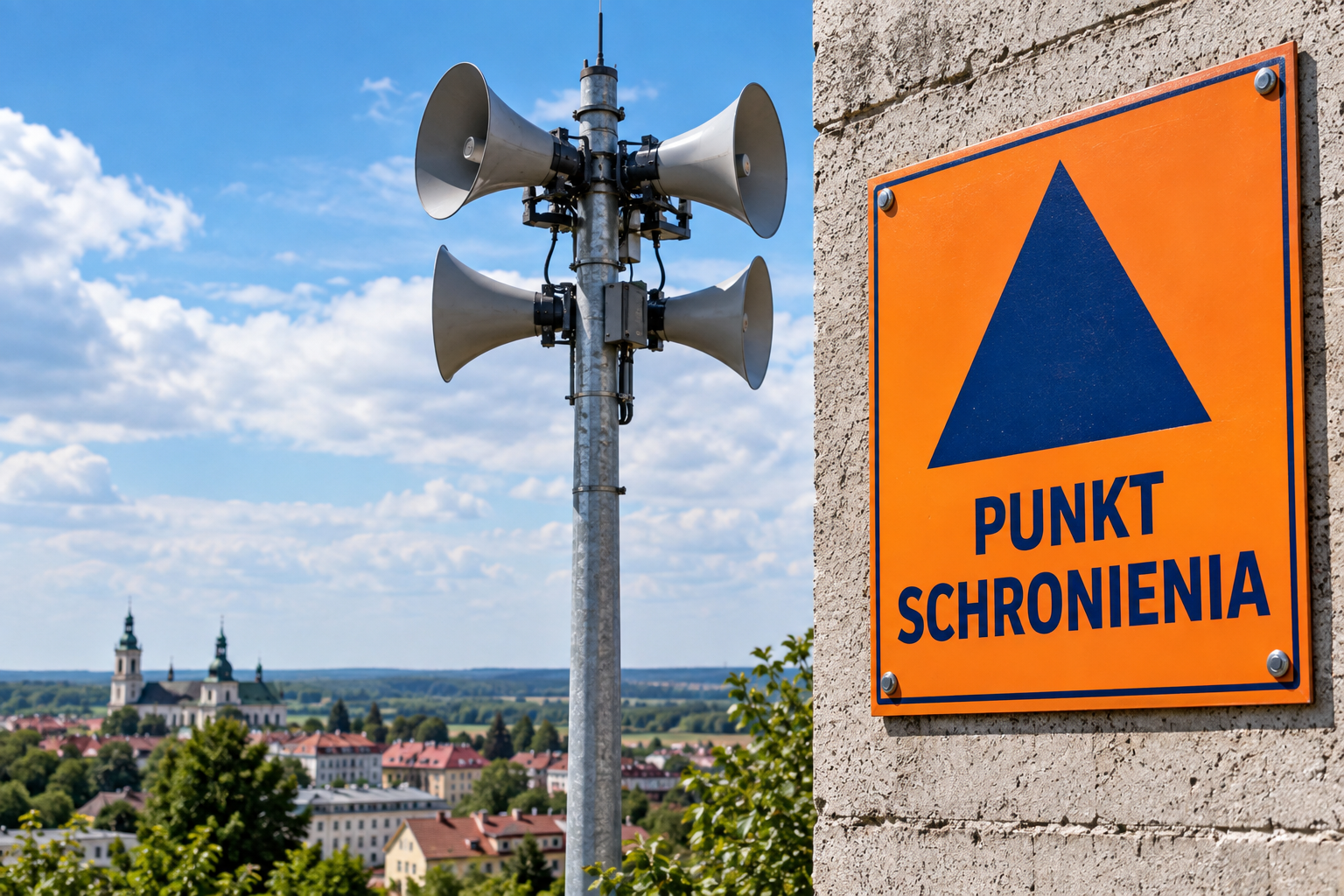
The ministry published proposed signage in September using the international civil-defence emblem — a blue triangle on an orange background — together with the words “PUNKT SCHRONIENIA”, or “SHELTER POINT”. It said property owners are required to display the marking, although at the time of that announcement the ministry was still preparing an amendment to fire-safety regulations that would formally add the standard design.
That means the obligation to make an identified point available during an alarm is already contained in statute, while the detailed regulatory framework for the nationwide standardised signs was still being completed in September.
The expansion forms part of Poland’s broader reconstruction of a civil-defence system that received a new legal framework under the 2024 Civil Protection and Civil Defence Act and subsequent amendments.
The government allocated PLN 16.7 billion to its Civil Protection and Civil Defence Programme in 2025 and PLN 17.2 billion for 2026, covering shelter infrastructure, warning systems, emergency communications, equipment and training. Lubelskie received close to PLN 300 million for civil-protection measures in 2026, according to the interior ministry.
The programme is therefore about more than building conventional bunkers. Poland is simultaneously trying to increase the number of stronger protective structures, identify existing spaces that could provide at least basic cover, improve warning systems and train residents to react when alerts are issued.
In Lubelskie, the growth from dozens to hundreds of remotely activated sirens — with more than a thousand planned by year-end — provides one of the clearest measures yet of how quickly that system is being expanded along Poland’s eastern frontier.