The Polish Space Agency is monitoring a five-tonne Chinese rocket component expected to re-enter Earth’s atmosphere between 30 November and 1 December. Although the object’s orbital path passes over Poland and other parts of Europe, the agency’s latest central forecast places its re-entry over northern Asia. Officials have warned that some debris could survive the descent, but there is no confirmed prediction that fragments will fall in Poland.
The Polish Space Agency (POLSA) announced its latest assessment on Friday, 27 November, identifying the object as ZQ-2E R/B, a spent component of a Chinese rocket launched earlier this year.
The object has an estimated mass of approximately 5,000 kilograms and is being tracked by the agency’s Space Situational Awareness Operations Centre. POLSA has confirmed that relevant government institutions and services are receiving updates as specialists monitor its declining orbit.
- Find more news from Poland on our Homepage .
When is the Chinese rocket expected to re-enter Earth’s atmosphere?
According to POLSA’s latest forecast, the rocket component is expected to enter the atmosphere between 7:32am on 30 November and 11:10pm on 1 December 2026, both times in Polish local time.
The agency’s central estimate places atmospheric re-entry at approximately 3:21am Polish time on 1 December, corresponding to 2:21am UTC. However, the calculation carries an uncertainty of almost 20 hours in either direction.
The forecast currently places the nominal re-entry location over northern Asia, although POLSA emphasises that both the timing and location could change as new tracking information becomes available.
The latest prediction also differs from the agency’s earlier assessment published on 26 November, illustrating how estimates can shift as an orbiting object approaches the atmosphere.
Could the rocket debris fall in Poland?
The rocket stage is travelling along a near-polar orbit, inclined at approximately 88.93 degrees. This means its orbital path crosses a broad range of latitudes and passes over substantial parts of Europe, including Poland.
However, an orbital path passing over a country does not mean the object is expected to break apart or land there. POLSA has not announced a predicted debris impact in Poland.
The distinction is particularly important because large space objects can complete multiple orbits during a broad re-entry window. A relatively small change in the estimated time of atmospheric entry can therefore produce a substantial change in the predicted location.
The European Space Agency explains that variations in atmospheric density, solar activity and an object’s orientation can make the final stages of an uncontrolled re-entry difficult to predict. Even shortly before re-entry, considerable uncertainty may remain.
Consequently, the current forecast should be understood as a developing scientific assessment rather than a definitive prediction of where the rocket will return to Earth.
Could parts of the five-tonne rocket survive?
POLSA has specifically cautioned that the rocket stage might not burn up completely during atmospheric re-entry. The agency points to two factors: its estimated mass of five tonnes and incomplete information about its construction.
As a large object descends into the atmosphere, intense heating and mechanical forces can cause it to fragment. Much of the material may burn up, but some components — particularly those made from more heat-resistant materials — can survive and potentially reach the Earth’s surface.
The European Space Agency’s guidance on space debris confirms that large rocket bodies and other abandoned spacecraft can sometimes leave fragments following uncontrolled re-entry. However, ESA also notes that the risk to any individual person is extremely small compared with many everyday hazards.
The rocket’s estimated five-tonne mass represents the object before atmospheric entry. It does not mean that five tonnes of material will reach the ground.
How much, if anything, survives will depend on the component’s construction and the conditions during its descent. POLSA has not published an estimate of the amount of debris that might survive this particular event.
Rocket launched from China in May
The object being monitored is officially designated ZQ-2E R/B, with the international tracking identifiers NORAD 69095 and COSPAR 2026-105A. It was launched from China’s Jiuquan Satellite Launch Centre on 13 May 2026.
The designation identifies it as a rocket body rather than an operational satellite. Once a launch vehicle has delivered its payload, some components may remain in orbit. Over time, atmospheric drag can cause their orbits to decay until they return to Earth.
The current case follows another Chinese rocket-related incident monitored by Polish authorities last month. As Poland-24 reported in October, Polish sky-monitoring cameras recorded a different five-tonne ZQ-2E rocket stage passing above the country shortly before its expected atmospheric re-entry.


That object had been launched on 14 October and carried a different international tracking number. The rocket stage currently being monitored is a separate object, launched five months earlier.
Polish authorities continue monitoring
The Polish Space Agency’s Space Situational Awareness Operations Centre is responsible for monitoring objects in orbit and analysing potential hazards associated with space activity. Its work includes tracking orbital debris and assessing the possible consequences of objects returning to Earth’s atmosphere.
Such monitoring is also conducted internationally. The European Union’s Space Surveillance and Tracking programme provides assessments of uncontrolled re-entries, using information from tracking sensors and other sources to help authorities understand potential risks.
For the current Chinese rocket stage, POLSA says it is keeping government agencies and relevant services informed through established operational procedures. The agency has asked the public to follow its official communications as new information becomes available.
As of its 27 November notice, POLSA had not issued any specific public-safety instructions for residents of Poland. The coming days should bring more precise estimates of when the rocket will enter the atmosphere.
For now, the key point remains unchanged: Poland is monitoring the object’s trajectory, but there is no confirmed forecast that debris will fall on Polish territory.
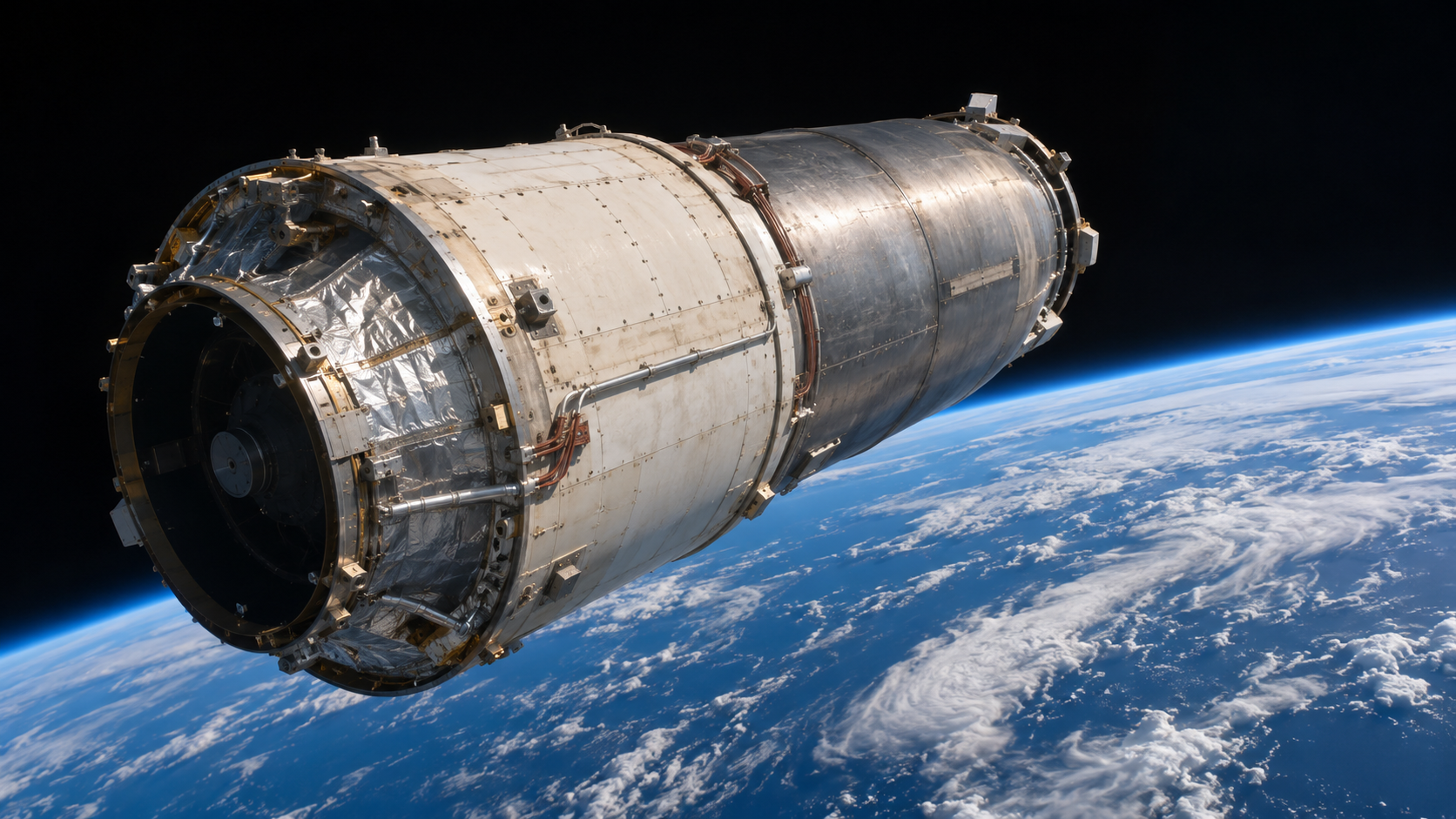
Featured image: AI-generated editorial illustration of a spent rocket stage above Earth. It does not depict the actual ZQ-2E component being monitored by POLSA.