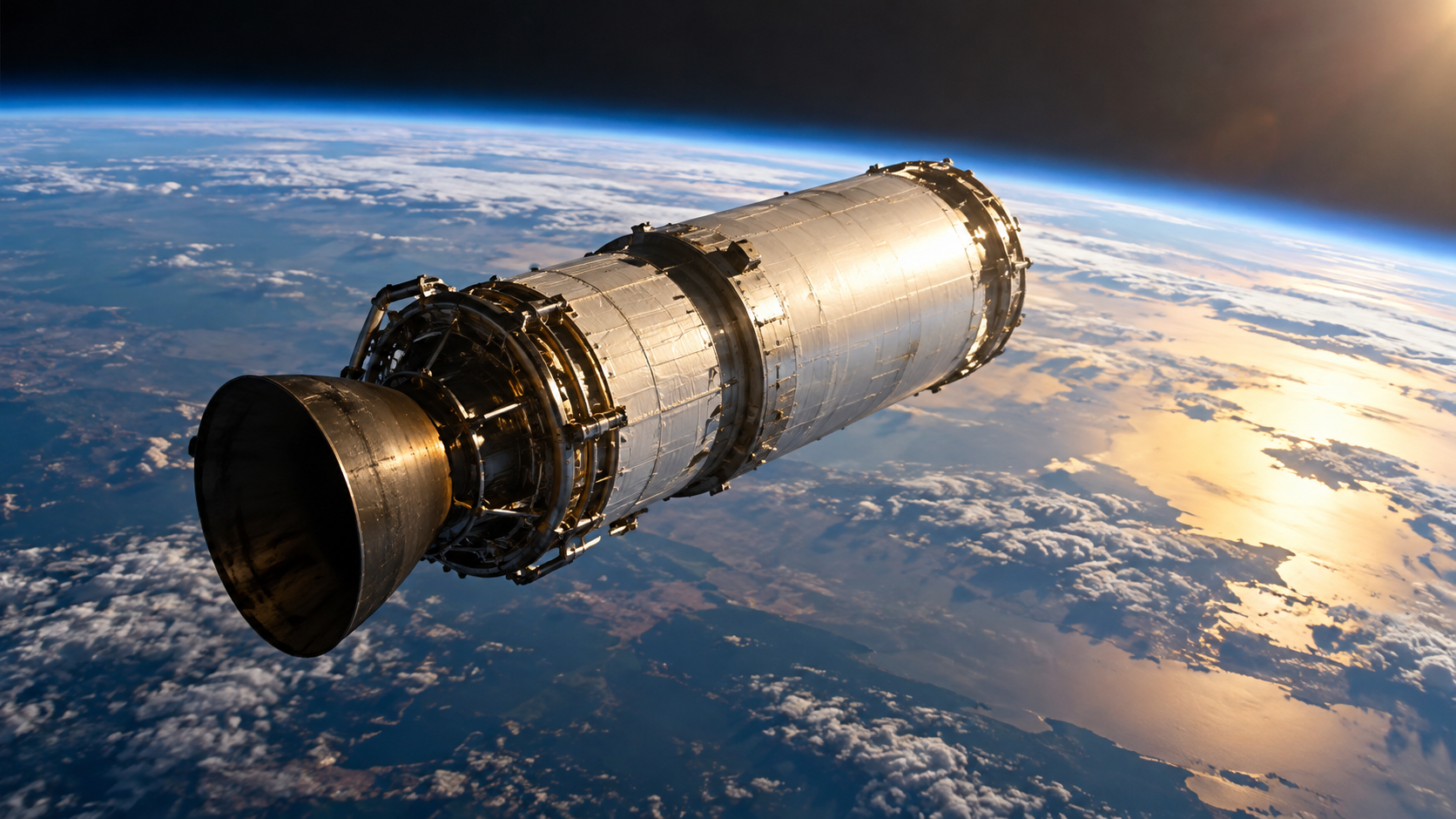
Poland’s space agency has confirmed that a large Chinese rocket stage, weighing approximately five tonnes, passed over the country on Sunday morning, 18 October, after its movement was captured by a Polish network of sky-monitoring cameras.
The Polish Space Agency (POLSA) said the ZQ-2E rocket component was recorded at approximately 6:13am local time by the Skytinel observation network, confirming a passage that had previously been forecast during preparations for the object’s expected return to Earth’s atmosphere.
In its official announcement on Sunday, POLSA said it was continuing to monitor the situation and would publish a final assessment on Monday, 19 October, after reviewing the available observational data.
- Find more news from Poland on our Homepage .
The agency has not announced that rocket debris landed in Poland.
Preliminary observations indicate that the object was travelling at orbital speed, more than 150 kilometres above Earth, when it passed over the country.
Polish cameras record Chinese rocket stage
The object was identified as a spent stage of China’s ZQ-2E rocket, launched from the Jiuquan Satellite Launch Centre on 14 October.
POLSA estimates that the component has a mass of approximately 5,000 kilograms.
The rocket stage is registered under the international identifiers NORAD 101070 and COSPAR 2026-234L, allowing space-monitoring organisations to distinguish it from thousands of other objects orbiting Earth.
According to Skytinel’s preliminary findings, reported by Newsmax Polska, the object was recorded by four monitoring stations in Wrocław, Śrem, Polanka Wielka and Luszewo.
By combining observations from different locations, the network’s operators were able to reconstruct an approximate trajectory.
Their initial analysis indicates that the rocket stage travelled across the sky between approximately 6:13am and 6:14:25am Polish time.
The object was moving at about 7.9 kilometres per second — nearly 29,000 kilometres per hour — at an altitude exceeding 150 kilometres.
The observations suggest that the rocket stage was following an ascending section of its orbital path during the recorded passage, rather than descending towards the ground in Poland.
Those figures remain preliminary pending POLSA’s final assessment.
The agency has linked to the original Skytinel observation in its official statement.
Space agency had warned of possible atmospheric re-entry
The confirmed passage followed a series of warnings and orbital forecasts issued by POLSA on Saturday.
Initially, the agency estimated that the rocket stage could re-enter Earth’s atmosphere on Sunday between 5:03am and 3:43pm Polish time.
The forecast’s central estimate placed the re-entry point over the Atlantic Ocean, although the agency stressed that the calculation was subject to considerable uncertainty.
A later POLSA update published on 17 October revised the estimated window to between 5:55am and 4:03pm on Sunday.
The updated nominal estimate placed re-entry at approximately 10:59am Polish time, with a margin of uncertainty exceeding five hours, and indicated a possible location over Japan.


POLSA also forecast that the object would pass over Poland between 6:14am and 6:16am.
The subsequent observation at approximately 6:13am broadly confirmed that predicted passage.
The changing forecasts reflected the difficulties involved in predicting exactly when and where a large object will return to the atmosphere.
The descent of an uncontrolled rocket stage depends on factors including its orbit, atmospheric drag and physical characteristics.
Even relatively small uncertainties can translate into large differences in the predicted location of re-entry.
Did the rocket pose a danger to Poland?
The most important distinction is between a rocket stage passing over a country while still travelling in space and one breaking apart during atmospheric re-entry.
Although the ZQ-2E component was recorded above Poland, the observational evidence available on Sunday did not establish that it was falling towards Polish territory.
Skytinel’s preliminary analysis indicated that the rocket stage was travelling above 150 kilometres and was not undergoing re-entry over Poland during the recorded pass.
That is different from saying that the object posed no possible risk anywhere along its eventual descent.
In Saturday’s warnings, POLSA cautioned that some fragments might survive atmospheric re-entry because the component weighed approximately five tonnes and complete information about its structure was unavailable.
A rocket stage returning from orbit is exposed to intense heating and mechanical stresses. Much of its material can burn up or fragment, although some more robust components may survive and reach the ground.
The precise outcome for this particular object had not been established in POLSA’s latest statement.
No confirmed debris impact in Poland has been announced.
Why a Chinese rocket was passing over Poland
The ZQ-2E, also known as Zhuque-2E, belongs to a family of launch vehicles developed by Chinese commercial space company LandSpace.
The rocket was launched on 14 October from Jiuquan in northwestern China.
The mission record published by Next Spaceflight identifies the mission as a successful launch of ten satellites into a sun-synchronous orbit.
After launch, rocket components that are no longer required may remain in orbit before eventually descending into the atmosphere.
Depending on their altitude and orbital inclination, these objects can travel over many different regions of the world, sometimes thousands of kilometres from the country where they were launched.
POLSA reported an orbital inclination of approximately 98 degrees for the monitored component.
Such an orbit allows an object to pass over a wide range of northern and southern latitudes, including much of Europe.
The rocket’s passage over Poland therefore did not mean that Poland was its launch destination or that the object had been deliberately directed towards the country.
Polish monitoring network helps reconstruct the flight
The event also demonstrated the role of ground-based observation networks in monitoring objects approaching the end of their orbital lives.
Skytinel operates optical cameras designed to record bright objects crossing the sky, including fireballs and other unusual phenomena.
The network’s technical description explains that its camera systems can record at high frame rates, allowing observers to estimate trajectories and speeds from collected images.
Observations from multiple locations can help distinguish between meteors, aircraft and artificial objects travelling through or above the atmosphere.
In this case, the network provided observational evidence that POLSA could compare with existing orbital predictions.
The Polish Space Agency’s Space Situational Awareness operations monitor space objects and potential hazards associated with their movement.
Such work is increasingly important as the number of satellites, launch vehicles and discarded components in orbit continues to grow.
The United States-based Aerospace Corporation also listed the ZQ-2E stage in its re-entry prediction database, using the same NORAD identification number.
Its publicly available prediction similarly included a wide uncertainty window rather than a definitive impact location.
These assessments underline the importance of distinguishing predicted trajectories from confirmed observations.
Final assessment expected on Monday
POLSA said on Sunday that its final report on the event would be published on 19 October, once the available data had been verified.
That assessment is expected to clarify the observation and provide the agency’s conclusions on the rocket stage’s movement and re-entry.
At present, the confirmed finding is that a large Chinese rocket component passed high above Poland and was recorded by a Polish observation network.
Its final atmospheric re-entry circumstances have not yet been established in the official material reviewed for this article.
The incident illustrates how events in the global space industry can become matters of observation and public safety far from their original launch sites — and why reliable tracking is essential to understanding the actual risks.