Polish police have detained six people during an investigation into the vandalism of three monuments in Warsaw, with investigators examining whether some of the suspects were acting on behalf of Russian intelligence. Two men accused of involvement in the alleged operation have subsequently left Poland following deportation referrals.
The investigation concerns the defacement of three memorials in the Polish capital with slogans praising the Ukrainian Insurgent Army (UPA), a wartime nationalist organisation responsible for massacres of Polish civilians.
According to a statement issued by Warsaw district police on Friday, 27 November, officers believe the vandalism may have been organised through an international criminal network with connections to Russian intelligence services.
- Find more news from Poland on our Homepage .
The suspected Russian involvement remains under investigation and has not been established by a court.
Three Warsaw monuments targeted
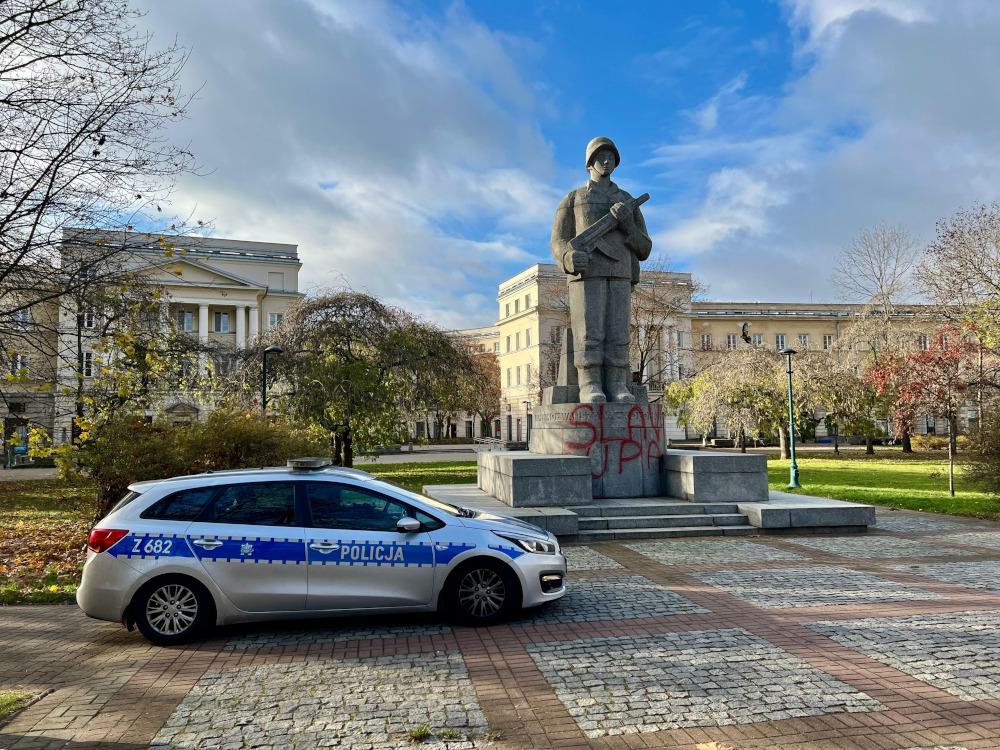
The vandalism occurred overnight on 13–14 November, when red inscriptions appeared on three monuments across two Warsaw districts.
The affected sites were:
- The Polish Army Monument.
- The Memorial to the Victims of the Volhynia Massacre.
- The Monument to the Ghetto Heroes, commemorating the 1943 Warsaw Ghetto Uprising.
The graffiti included slogans praising the Ukrainian Insurgent Army, commonly known as the UPA.
Stickers containing QR codes linking to material about the organisation were also placed on the monuments.
Investigators believe two individuals were directly responsible for painting the inscriptions: a 32-year-old Polish national and a 16-year-old Ukrainian national.
According to police, the pair had allegedly been promised a combined payment of PLN 1,000 for carrying out the vandalism.
Instructions were reportedly delivered through an online messaging application.
Investigators uncover suspected organisers
The investigation began to develop when officers examining a separate series of impersonation fraud offences identified potential connections to the monument vandalism.
Further inquiries involving telephone records, financial information and communications led investigators to additional suspects in different Polish cities.
Police detained two Ukrainian brothers, aged 24 and 19, in Nowy Sącz, southern Poland.
Officers searching their accommodation recovered electronic devices, SIM cards, bank cards and cash in several currencies.
Another suspect, a 31-year-old Ukrainian national, was detained in Wrocław.
Investigators allege that some of those arrested helped organise the vandalism or facilitated payments to the individuals carrying it out.
Police also uncovered indications that further attacks on memorials connected to the Volhynia massacres were being considered in Wrocław.
According to investigators, potential participants were being offered $1,000 to carry out similar acts.
There is no confirmation that those additional acts of vandalism took place.

Police investigate possible Russian intelligence involvement
The Polish authorities suspect that some of the individuals involved may have been operating as part of an organised criminal group carrying out activities for Russian intelligence.
A 32-year-old Polish suspect has been charged with offences concerning cooperation with a foreign intelligence service against Poland, insulting a monument and fraud.
Two Ukrainian men, aged 24 and 31, have also been charged with offences involving organised criminal activity, participation in or organisation of activities for a foreign intelligence service, and insulting a monument.
However, the authorities have not publicly established the complete alleged chain of command or identified a specific Russian intelligence officer responsible for commissioning the vandalism.
The allegations therefore remain subject to criminal proceedings.
Two suspects leave Poland after court refuses detention
The investigation has already resulted in several different judicial decisions.
The 32-year-old Polish suspect was placed in pre-trial detention for three months.
A family court ordered the 16-year-old Ukrainian suspect to be placed in a juvenile educational institution for the same period.
Prosecutors also requested three months of pre-trial detention for the 24-year-old and 31-year-old Ukrainian suspects.
However, the court rejected those applications and imposed no preventive measures on either man.
Police subsequently referred both individuals to the Polish Border Guard for deportation, citing concerns that their continued presence could threaten national security.
According to the official police statement, both men have since left Poland.
The 19-year-old suspect was placed under police supervision, prohibited from leaving the country and ordered not to contact other individuals connected with the investigation.
A sixth individual, a 30-year-old Ukrainian national, was detained during the wider police operation but faces fraud allegations unrelated to the monument vandalism. He was also placed in pre-trial detention.
The six detentions therefore do not mean that all six individuals are suspected of personally vandalising the monuments or working for Russian intelligence.
Why the graffiti is particularly sensitive
The references to the Ukrainian Insurgent Army carry considerable historical significance in Poland.
During the Second World War, members of the UPA and the Organisation of Ukrainian Nationalists participated in the mass killing of Polish civilians in Volhynia and Eastern Galicia.
Poland’s Institute of National Remembrance describes the killings as a campaign of ethnic cleansing.
The events remain among the most sensitive historical issues in Polish-Ukrainian relations.
The decision to place slogans praising the UPA on a memorial dedicated specifically to the victims of the Volhynia massacres is therefore particularly provocative.
The inclusion of the Monument to the Ghetto Heroes also meant that a memorial commemorating Jewish resistance against Nazi German occupation was targeted.
The choice of locations and slogans raises concerns that the vandalism was intended to exploit historical grievances and generate tensions between communities.
Those concerns are particularly relevant given Poland’s extensive political, military and humanitarian support for Ukraine following Russia’s full-scale invasion.
However, the precise motivation behind the operation and the extent of any Russian intelligence involvement remain matters for investigators to establish.
Investigation continues
The case is being supervised by the Military Affairs Department of the Warsaw Regional Prosecutor’s Office.
The investigation involves suspected organised criminal activity, offences against Polish state security, monument desecration and separate allegations of fraud.
Police say cooperation between officers in Warsaw, Kraków, Nowy Sącz and Wrocław helped them identify both the suspected perpetrators and individuals believed to have organised the activities.
No convictions have been reported in connection with the alleged monument vandalism.