Polish authorities have detained 33 foreign nationals during a large-scale immigration and employment-enforcement operation in the southern region of Silesia, after officers checked 191 people for compliance with residence and work regulations.
The operation, codenamed Pobyt — meaning Stay or Residence — began on Tuesday, 17 November, and continued into Wednesday, involving Poland’s Border Guard, police and National Revenue Administration.
According to the Polish Border Guard’s official announcement on 18 November, the 33 people were detained after checks identified unlawful residence or employment in Poland.
- Find more news from Poland on our Homepage .
Authorities said further proceedings were under way for everyone detained.
The Border Guard described the operation as another coordinated effort to enforce Poland’s immigration and employment rules.
Foreign nationals from at least 10 countries detained
The Border Guard said the people detained included citizens of Ukraine, India, Bangladesh, Colombia, the Philippines, Venezuela, Tajikistan, Kyrgyzstan, Georgia and Pakistan.
The list was not presented as exhaustive, and authorities did not provide the number of detainees from each country.
Officers checked the legal residence and employment status of 191 foreign nationals.
The 33 detentions resulted from findings that those individuals were staying in Poland without the necessary legal basis or working in breach of applicable employment rules.
However, the service did not specify how many of the cases involved unlawful residence, how many involved unauthorised employment or whether some individuals were found to have breached both sets of rules.
It also did not publish individual circumstances explaining the alleged irregularities.
The nationality of a person alone does not establish their legal residence or employment status. Different requirements and exemptions can apply depending on citizenship, immigration status and the circumstances of employment.
More than 130 Border Guard officers involved
The operation was coordinated by the Silesian Border Guard Unit, headquartered in Racibórz.
According to the unit’s own account of the operation, 133 Border Guard officers participated alongside personnel from the Silesian Police and National Revenue Administration.
The total number of personnel deployed across all three agencies was not disclosed.
The cooperation brought together services responsible for immigration control, policing and tax-related enforcement.
The checks covered both the legality of foreign nationals’ residence and whether their employment complied with Polish regulations.
In a separate statement, police in Sosnowiec confirmed their participation, including inspections at places employing foreign workers.
The local police reported that 16 people had been detained during their part of Operation Pobyt.
Those detentions relate to the same coordinated operation. The authorities have not published a reconciled locality-by-locality breakdown, so the Sosnowiec figure should not be added to the Border Guard’s regional total of 33.
You May Also Be Interested In


What are Poland’s rules for foreign workers?
Poland distinguishes between a foreign national’s legal right to remain in the country and their authorisation to undertake employment.
Someone may have a legal basis for staying in Poland but still require additional permission to perform certain types of work.
For many non-EU nationals, lawful employment depends on having an appropriate residence status and meeting the relevant work-authorisation requirements.
There are exemptions, including for certain categories of foreign nationals, and specific rules apply to people covered by temporary protection.
The Polish government’s official guidance for employers and foreign workers explains that employers must verify the documents permitting foreign nationals to work and comply with the conditions attached to their employment.
The Border Guard has powers to check compliance with immigration regulations and the legality of employing foreign nationals.
Where irregularities are established, the consequences depend on the circumstances and applicable law.
They may include administrative proceedings, financial penalties or decisions requiring a foreign national to leave Poland.
However, detention during an immigration check does not automatically mean that a person has been charged with a criminal offence or ordered to be deported.
No deportation decisions announced
The initial announcement did not establish what would happen to the 33 people detained.
The Border Guard said further procedures were continuing but did not report any completed deportations or compulsory returns arising from Operation Pobyt.
It also did not disclose whether any employers had been fined, referred for prosecution or subjected to separate administrative proceedings.
Those questions remain relevant because employment violations can involve failures by employers as well as by individual workers.
The operation was still taking place when the Border Guard published its first results on 18 November.
Authorities have not yet provided a final number of people checked or detained across the complete operation.
Latest in a series of immigration checks
The Silesian operation follows several recent enforcement announcements concerning foreigners’ residence and employment status in Poland.
Earlier in November, the Border Guard reported a separate operation in the Opole region that resulted in 28 detentions.
Poland-24 reported on those earlier immigration checks, which involved officers examining the legal status of foreign nationals in the region.
The new operation is distinct from those earlier checks and should not be treated as part of the same arrest total.
Poland’s Border Guard also conducts wider coordinated operations with police and other state agencies to identify breaches of immigration legislation.
In its latest announcement, the service said the objective was to respond consistently to violations of residence regulations and protect public order.
For now, the confirmed results of Operation Pobyt are 191 foreign nationals checked and 33 detained, with further legal and administrative proceedings continuing.
The final outcome will depend on the results of those individual cases and any additional enforcement activity carried out before the operation ends.
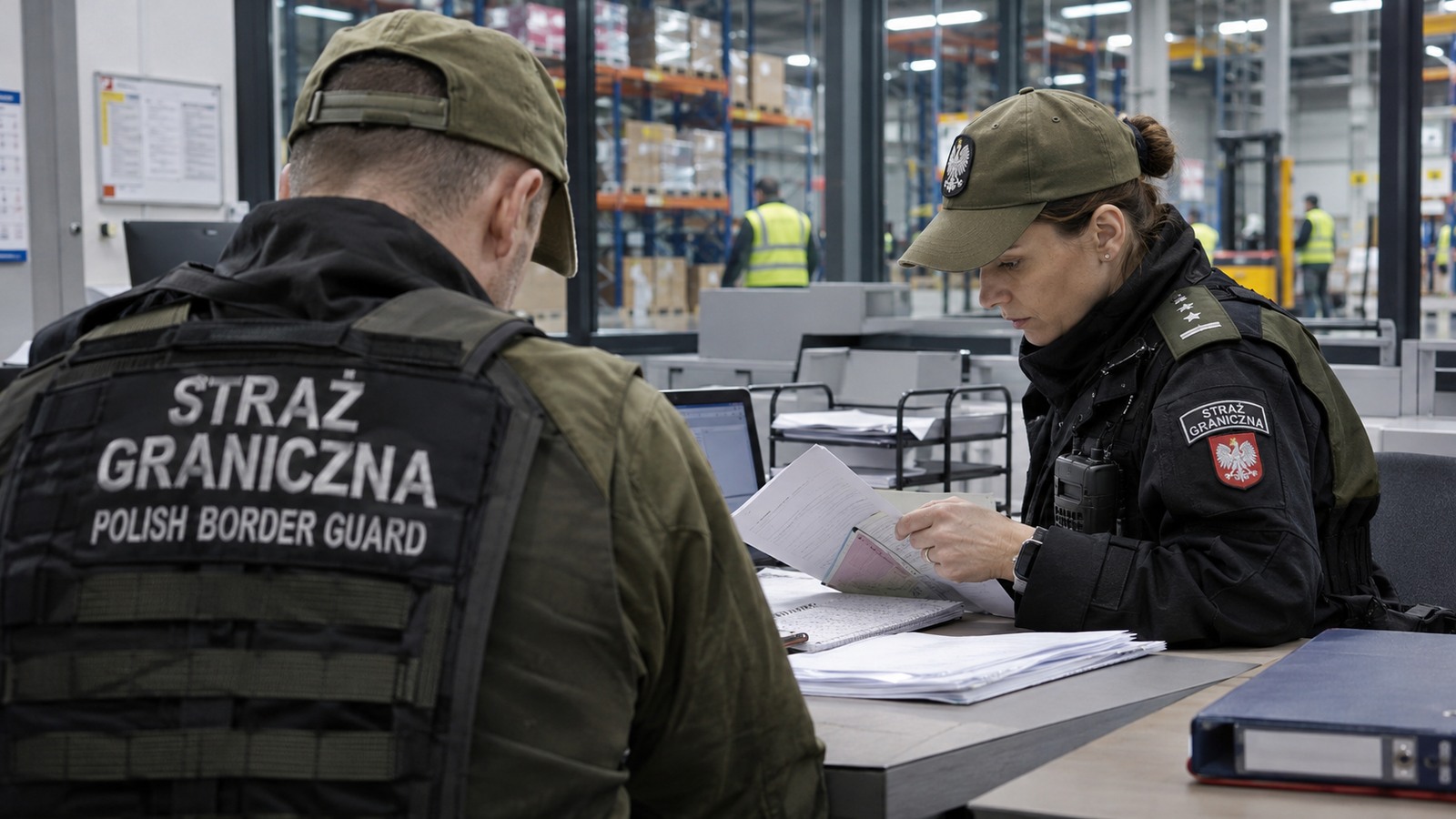
Featured image: Digitally generated editorial illustration of Polish Border Guard officers checking documents in a workplace. Not a photograph of Operation Pobyt.