

Poland has formally begun forming a new 3,000-strong rocket brigade that will operate Homar-K multiple-launch rocket systems, marking another step in the rapid expansion of the Polish Army’s long-range strike capabilities.
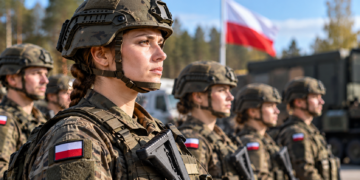
The formation of the 2nd Rocket Brigade, named after 17th-century Polish-Lithuanian artillery specialist Kazimierz Siemienowicz, was officially inaugurated during a military ceremony in Łowicz on Sunday, 27 September.
The event marks the beginning of the brigade’s formation rather than the arrival of a fully equipped and operational unit.
- Find more news from Poland on our Homepage .
Deputy Defence Minister Paweł Bejda said the brigade is ultimately expected to comprise around 3,000 soldiers, with approximately 2,000 stationed in the Łowicz area and another 1,000 in Gostynin.
“Polish soldiers are returning here not merely as a symbol, but as a real force equipped with state-of-the-art weaponry,” Bejda said during the ceremony.
Colonel Daniel Noga has been appointed commander of the new brigade, while Lieutenant General Sławomir Owczarek, deputy commander of the General Command of the Armed Forces, said the first heavy equipment is expected to reach the unit before the end of 2026.
Recruitment is also beginning for specialists including weapons operators, drivers, technicians and commanders.
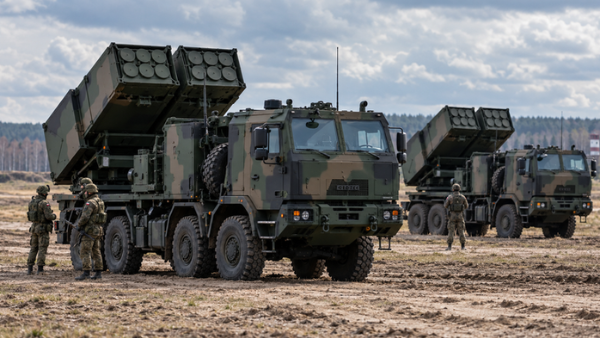
The brigade will be centred on Homar-K, Poland’s customised version of South Korea’s K239 Chunmoo multiple-launch rocket system.
The Polish Defence Ministry says Homar-K combines the Korean launcher module with a Polish-built Jelcz truck chassis and Poland’s TOPAZ automated fire-control system.
Each launcher carries two rocket pods.
Depending on the ammunition fitted, each pod can hold six 239mm precision-guided rockets with a range of around 80 kilometres, or one larger tactical missile capable of striking targets at approximately 290 kilometres.
That gives the system a considerably deeper strike capability than conventional tube artillery and is one reason Warsaw has made rocket forces an increasingly prominent part of its military modernisation programme.
Poland has ordered 290 Homar-K launcher modules under agreements with South Korea’s Hanwha Aerospace.
The first implementation contract, signed in November 2022, covered 218 modules, while a second agreement signed in April 2024 added another 72. Deliveries under the programme run through 2029.
Thousands of guided rockets with ranges of 80 and 290 kilometres are also included in the procurement.
The system is becoming increasingly Polish as the programme develops.
Launchers are integrated onto Jelcz vehicles in Poland and use the domestically developed TOPAZ command-and-fire-control system. Warsaw has also secured technology-transfer arrangements covering servicing, spare parts and further industrialisation of the system.
In December 2025, Poland took another significant step by signing an agreement intended to establish domestic production of rockets for Homar-K through cooperation between Poland’s WB Group and South Korea’s Hanwha Aerospace.
The new brigade will therefore be receiving a weapons system that Poland is increasingly seeking not simply to purchase abroad, but to support and manufacture domestically.
Plans for the unit itself have been developing for months.


The Defence Ministry confirmed in April that the 2nd Rocket Brigade would be organised around two principal locations, Łowicz and Gostynin, as part of Poland’s Armed Forces Reinforcement Package.
Defence Minister Władysław Kosiniak-Kamysz said at the time that Homar-K launchers would be stationed in Gostynin and stressed that increasing Polish industrial involvement in the system was part of the wider investment.
The two-garrison arrangement is also intended to give the brigade access to transport infrastructure and sufficient space for training and logistical operations.
In a parliamentary response earlier this year, the Defence Ministry said Łowicz had been selected partly for operational reasons, its road and rail connections and its proximity to Gostynin. The ministry said the Łowicz site cost PLN 9.01 million when acquired in 2025.
The brigade’s creation is also part of a broader rebuilding of Poland’s rocket artillery.
The Polish armed forces have been expanding their inventory of both Homar-K systems and the US-made M142 HIMARS, known in Polish service as Homar-A.
Together, the programmes are intended to give Polish forces the ability to strike command posts, logistics centres, air-defence positions, concentrations of troops and other high-value targets far beyond the range of conventional artillery.
The scale of the Homar-K acquisition is particularly significant.
With 290 launcher modules contracted, Poland is building one of Europe’s largest inventories of modern multiple-launch rocket artillery.
The programme is accompanied by investment in command vehicles, ammunition carriers, communications equipment and unmanned systems designed to support and protect rocket units.
In May, the Defence Ministry signed contracts covering around 1,000 support vehicles for Homar-K formations and K9 self-propelled artillery units as part of a wider package of Polish defence-industry orders.
For Łowicz and Gostynin, the formation of the brigade also represents the return or expansion of a permanent military presence.
Bejda said the arrival of thousands of soldiers should generate civilian employment and infrastructure investment alongside its military role.
But the process will be gradual.
Sunday’s ceremony formally inaugurated the formation of the 2nd Rocket Brigade. It does not mean that 3,000 soldiers and the brigade’s complete Homar-K inventory are already in place.
Personnel recruitment, construction, equipment deliveries and training will continue as the unit builds towards its intended strength.
The first heavy equipment is due to arrive before the end of this year, putting the new brigade on the path towards becoming another major element of Poland’s rapidly expanding long-range rocket forces.