On the morning of 26 November 1939, two explosions struck a Polish ocean liner sailing through the North Sea off England’s Yorkshire coast.
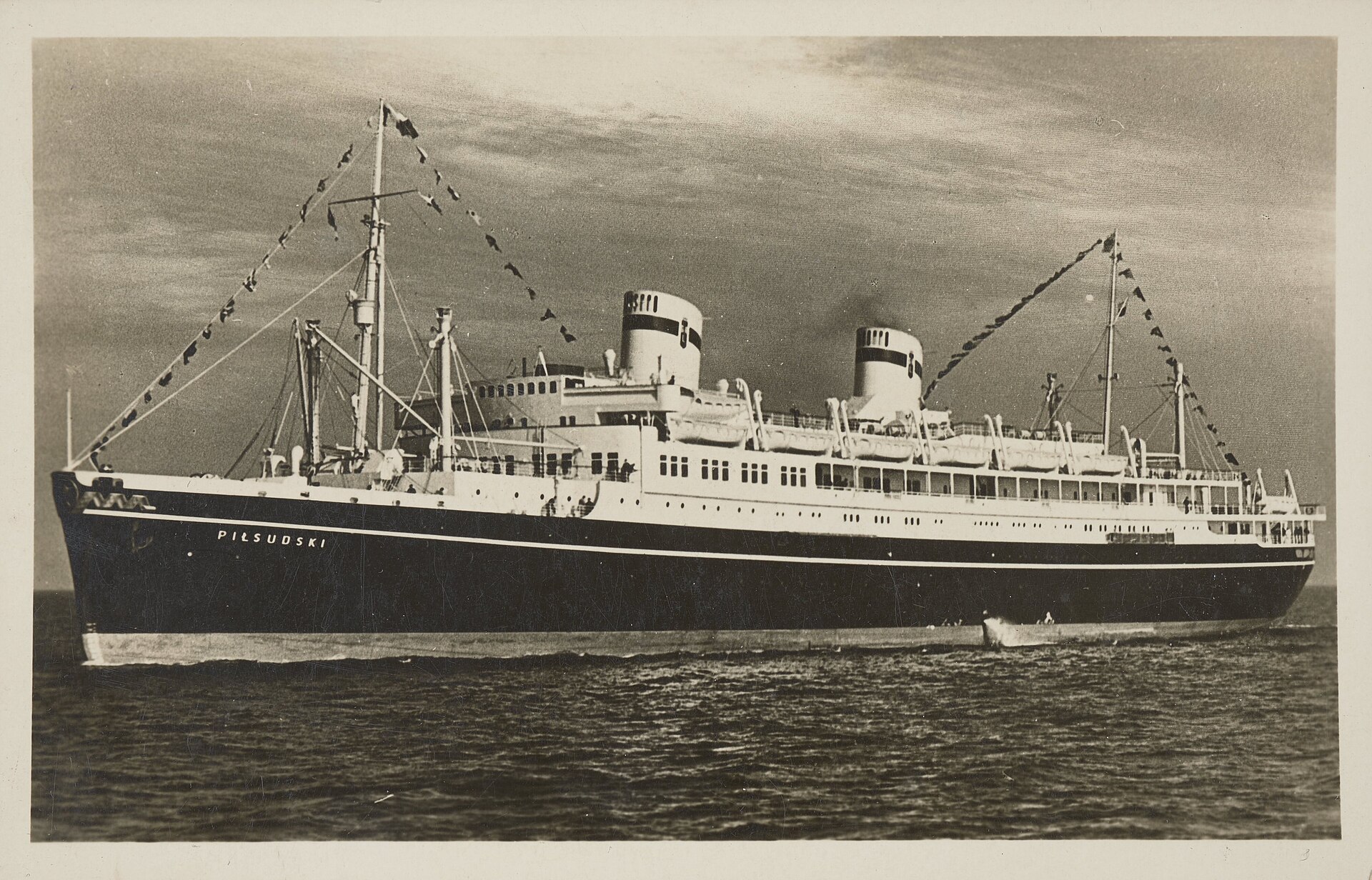
The vessel was MS Piłsudski, one of the most prestigious passenger ships built for Poland between the two world wars.
Only weeks earlier, it had been carrying civilian passengers across the Atlantic. Now, converted into a military transport ship, it was beginning its first wartime voyage.
- Find more news from Poland on our Homepage .
The explosions occurred shortly after 5.30am. The damaged liner remained afloat for several hours before sinking.
Most of those aboard survived, but two men lost their lives, including the ship’s captain, Mamert Stankiewicz.
The sinking, 87 years ago, ended the career of a vessel that had symbolised Poland’s growing international ambitions and its connections with millions of people of Polish descent living abroad.
What caused the explosions has never been established conclusively.
German naval mines remain the leading explanation, although the possibility of a torpedo attack was also considered.
A symbol of Poland’s return to the world
When MS Piłsudski entered service in 1935, it represented something considerably larger than a new passenger ship.
Poland had regained independence in 1918 after 123 years during which its territory had been divided between neighbouring powers.
During the following two decades, the country invested heavily in modern infrastructure and international trade.
One of its most ambitious projects was Gdynia, a Baltic port developed into a major commercial gateway.
The country also wanted a modern passenger fleet capable of competing on international routes.
MS Piłsudski was built at the Italian shipyard in Monfalcone and launched in 1934.
More than 160 metres long, with seven decks, the ship could accommodate hundreds of passengers and a substantial crew.
Its sister vessel, MS Batory, entered service the following year.
Together, the two liners became prominent symbols of interwar Poland.
Named after Józef Piłsudski, the military leader closely associated with Poland’s restoration of independence, the first ship began its maiden voyage to New York on 15 September 1935.
Captain Mamert Stankiewicz commanded that historic crossing.
The vessel’s arrival in New York was an important occasion for the Polish-American community, which welcomed the new connection with its ancestral homeland.


For emigrants and their families, the ships offered more than transport.
They provided a direct connection between the United States and a country that had only recently returned to Europe’s political map.
A floating showcase of Polish culture
MS Piłsudski was also designed to demonstrate the artistic achievements of the Second Polish Republic.
Its interiors brought together modern design, craftsmanship and work by prominent Polish artists.
Nearly 80 Polish designers, architects and artists contributed to the interiors of Piłsudski and Batory.
The ships featured paintings, sculptures, decorative textiles and furniture created specifically for their elegant public spaces.
Among the works aboard Piłsudski were a portrait of Józef Piłsudski by Zygmunt Grabowski, a sculpture by Alfons Karny and a decorative textile by Zofia Stryjeńska.
Polish manufacturers supplied additional furnishings and decorative objects.
The liner offered passengers modern amenities, including an electric lift and a swimming pool.
Its accommodation and public rooms reflected the ambition to present Poland as a technologically advanced, culturally sophisticated European country.
For four years, the vessel maintained its transatlantic connections.
Then the outbreak of the Second World War brought that civilian career to an abrupt end.
From passenger liner to military transport
When Nazi Germany invaded Poland on 1 September 1939, Piłsudski was returning towards Europe from the United States.
Rather than returning to a country engulfed by war, the ship eventually reached Britain.
At Newcastle upon Tyne, preparations began to convert the passenger liner for military service.
On 11 November 1939, an agreement was signed to charter the vessel to the British authorities as a wartime transport ship.
Its luxurious civilian fittings were no longer appropriate for its new role.
Works of art, furniture and other valuable objects were removed as the conversion proceeded.
The vessel’s peacetime purpose had disappeared almost overnight.
On 25 November 1939, Piłsudski departed Newcastle on its first wartime voyage, bound for Australia.
It never reached its destination.
During the early hours of 26 November, the ship was travelling through the North Sea when two explosions struck its hull.
The National Maritime Museum in Gdańsk places the disaster approximately 29 nautical miles — about 54 kilometres — south-east of Flamborough Head, on the Yorkshire coast.
Contemporary British Admiralty records describe two explosions occurring within seconds of each other.
The damaged vessel remained afloat while efforts were made to rescue those aboard and save the ship.
According to the Admiralty’s wartime diary, Piłsudski finally sank at approximately 10.10am.
Most members of the crew escaped.
But the evacuation claimed the life of fourth engineer Tadeusz Piotrowski.
Captain Mamert Stankiewicz survived the initial disaster but died after being rescued, reportedly from exhaustion and hypothermia.
He was subsequently awarded Poland’s Virtuti Militari military decoration posthumously for his conduct during the rescue operation.
The loss was a serious blow to Poland’s merchant fleet, which had been placed at the service of the Allied war effort.
Was the ship sunk by German mines?
The precise circumstances of the sinking have remained disputed for decades.
Early wartime reports raised two principal possibilities: a torpedo attack by a German submarine or the detonation of naval mines.
A contemporary British Admiralty record itself described the vessel as having been mined or torpedoed.
The uncertainty was understandable.
Both weapons could cause catastrophic damage beneath a ship’s waterline, and investigators lacked the evidence needed to establish exactly what had happened.
Over time, the mine explanation became the stronger hypothesis.
Research into German naval operations suggests that German destroyers had laid magnetic mines in the region shortly before the disaster.
These weapons could detonate when a vessel passed sufficiently close, without requiring direct physical contact.
The two explosions reported aboard Piłsudski are consistent with the possibility that the vessel encountered such mines.
Nevertheless, that explanation has not been conclusively demonstrated.
The wreck lies approximately 30 metres beneath the North Sea.
In 2009, Polish divers from a London-based diving club organised an expedition to investigate it.
Although they documented the wreck, their work did not establish the definitive cause of the disaster.
The sinking remains an unresolved chapter of the early naval war in the North Sea.
The second mystery: what happened to the ship’s treasures?
The fate of Piłsudski did not end with its sinking.
Another question survived for decades: what happened to the valuable artwork and furnishings removed from the vessel before its conversion into a military transport ship?
For years, some believed that the objects had been destroyed in wartime bombing or lost with the ship.
Recent research has challenged those assumptions.
Between 2024 and 2025, specialists from the National Maritime Museum in Gdańsk investigated archives in Poland, Britain, Italy and the United States.
Their discoveries included previously unknown documents, photographs and inventories connected with the liner.
The research established that numerous objects removed from Piłsudski had not been destroyed or sent to the bottom of the North Sea.
Instead, parts of the ship’s furnishings and artistic collections had been dispersed, including among Polish communities in Britain.
The findings have helped historians reconstruct the fate of works by important interwar Polish artists.
The museum’s research received national recognition in 2026 and contributed to a major exhibition devoted to Piłsudski and Batory.
The exhibition, Ships That Told the World About Poland, opened in Gdańsk in August 2026 and is scheduled to continue until October 2027.
It explores the ships’ passengers, crews, interiors and wartime experiences.
Other surviving objects provide a more personal connection with the lost liner.
Among the National Maritime Museum’s collections is a fragment of Piłsudski’s Polish flag, donated in 2014 by the family of Władysław Milewski, who had supervised the vessel’s construction and received the flag when he left the ship in 1936.
The surviving fabric represents a vessel that once connected Poland with its emigrant communities across the Atlantic.
Today, the wreck of MS Piłsudski remains beneath the North Sea off Yorkshire.
Its precise cause of loss remains uncertain, but its place in Polish maritime history is clear.
For just four years, the ship carried passengers between Poland and North America, showcasing a newly independent country’s modern achievements.
Its transformation into a wartime transport and its loss in November 1939 marked the sudden end of that ambition.
The ship disappeared beneath the waves, but the surviving objects, personal histories and recently recovered archival records continue to reveal what it meant to the people who sailed aboard it.
Sources and further reading
- National Maritime Museum: history of MS Piłsudski
- National Maritime Museum: discoveries about the liner’s artwork
- National Maritime Museum: 2026–2027 exhibition
Featured image: Period postcard of MS Piłsudski at sea, published 1937–1939. National Library of Poland / Polona, via Wikimedia Commons (public domain).