On 25 November 1764, Warsaw celebrated the coronation of a new king. Streets were illuminated, a triumphal arch stood on Krakowskie Przedmieście, and wine was distributed to the crowds.
The monarch at the centre of the celebrations was Stanisław August Poniatowski, a 32-year-old aristocrat who had just become King of Poland and Grand Duke of Lithuania.
Exactly 31 years later, on 25 November 1795, the same man signed away his crown.
- Find more news from Poland on our Homepage .
There were no celebrations this time.
Far from Warsaw, in the city of Grodno — today Hrodna in Belarus — Stanisław August signed his abdication under Russian supervision.
By then, the Polish-Lithuanian Commonwealth had been partitioned by Russia, Prussia and Austria. The state he had spent much of his reign trying to reform had disappeared from Europe’s political map.
The extraordinary coincidence of the two dates captures the contradictions of Poland’s last king: a reformer who owed his throne to foreign intervention, and a monarch whose reign ended with the destruction of the state he governed.
A coronation shaped by Russia
Stanisław August’s coronation was unusual from the beginning.
For centuries, Poland’s royal coronations had traditionally taken place in Kraków, the country’s historic royal capital.
Poniatowski’s ceremony was instead held at the Collegiate Church of St John in Warsaw, now St John’s Archcathedral.
It was one of only two royal coronations of the Polish-Lithuanian Commonwealth to take place outside Kraków.
The date was significant, too.
The new king was crowned on St Catherine’s Day, 25 November — the name day of Empress Catherine II of Russia.
This was no accidental tribute.
Poniatowski had previously been romantically involved with Catherine before she became empress. Their personal connection subsequently acquired enormous political significance.
In September 1764, Poniatowski had been elected king with Catherine’s support.
The election took place within the Commonwealth’s distinctive political system, in which the nobility elected the monarch rather than passing the crown automatically through hereditary succession.
Yet the process was heavily influenced by Russia.
Russian troops were stationed nearby, and Catherine regarded Poniatowski as a candidate who would serve her empire’s interests.
The choice of coronation date publicly acknowledged the power of the woman who had helped place him on the throne.

But Russia’s expectations and the new king’s ambitions would not always coincide.
The king who tried to reform Poland
Stanisław August inherited a Commonwealth struggling with serious political weaknesses.
Its parliamentary system allowed individual deputies to obstruct legislation, while powerful magnates frequently defended their own privileges against attempts to strengthen the central government.
Foreign powers, particularly Russia, had gained considerable influence over its internal affairs.
Poniatowski believed that the state needed fundamental reform.
His reign became closely associated with the Enlightenment, the European intellectual movement that promoted education, rational government and institutional improvement.
He supported efforts to modernise administration, strengthen public institutions and develop education.
During his reign, Warsaw gained the National Theatre, while the School of Chivalry was established in 1765 to educate future military officers and public servants.
The Commission of National Education, founded in 1773, became one of Europe’s pioneering national education authorities.
Stanisław August was also an important patron of art, architecture and literature.
He assembled substantial collections, supported artists and intellectuals, and helped transform Warsaw into a significant centre of Enlightenment culture.
Yet his domestic ambitions were repeatedly constrained by international politics.
In 1772, Russia, Prussia and Austria carried out the First Partition of Poland, seizing large areas of the Commonwealth’s territory.
The king remained on the throne, but the partition demonstrated how little freedom the state possessed when confronted by its powerful neighbours.
His greatest reforming achievement came nearly two decades later.
On 3 May 1791, the Commonwealth adopted a new constitution.
Stanisław August was among its principal architects.
The constitution sought to strengthen government and address weaknesses that had left the country vulnerable to foreign interference.
For reformers, it offered the possibility of restoring an effective and more independent state.
For Russia, however, the prospect of a stronger Commonwealth threatened its established influence.
The reforms collapse
In 1792, Russian forces invaded the Commonwealth as opponents of the new constitution sought Catherine II’s intervention.
The resulting war ended in defeat for the reforming camp.
Stanisław August made one of the most controversial decisions of his reign by joining the Targowica Confederation, the Russian-backed political alliance opposing the constitution.
The decision damaged his reputation profoundly.
To many supporters of reform, it represented a betrayal of the political transformation he had helped initiate.
Historians nevertheless continue to debate his calculations.
The king believed that compromise with Russia might preserve what remained of the Commonwealth’s political existence.
His critics argue that repeated concessions only strengthened Russia’s control and weakened the possibility of meaningful resistance.
The outcome was disastrous.
In 1793, Russia and Prussia carried out the Second Partition, taking another vast portion of the Commonwealth.
The following year, Tadeusz Kościuszko led an uprising against foreign domination.
The insurrection was defeated.
In 1795, Russia, Prussia and Austria agreed to the Third Partition, dividing the Commonwealth’s remaining territories.
After centuries as one of Europe’s major political entities, the Polish-Lithuanian state ceased to exist.
Its king was still alive, but there was effectively no country left for him to govern.
The final signature in Grodno
In January 1795, Stanisław August left Warsaw under orders from Catherine II.
Escorted by Russian dragoons, he travelled to Grodno, where he remained under Russian supervision.
His freedom of political action was severely restricted.
The final act came on 25 November 1795.
The abdication document was prepared by Nikolai Repnin, a Russian general and former ambassador who had played an important role in the Commonwealth’s political affairs.
Stanisław August signed it in Grodno.
The document formally renounced his rights to the Polish crown and the Grand Duchy of Lithuania, placing his abdication in the hands of Catherine II.
It described his decision as voluntary.
Yet the circumstances were hardly those of a monarch exercising independent power.
His state had already been partitioned, his political authority had collapsed, and he was living under the control of the empire that had originally helped secure his election.
The date gave the ceremony a particularly striking symmetry.
Thirty-one years earlier, he had been crowned on Catherine’s name day. Now he surrendered his crown on that same date.
The empress whose support had helped begin his reign was also the dominant foreign ruler at its conclusion.
The last king’s complicated legacy
Stanisław August remained in Grodno until 1797, when Catherine’s successor, Emperor Paul I, allowed him to move to St Petersburg.
He spent his final years there and died on 12 February 1798, aged 66.
His reputation has remained contested.
Critics have condemned his dependence on Russia and his political concessions, particularly his decision to join the Targowica Confederation.
Others emphasise the extraordinary restrictions under which he governed, his commitment to reform and his role in the Constitution of 3 May.
His reign cannot easily be reduced to either failure or betrayal.
He was both a beneficiary of Russian intervention and a central figure in attempts to strengthen the Commonwealth against foreign domination.
The state’s disappearance was the consequence of a much wider struggle involving its political institutions, internal divisions and the expansionist ambitions of neighbouring powers.
Poland would not regain independence until 1918, more than a century after his abdication.
There was one final historical symmetry.
In 1995, Stanisław August’s remains were laid to rest in St John’s Archcathedral in Warsaw — the same church where he had been crowned 231 years earlier.
Today, his tomb stands in the building where his reign began.
The two dates of 25 November remain a remarkable reminder of how dramatically the Commonwealth’s fortunes changed during the final generation of its existence.
Sources and further reading
- Museum of Polish History: The coronation of Stanisław August Poniatowski
- Museum of Polish History: The abdication of Stanisław August
- Royal Łazienki Museum: Stanisław August
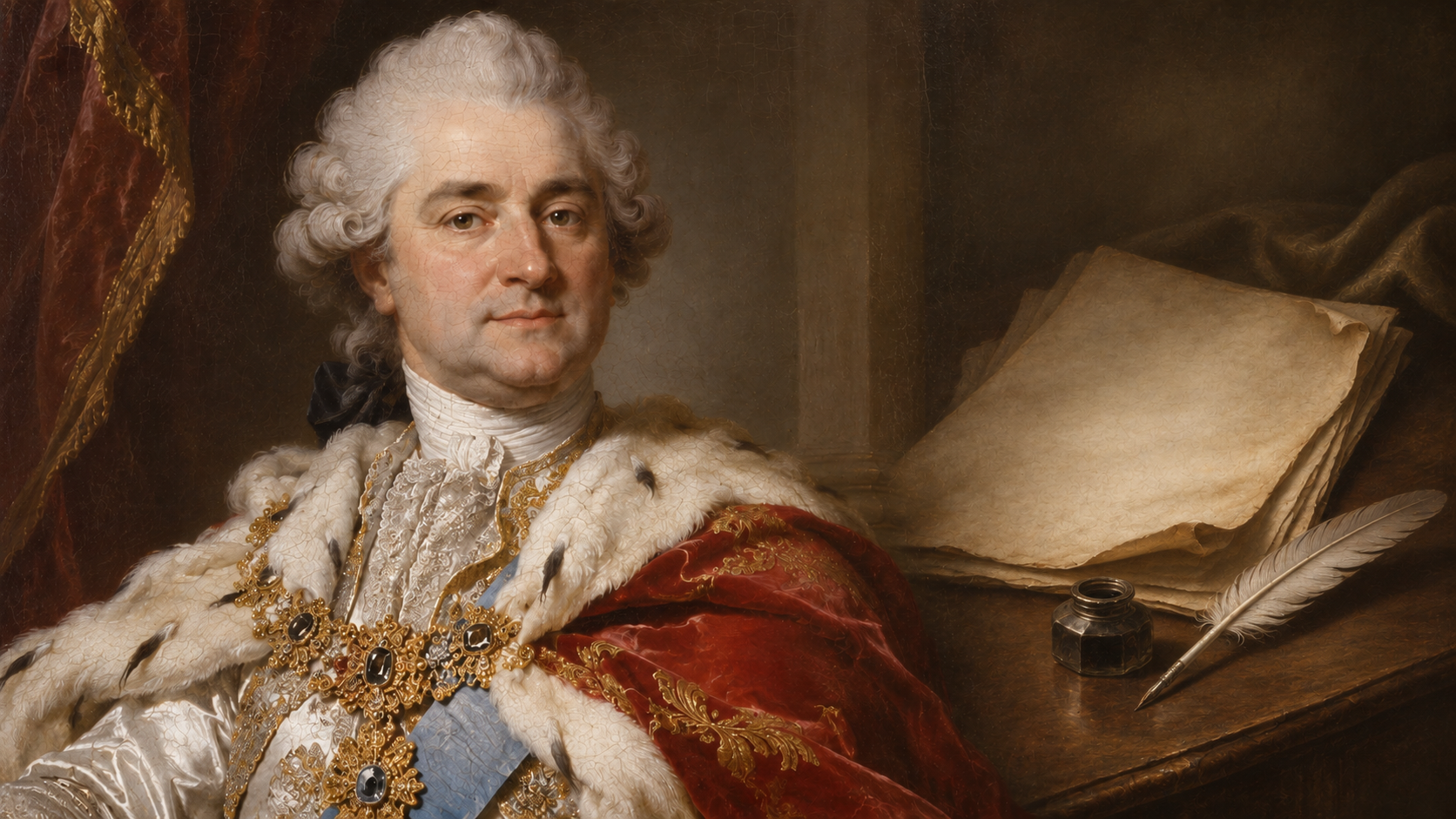
Featured image note: AI-generated historical editorial illustration inspired by period portraiture. The parchment, inkpot and quill are symbolic, not an image of the actual abdication document.