

In southern Poland, palaeontologists have assembled what they describe as the world’s richest known concentration of fossils from one of prehistory’s strangest reptiles.
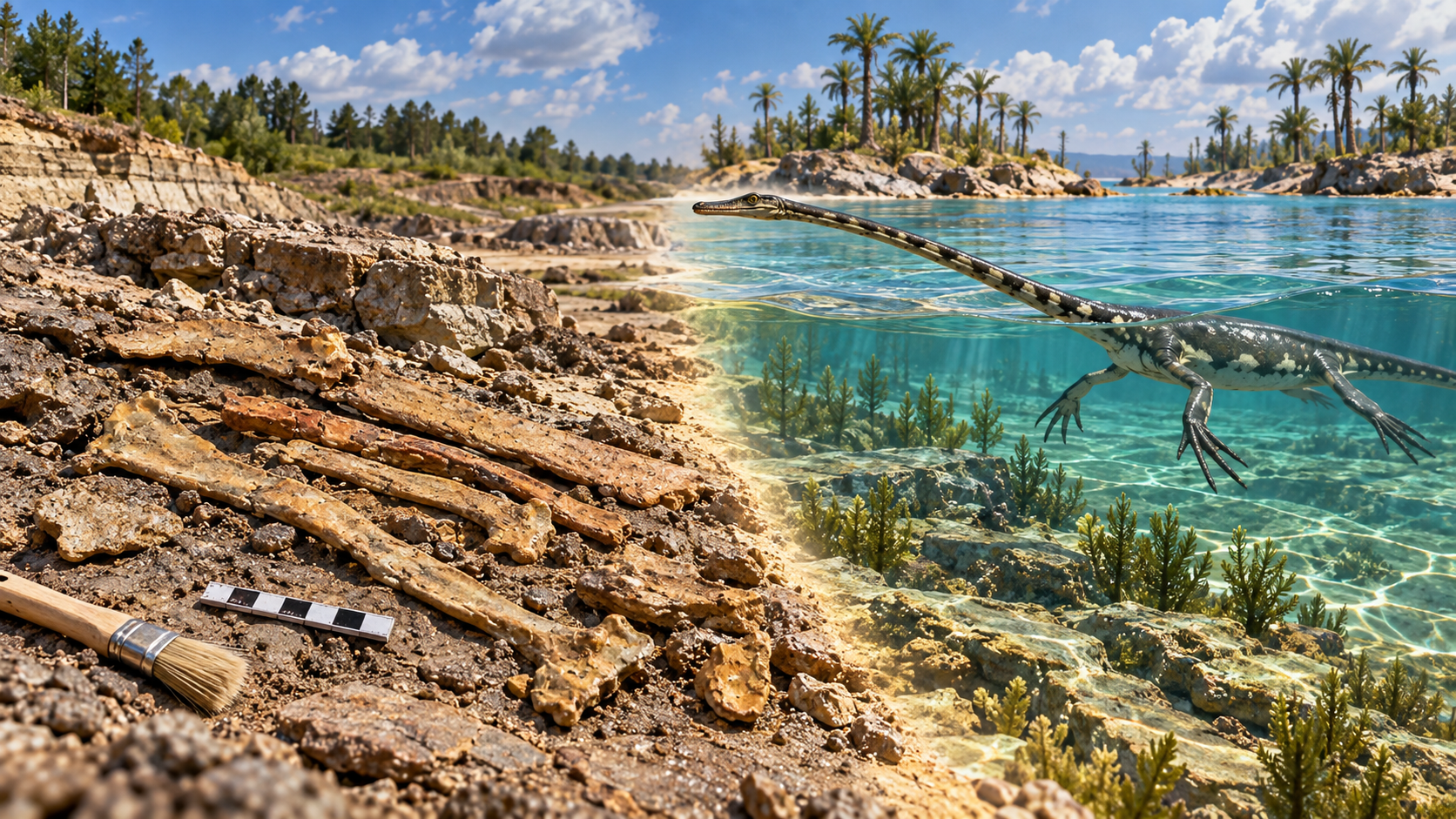
At the fossil site in Miedary, in Silesia, researchers have recovered around 1,000 bones belonging to Tanystropheus, a long-necked reptile that lived roughly 240 million years ago during the Middle Triassic. The material represents at least 25 individuals of different ages and, according to the researchers, no other known site has produced such a concentration of Tanystropheus remains.
That matters because Tanystropheus has long fascinated scientists while also frustrating them. The animal was first described in the 19th century, but much of what was known about it came from incomplete or flattened fossils. By contrast, many of the Miedary remains are preserved three-dimensionally, giving researchers a far clearer view of the animal’s anatomy.
- Find more news from Poland on our Homepage .
The collection comes from excavations conducted by scientists from the Institute of Paleobiology of the Polish Academy of Sciences and the University of Warsaw, who have been working at the Miedary site since 2014.
A reptile with a neck unlike almost anything else
Tanystropheus was one of the most distinctive reptiles of the Triassic world.
The largest individuals could reach around seven metres in length, and roughly half of that was neck. What made the animal especially unusual was that its neck was not built from an exceptionally large number of vertebrae, but from just 13 vertebrae that were stretched to remarkable lengths.
Researchers believe it lived in an aquatic or semi-aquatic coastal environment and likely hunted by ambush. Its elongated neck may have allowed it to approach prey while keeping the rest of its body at a distance.
The Polish material is especially important because it includes fossils from individuals of different ages, from much smaller juveniles to full-grown adults. That gives scientists a rare chance to study how the animal changed through life rather than relying on isolated specimens from separate sites.
Why Miedary stands out
Miedary had already become known in palaeontological circles as a promising Middle Triassic site, but the newly reported scale of the Tanystropheus material makes it exceptional.
Earlier academic work had already identified Miedary as the richest source in the world of three-dimensionally preserved Tanystropheus remains. The newer synthesis of the material now points to a collection of around 1,000 bones and teeth, many excavated in recent years, making it possible to reconstruct almost the entire skeleton.
The finds also include a particularly important category of fossils: skull material.
Researchers say Miedary has yielded the first cranial elements of Tanystropheus found outside the Monte San Giorgio area on the Swiss-Italian border, one of the classic localities for Triassic marine reptiles. That gives Polish scientists an opportunity to compare the Silesian material with better-known Swiss and Italian specimens and refine the animal’s anatomy and classification.
The result is that a reptile once known from comparatively fragmentary material can now be understood in far greater detail.
A tropical lagoon in what is now Silesia
When Tanystropheus was alive, Miedary looked nothing like modern Upper Silesia.
Scientists say the area was then part of a warm coastal setting linked to a shallow sea. Earlier research on the broader vertebrate assemblage from Miedary suggested an environment somewhat like a low-salinity lagoon or inland sea, where marine and freshwater influences overlapped.
That helps explain why the site contains such a striking mixture of fossils, including fish, amphibians and several kinds of reptiles.
It may also help explain why Tanystropheus appears there in such abundance. Researchers are still studying whether the extraordinary concentration reflects the reptile’s genuine ecological success in that environment, unusual conditions of fossil preservation, or a combination of both.
What is already clear is that the site has transformed Poland’s importance in the study of this genus.
For decades, fossil sites in Switzerland, Italy and Germany played a central role in research on Tanystropheus. Miedary has now pushed Poland into the front rank of places shaping scientific understanding of the animal.
A Polish site with global significance
This is not a story about a newly discovered species. Nor is Miedary itself a newly discovered excavation site.

The real news lies in the growing scale of the fossil collection and the scientific interpretation now emerging from it. With around 1,000 bones, rare skull remains and material from at least 25 individuals, Miedary is no longer simply another Triassic fossil locality.
It is becoming one of the most important windows anywhere in the world onto an animal that has puzzled palaeontologists for generations.
For Poland, that gives the story a particularly strong scientific and cultural appeal: one of the world’s most significant fossil collections for a bizarre prehistoric reptile is being assembled not in a famous Alpine site, but in Silesia.