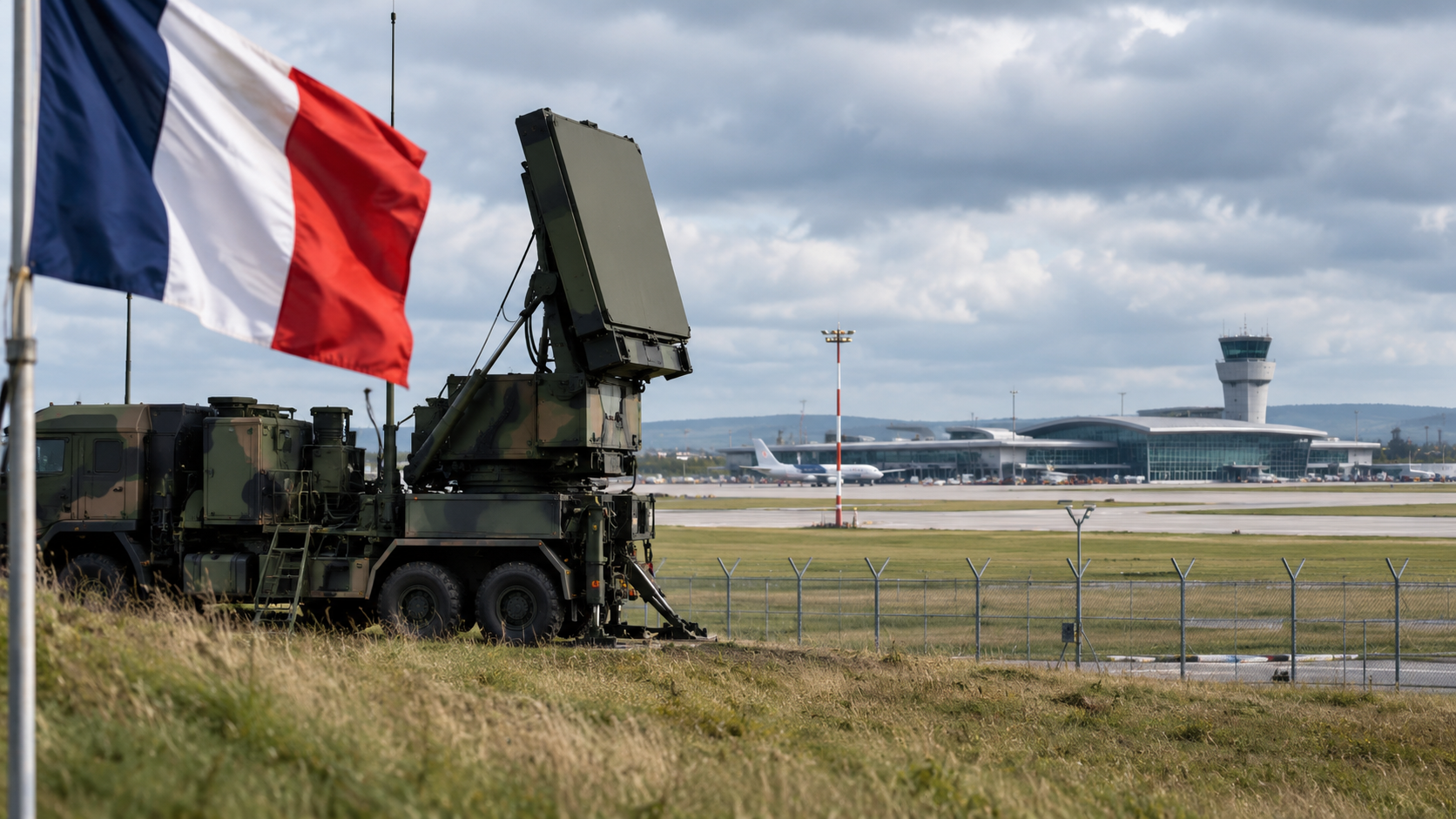
France will take responsibility for air defence around one of NATO’s most important logistics hubs in Poland from 1 January 2027, deploying French military equipment to protect Rzeszów-Jasionka airport, a crucial gateway for Western military assistance to Ukraine.
The planned deployment was announced on Friday, 6 November, by French Ambassador to Poland Étienne de Poncins during a briefing with journalists in Warsaw.
French forces will assume responsibility for defending the airspace around the southeastern Polish airport under NATO arrangements, marking the first time French air-defence equipment has been assigned to protect the location.
- Find more news from Poland on our Homepage .
The ambassador also confirmed that French systems would operate alongside American-designed Patriot missile defences, providing an opportunity to test how equipment from different NATO allies works together.
The announcement comes as the Netherlands prepares to conclude its current air-defence mission in Poland and Sweden begins deploying its own Patriot systems to the same strategic location.
France to assume air-defence responsibility from January
According to Reuters’ report of the ambassador’s announcement, France will assume responsibility for air defence in the area surrounding Rzeszów from the beginning of next year.
The mission will involve French air-defence equipment working in cooperation with existing allied systems.
De Poncins explained that the deployment would allow French forces to assess interoperability with Patriot missile-defence systems developed in the United States.
Interoperability refers to the ability of different countries’ military equipment, communications networks and command arrangements to operate effectively as part of a coordinated force.
For NATO, this is particularly important in air defence, where radar systems, command centres and missile batteries operated by different allies may need to respond to the same aerial threats.
The ambassador did not publicly identify which specific French missile-defence system would be deployed or how many personnel would participate.
France operates the SAMP/T air-defence system, also known as Mamba, which uses Aster missiles to engage aircraft and other aerial threats. Its next-generation version is also being developed.
However, no official announcement has established that either version will be deployed to Rzeszów.
The new mission concerns protection of the airport and surrounding airspace. It does not mean French forces will take ownership or administrative control of the airport itself.
Why Rzeszów-Jasionka is so important to NATO and Ukraine
Rzeszów-Jasionka became a strategically important logistics centre following Russia’s full-scale invasion of Ukraine in February 2022.
Located in southeastern Poland, the airport provides a major gateway for military equipment and humanitarian assistance delivered by Western countries to Ukraine.
Its proximity to the Ukrainian border allows supplies arriving by air to be transferred into wider transport networks.
Protecting the facility is therefore important both for Poland’s national security and for the continuing delivery of international support to Ukraine.
The airport forms part of the wider logistics network associated with NATO Security Assistance and Training for Ukraine (NSATU).
According to NATO’s official explanation of the mission, NSATU coordinates military assistance, training and the movement of donated equipment to logistical hubs in the alliance’s eastern member states.

The alliance does not itself undertake the onward delivery of military assistance into Ukraine.
Because the support network operates on NATO territory, its protection also forms part of the alliance’s wider defensive arrangements along its eastern flank.
Air-defence systems deployed around Rzeszów are intended to protect the logistics operation against potential aerial threats, rather than respond to a newly announced attack against the airport.
Sweden prepares to deploy Patriot systems in December
France’s arrival will follow another change in the multinational forces protecting the airport.
The Netherlands currently operates Patriot air-defence equipment in Poland and has maintained a significant military presence supporting the logistics hub.
According to the Dutch Ministry of Defence, its mission began in December 2025 with approximately 300 personnel and a combination of Patriot, NASAMS and counter-drone systems.
The Dutch deployment subsequently changed in scope, with some equipment withdrawn in June 2026. Dutch Patriot systems and a reduced contingent were scheduled to remain until the beginning of December.
Sweden has meanwhile confirmed that it will deploy Patriot air-defence equipment and approximately 100 personnel to Rzeszów from December 2026.
In its official announcement on 6 October, the Swedish Armed Forces described the mission as their first deployment of the Patriot system under NATO command.
The Swedish contribution will involve personnel from the Air Defence Regiment and support from the Blekinge Air Wing.
Sweden has also contributed Gripen fighter aircraft to NATO’s air-defence operations over Poland since October.
The Swedish Patriot mission is initially planned for December, but Stockholm intends to maintain a contribution during the first half of 2027, subject to parliamentary approval.
That means Sweden’s planned deployment could overlap with the French mission beginning in January.
The precise division of responsibilities between the two contingents has not yet been publicly established.
In October, Poland-24 reported on Sweden’s decision to send Patriot systems and troops to Poland, following an earlier announcement that allied Patriot batteries would continue protecting the hub into 2027.
French deployment part of continuing allied rotation
The French announcement represents another stage in NATO’s rotating multinational air-defence presence at Rzeszów-Jasionka.
Allied countries have previously contributed different combinations of missile-defence systems, fighter aircraft and military personnel to protect the airport and surrounding infrastructure.
The arrangement allows responsibility for particular missions to be shared between NATO members while maintaining protection of strategically important facilities.
The ambassador’s remarks were also covered by Polska Zbrojna, a Polish military publication, which reported that the planned French mission would last more than three months.
However, an exact end date has not been publicly confirmed.
The announcement also comes as French personnel prepare to participate in multinational military exercises in Poland under the Coalition of the Willing framework.
Those exercises, scheduled for November, concern preparations for a possible future international security role in Ukraine following a ceasefire.
They are separate from the NATO air-defence mission planned for Rzeszów.
The French deployment at Jasionka is part of existing NATO security arrangements on Polish territory.
What happens next?
The immediate next step will be Sweden’s planned arrival in December, as the Netherlands concludes its current Patriot mission.
France is then scheduled to assume its air-defence responsibilities on 1 January 2027.
Before the deployment begins, several operational details remain to be confirmed, including the specific French equipment involved, the number of participating personnel and the precise arrangements for cooperation with Swedish-operated Patriot systems.
The French Ministry of the Armed Forces and NATO have not yet published a detailed force structure for the mission.
For Poland, the announcement provides further confirmation that allied air-defence protection of Rzeszów-Jasionka is expected to continue into 2027.
For Ukraine, it means that another NATO member is preparing to contribute directly to the protection of a logistics network that remains important to the country’s military support from Western partners.