Few prehistoric sites in Europe can be dated with the precision achieved at Biskupin.
Few prehistoric sites in Europe can be dated with the precision achieved at Biskupin.
The famous settlement on the Biskupin lake peninsula is one of the best-known archaeological sites in Poland, and its importance rests not only on its striking reconstruction but also on the survival of original wooden remains in unusually good condition. Those preserved timbers allowed researchers to use dendrochronology — tree-ring dating — to establish that most of the wood used to build the settlement was cut in the winter of 738–737 BC.
- Find more news from Poland on our Homepage .
That dating is remarkable because it narrows the construction of the settlement to a specific season nearly 2,800 years ago. For many ancient sites, archaeologists must work with much broader time ranges. At Biskupin, however, the preserved wood made it possible to move beyond approximate dating and reconstruct the chronology of construction with much greater confidence. The Archaeological Museum in Biskupin notes that earlier estimates placed the settlement more loosely between 700 and 400 BC, and for a long time many people associated it with an even later date. The dendrochronological results changed that understanding decisively.
Why Biskupin preserved what so many sites lose
Biskupin’s exceptional status is closely linked to its environment. The settlement stood on the peninsula of Lake Biskupin in wet, boggy conditions, and the museum says its excavations opened a new chapter in Polish archaeology precisely because of the exceptionally well-preserved wooden constructions found there. Waterlogged conditions helped protect structural timber that would have decayed long ago on a drier site. That preservation is one reason Biskupin became famous far beyond Poland.
The site is associated with the Lusatian archaeological culture and belongs to the transition between the Bronze and Iron Ages. The archaeological reserve’s visitor information describes the best-known part of Biskupin as the remains — and now reconstruction — of a fortified settlement from that transitional period. The museum also stresses that the site is important for what is often called wetland archaeology, because it preserves evidence in a way uncommon for prehistoric settlements.
How archaeologists worked out the date
Dendrochronology works by comparing the annual growth rings in timber. Because trees form one ring per year, and because patterns of narrow and wide rings can be matched against established sequences, archaeologists can often determine when a tree was felled. At Biskupin, this method showed not merely a broad era, but that the majority of the construction wood came from the winter of 738–737 BC. The archaeological reserve also notes that the timber used in the settlement came from trees felled between 747 and 722 BC, with more than half from that specific winter season.
That does not mean every beam in the settlement was cut on a single day, or that all construction happened at once. It does mean that a substantial part of the building material came from a concentrated period of activity, giving archaeologists an unusually sharp chronological picture. In practical terms, researchers can say that much of the famous fortified settlement was built using timber cut during one winter at the end of the eighth century BC.
Discovered in the twentieth century, famous ever since
The site’s modern history began after drainage works lowered the water level of Lake Biskupin. The museum explains that this exposed rows of wooden stakes, which caught the attention of local teacher Walenty Szwajcer in 1933. He informed archaeologist Józef Kostrzewski, who quickly realised the significance of the find and moved to begin excavations. Research started in 1934 and soon revealed an extensive prehistoric settlement with remarkably preserved timber structures.
The archaeological reserve describes Biskupin as one of the largest archaeological reserves in Europe and says the discovery ranks among the 100 most important archaeological discoveries of the twentieth century. Its broader reserve covers around 38 hectares and contains traces of settlement from the Stone Age to the early Middle Ages, but the fortified peninsula settlement remains its most famous element.
What visitors see today
An important distinction must be made between the original archaeological remains and the modern reconstruction that visitors encounter today.
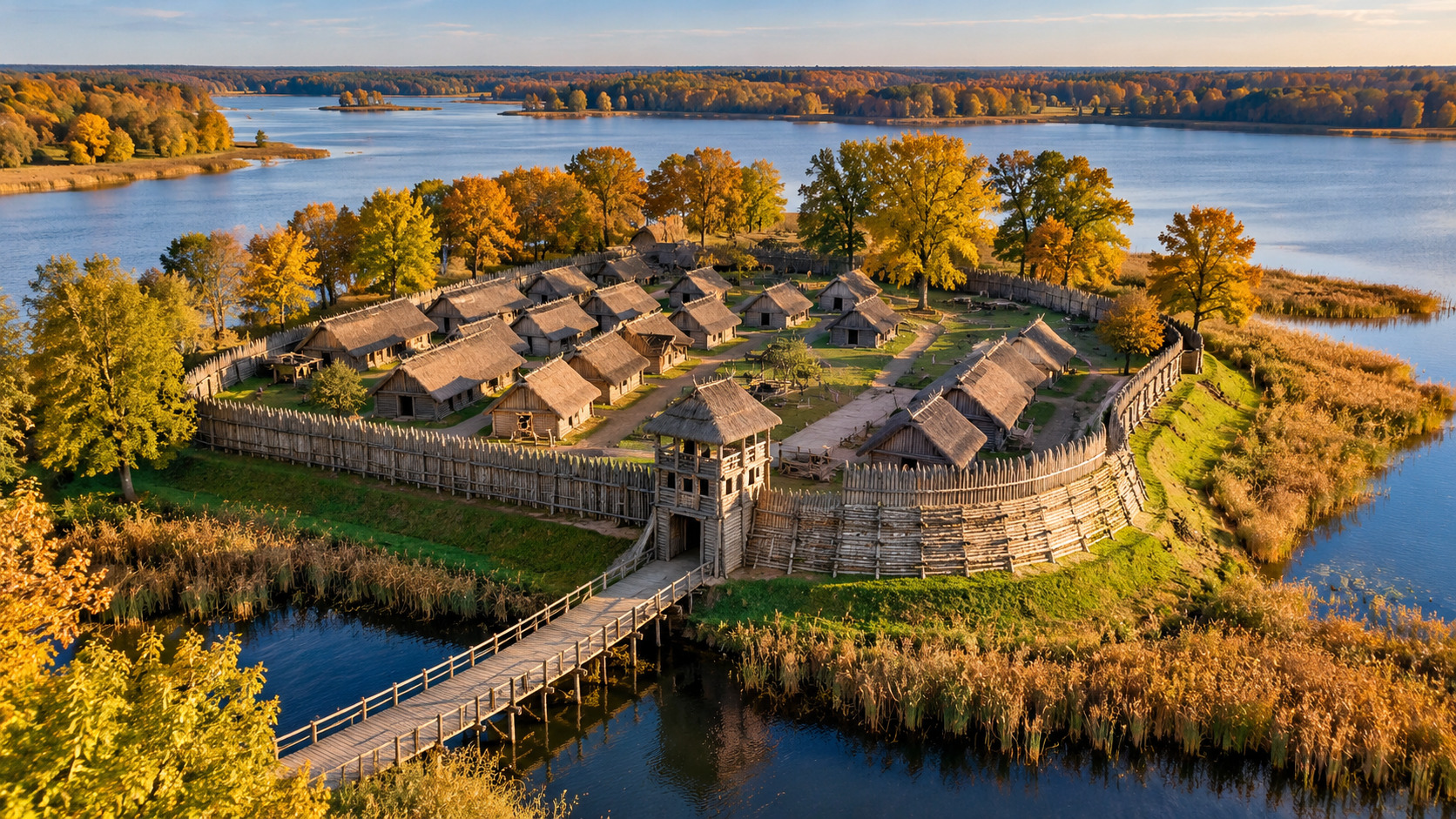
The museum states clearly that the reserve now contains reconstructions, including the fortified settlement on the peninsula. Today’s Biskupin includes reconstructed houses, streets, defences and other educational features designed to help visitors understand prehistoric life. These are based on archaeological research, but they are not the same thing as the surviving eighth-century-BC remains preserved in the ground.
That distinction matters because Biskupin is often visually introduced through the reconstructed settlement, which is highly photogenic and accessible. Yet the scientific importance of the site lies in the underlying archaeological evidence: the preserved timbers, the excavation history and the interdisciplinary research that allowed scholars to understand how the settlement was built and when it was constructed. The museum notes that Biskupin helped pioneer innovative research methods, including interdisciplinary study and even balloon photography for documentation.
Why the date matters
The winter 738–737 BC date gives Biskupin a special place in the story of prehistoric Europe. It allows readers to grasp that this was not a vague ancient settlement but a community built at a very specific moment, centuries before the Polish state existed. That precision also makes the site a powerful educational tool: it connects scientific method with a dramatic visual landscape and shows how archaeology can recover the timing of human activity from the annual growth rings of trees.
Biskupin remains one of the clearest examples of how preserved organic material can transform archaeological understanding. Nearly 2,800 years after those trees were cut, the timbers still allow researchers to say not only what was built, but when the builders were at work — in the winter of 738–737 BC.