

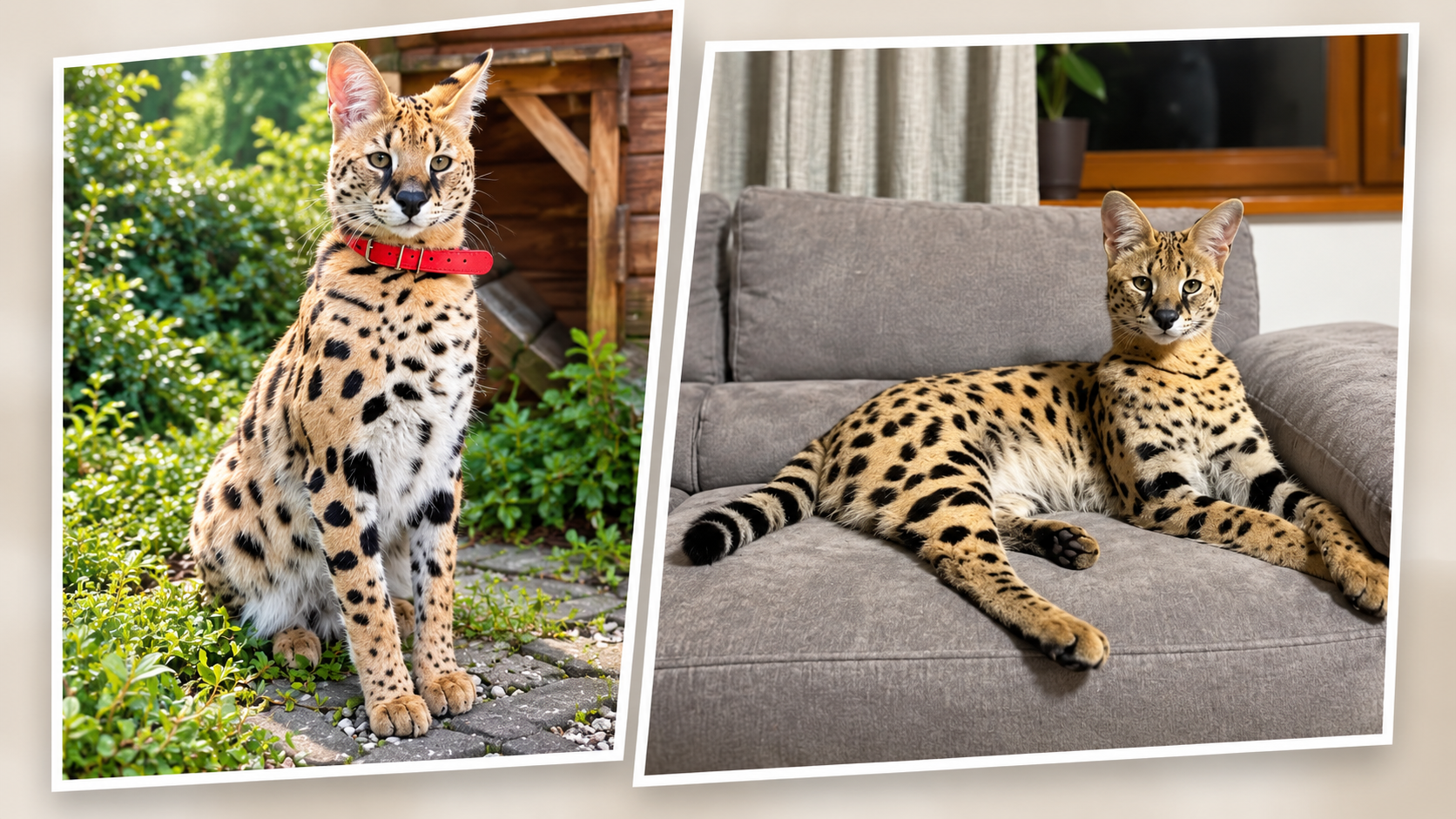
An escaped African serval prompted a police warning in the north-eastern Polish town of Orzysz after disappearing from a private property over the weekend — only for the exotic cat, named Gustaw, to return home by himself the following day. Police had urged residents not to approach or attempt to catch the animal while searches were under way.
Gustaw escaped during the night from Saturday to Sunday, 3–4 October, in Orzysz, a town in Poland’s Warmian-Masurian region. His disappearance was reported to police in nearby Pisz on Sunday.
The serval was believed to be wearing distinctive red leather harnesses and his owner warned that he might be frightened in unfamiliar surroundings. A reward was also offered for information that helped bring him home.
- Find more news from Poland on our Homepage .
Police said Gustaw was generally a gentle animal but nevertheless asked residents to keep their distance and not try to capture him themselves.
Anyone who spotted the cat was initially told to contact Poland’s 112 emergency number rather than approach him.
The warning attracted attention partly because servals look very different from ordinary domestic cats. Native to Africa, they are long-legged, spotted predators with unusually large ears and can weigh well over 10 kilograms.
They are adapted to hunting small animals in grassland environments and are capable of powerful jumps. While individual captive servals can become accustomed to people, they remain members of a wild species rather than a domesticated cat breed.
The search, however, ended without police or residents having to capture Gustaw.
On Monday, 5 October, senior commissioner Anna Szypczyńska of Pisz police confirmed that the animal had returned to his owners by himself. Local reporting citing the police said he was back safely at the property, bringing the unusual search to an end.
Pisz police subsequently announced through social media that Gustaw had returned home, according to local media that had been following the search.
Servals can legally be kept by private owners in Poland, although their possession is subject to wildlife-trade rules.
The species is covered by international CITES controls and is listed in Annex B of the European Union’s wildlife-trade regulation. Under Polish law, people keeping live mammals covered by Annexes A or B must register them with the relevant district authority within 14 days and retain documentation showing their legal origin, according to Poland’s Regional Directorate for Environmental Protection.
Gustaw’s brief adventure therefore ended rather more quietly than the police alert suggested: after prompting a search across Orzysz and warnings to local residents, he simply made his own way back home.