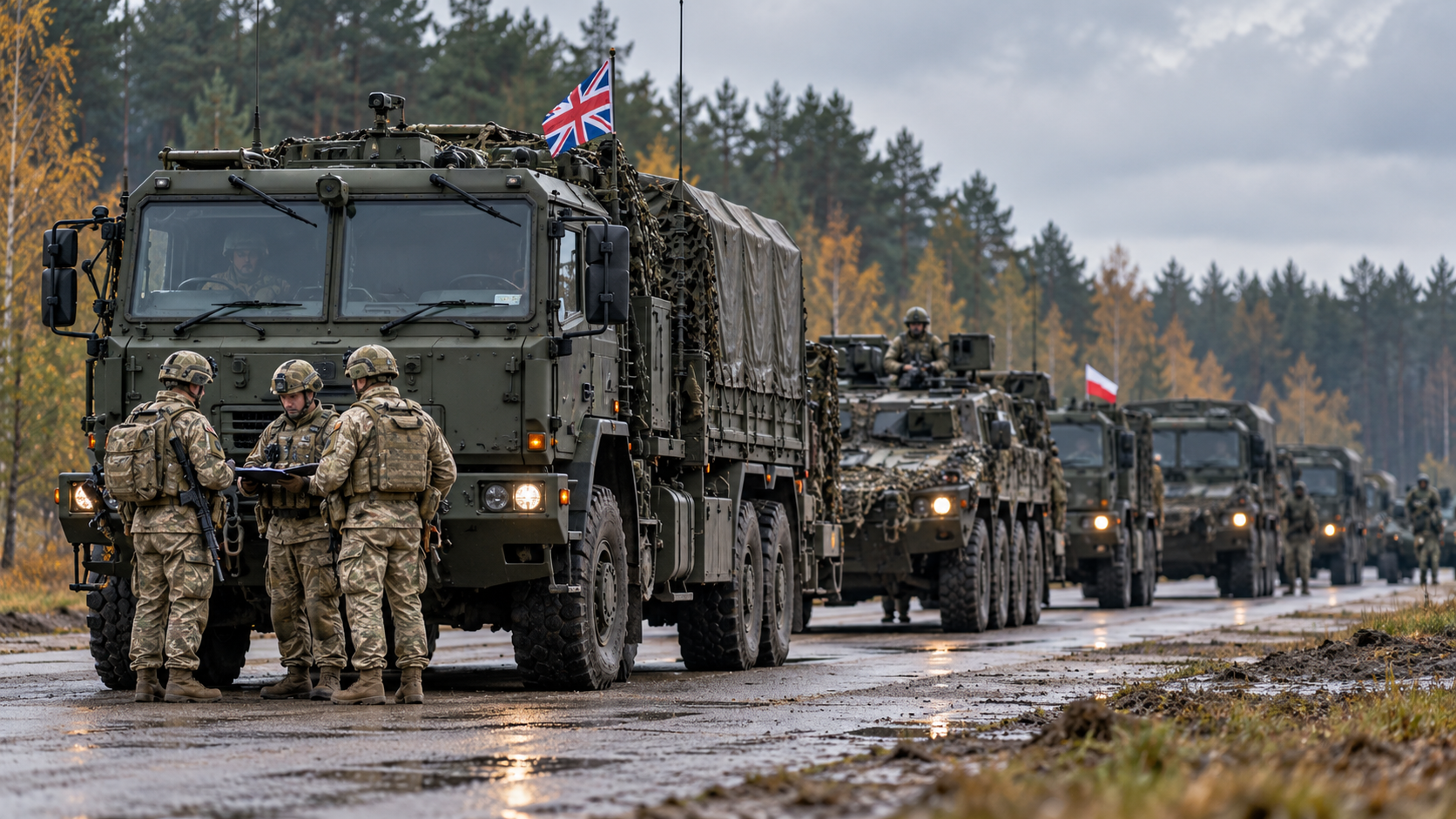
Hundreds of British troops are expected to deploy to Poland in November for a multinational military exercise preparing European forces for a possible future mission in Ukraine. At least 1,500 British, French and German personnel are reportedly set to participate alongside Polish forces, rehearsing the movement and supply of troops that could eventually help secure a ceasefire and deter renewed Russian aggression.
The planned manoeuvres are part of the Coalition of the Willing, a group of countries led by Britain and France that is developing security arrangements for Ukraine in the event of an agreement ending or suspending hostilities.
According to a report published by The Times on 17 October, the November exercise will test how European forces could deploy together and maintain supplies of fuel, food and other essential equipment during a multinational operation.
- Find more news from Poland on our Homepage .
The newspaper reported that hundreds of British personnel would participate, alongside French and German troops and members of Poland’s armed forces.
A British Ministry of Defence source described preparations for a scenario involving multinational forces operating together in a designated area, while declining to disclose further operational details.
The latest report provides more specific information about the scale and timing of an exercise that Polish Prime Minister Donald Tusk originally announced on 14 July, following a Coalition of the Willing summit in Paris.
The exercise will take place in Poland, not Ukraine. It does not mean European troops have been authorised to deploy into Ukraine, nor that Russia and Ukraine have agreed to a ceasefire.
The reported November timetable and the figure of at least 1,500 foreign personnel have not yet been independently confirmed in a new public military announcement. The Times attributes the latest operational details to defence sources.
What the multinational exercise will involve
The November manoeuvres are expected to focus on the practical challenges of deploying troops from several European countries and sustaining them during a possible overseas security mission.
Military personnel will rehearse moving forces, transporting equipment and coordinating logistical support, including the delivery of fuel, food and other essential supplies.
These arrangements would be necessary if European countries eventually agreed to station forces in Ukraine after a credible cessation of hostilities.
According to European Pravda’s account of The Times investigation, a British defence source said the exercise would simulate multinational forces operating together in the same area.
The source did not provide details of the exercise’s location within Poland, the formations involved or the precise military activities planned.
The reported 1,500 personnel are from Britain, France and Germany, with Polish forces participating alongside them. The overall number of troops, including the Polish contingent, has not been independently established.
Polish media, including TVP Info, have also reported the November exercise, citing the British newspaper.
The drills will take place against the background of continuing Russian military operations in Ukraine.
Their immediate purpose is to test planning and coordination rather than respond to an existing order to send troops across the Polish-Ukrainian border.
Poland chosen to host coalition’s first military exercise
The decision to conduct the exercise in Poland was announced three months ago.
Following a Coalition of the Willing meeting in Paris on 13 July, Prime Minister Donald Tusk said Poland would host the group’s first joint military manoeuvres during the autumn.
The agreement was reached with European leaders, including British and French representatives, as they discussed how to provide credible security guarantees for Ukraine.


In its official announcement on 14 July, the Polish Prime Minister’s Office confirmed that British and French troops would take part.
Tusk said the exercises were intended to prepare participating countries for providing security in Ukraine and the surrounding region.
He also described Poland’s role as evidence of the country’s growing importance in European defence cooperation.
The latest British reporting adds Germany to the countries expected to participate and provides a more precise timetable and estimated contingent size.
Germany’s participation in the November exercise has not been separately confirmed in the original July Polish government announcement.
Poland’s Defence Minister Władysław Kosiniak-Kamysz also welcomed the earlier decision, describing multinational exercises on Polish territory as an important demonstration of allied military cooperation.
The Polish government has separately expressed readiness to develop infrastructure capable of accommodating a greater permanent presence of allied forces, including troops from European countries.
That broader basing policy should not be confused with the temporary November exercise.
What is the Coalition of the Willing planning for Ukraine?
The Coalition of the Willing is a group of countries coordinating military assistance and possible future security guarantees for Ukraine, with Britain and France playing leading roles.
Its preparations involve a proposed Multinational Force for Ukraine, known as MNF-U.
The force is intended to help deter renewed Russian aggression after a credible ceasefire, including through training, assistance with rebuilding Ukrainian military capabilities and potential operations on land, at sea and in the air.
In a joint statement issued following the July Paris summit, participating countries described their commitment to preparing security arrangements that could be activated once a ceasefire was in place.
The statement made clear that any future presence in Ukraine would require an appropriate cessation of hostilities and Ukrainian agreement.
The following month, the British government confirmed that Lieutenant General Tom Bateman had assumed command of MNF-U from his French predecessor.
According to the British Ministry of Defence’s official announcement, Bateman took over at the force’s operational headquarters in Paris on 24 July.
The government described the proposed force’s principal objectives as reassuring Ukraine and helping restore the capabilities of its armed forces.
Possible future activities include improving the security of Ukrainian airspace and maritime routes, military training and rebuilding equipment stocks.
A multinational headquarters in Kyiv is also envisaged under the plans.
However, establishing a command structure and rehearsing deployment procedures are not equivalent to actually stationing troops in Ukraine.
The proposed force’s final size, national contributions, rules of engagement and deployment arrangements remain subject to further decisions.
Poland’s role is logistics, not sending troops into Ukraine
Poland occupies a particularly important position in the coalition because of its location, military infrastructure and existing role in delivering international assistance to Ukraine.
Since Russia’s full-scale invasion in February 2022, Poland has served as a major route for the movement of military equipment and humanitarian supplies.
Its roads, railways, airports and military facilities would be important for organising a future European security operation.
However, Warsaw has repeatedly distinguished logistical support from the deployment of Polish troops into Ukraine.
In a government statement following coalition talks on 6 January 2026, Tusk reaffirmed that Poland did not plan to send its soldiers into Ukraine, including after the war.
Instead, he identified logistics and organisational coordination as Poland’s principal contributions.
The government has maintained that position while participating in planning for possible European security guarantees.
Consequently, Polish troops taking part in exercises on Polish territory would not signal a reversal of Warsaw’s position concerning deployment inside Ukraine.
Other countries could eventually make different decisions about their participation in a multinational force, but these would require national authorisation and appropriate security arrangements.
There is also an important institutional distinction: although many participating countries are NATO members, the Coalition of the Willing is not itself a NATO operation.
The November exercises should therefore be described as coalition exercises involving NATO member states, rather than an independently authorised NATO mission.
European forces prepare despite uncertainty over a ceasefire
The preparations are taking place while Russia’s war against Ukraine continues and the prospects for a negotiated settlement remain uncertain.
European governments have argued that practical military preparations are necessary so that credible security arrangements can be put in place rapidly if fighting stops.
The alternative would be to begin building the relevant command structures, logistical systems and multinational procedures only after a ceasefire had been reached.
However, considerable political and operational questions remain.
A future multinational presence would require clarity over its legal basis, military responsibilities and the circumstances under which troops could defend themselves or respond to renewed attacks.
Russia has opposed proposals for European military contingents in Ukraine.
The British House of Commons Library’s August assessment identified unresolved questions concerning the size and composition of the proposed force, rules of engagement, duration of deployment and the military contributions participating governments would be prepared to make.
These questions remain relevant to the November exercises because rehearsing a deployment does not resolve every issue surrounding a real operation.
Nevertheless, the preparations indicate that European governments are attempting to move beyond political declarations towards practical military coordination.
For Poland, hosting the manoeuvres reinforces its role as a central location for European security cooperation and support for Ukraine.
The next milestone will be the exercise itself, now reported to be scheduled for November.
Its outcome should provide participating governments with information about the logistical and organisational challenges they would face if they eventually agreed to establish a multinational security presence in Ukraine.
Until then, the exercise remains a preparation for a possible future mission, not evidence that a ceasefire or deployment decision has been reached.