

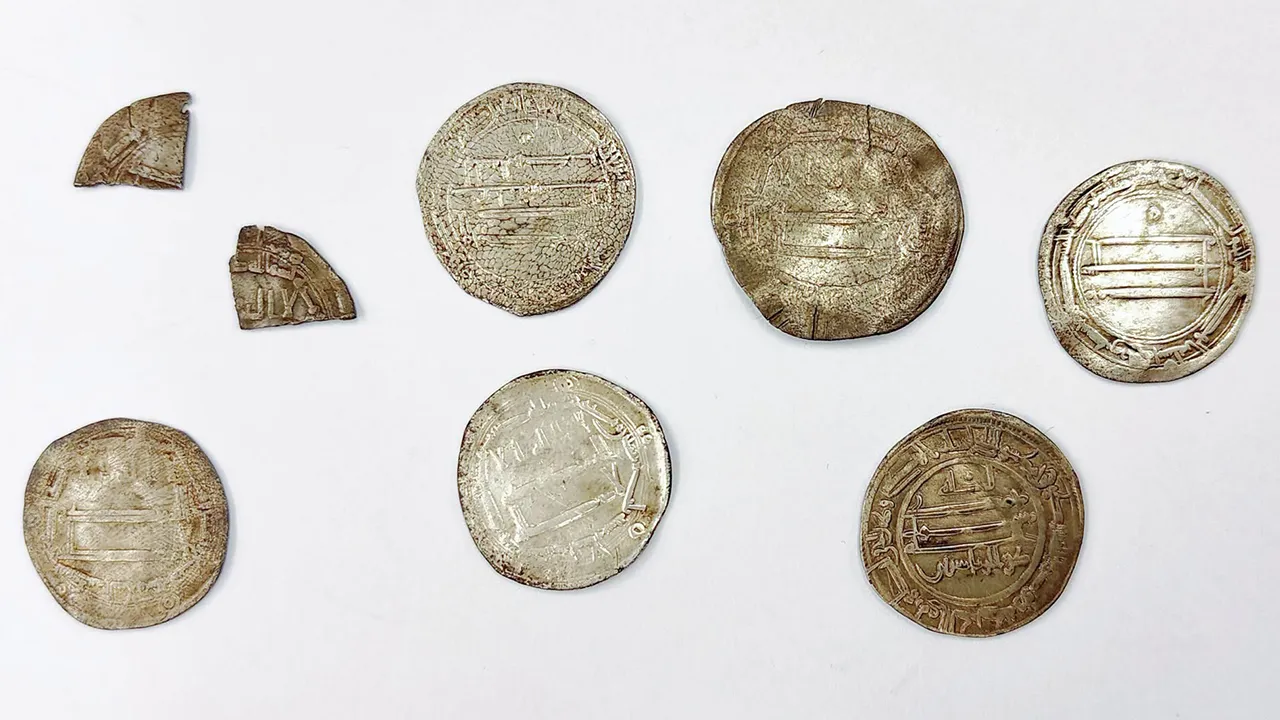
Six Arab silver dirhams and two fragments of similar coins dating from the early Middle Ages have been discovered in a forest near Elbląg in northern Poland, with archaeologists investigating whether the find was connected to merchants travelling to and from the Viking-age trading centre of Truso.
The coins were found during authorised searches in the Młynary Forest District and have since been transferred to the Archaeological and Historical Museum in Elbląg. Before reaching the museum, the objects were handed to the Elbląg branch of the regional heritage conservator.
Preliminary examination dates the six complete dirhams and two fragments to the first half of the ninth century.
- Find more news from Poland on our Homepage .
However, archaeologists have cautioned that the date when the coins were minted does not necessarily indicate when they were lost or deposited.
“More precise dating will only be possible after they have been studied,” Dr Jakub Jagodziński of the Archaeological and Historical Museum in Elbląg said.
He added that the coins may have remained in circulation until as late as the turn of the 10th and 11th centuries — approximately the period when Truso ceased functioning as a major trading settlement.
That possible connection makes the discovery particularly intriguing.
Truso stood near Lake Druzno, less than 10 kilometres from modern Elbląg, and was one of the major trading and craft centres operating around the Baltic during the Viking Age.
The settlement was known for centuries only from the account of the Anglo-Saxon traveller Wulfstan, who sailed from Hedeby in what is now northern Germany to Truso in the late ninth century.
Its location was finally established by Polish archaeologist Marek Franciszek Jagodziński in 1981. The Archaeological and Historical Museum in Elbląg describes Truso as a major Baltic emporium whose inhabitants participated in far-reaching commercial networks linking northern Europe with much more distant regions.
Finds from the settlement have included objects originating in Scandinavia, England, the Rhineland and the Arab Caliphate, demonstrating how extensive those connections were.
Arabic silver coins are an especially important part of that evidence.
The Elbląg museum says large quantities of dirhams travelled into northern and central Europe along early-medieval trading networks. The coins were struck in the Middle East and Central Asian mints and reached Scandinavian-dominated trading centres around the Baltic in substantial numbers.
Truso itself has already produced similar finds.
During archaeological excavations there in 1986, researchers uncovered a deposit containing 11 complete coins and five fragments, all originating in the Middle East. The youngest coin in that hoard dated to 814 or 815, and researchers concluded that the deposit was probably made during the first half of the ninth century.
That earlier discovery makes the newly recovered Młynary coins consistent with the type of silver already known from Truso — but it does not prove who owned them or precisely why they ended up in the forest.
Jagodziński said one possibility is that they belonged to merchants travelling along routes leading to or away from Truso.
Another hypothesis is that they were associated with Prussian guards collecting tolls from travellers using those routes.
Both explanations remain hypotheses pending further investigation.
Archaeologists from Elbląg are expected to examine the discovery site itself, which could help establish whether the coins were accidentally lost, deliberately deposited or associated with other archaeological material.

The coins will first undergo conservation before specialists in early-medieval numismatics attempt to determine their precise origins and dates.
Researchers may be able to identify the rulers under whom individual coins were issued and the mints where they were struck, potentially providing further clues about the commercial routes through which the silver reached what is now northern Poland.
Once conservation and analysis are complete, the museum plans to put the newly discovered coins on public display in Elbląg.
The find adds another piece to the archaeological picture of a region that more than a thousand years ago stood within a commercial network stretching far beyond the Baltic — and in which silver minted thousands of kilometres away could eventually find its way to the shores of what is now Poland.