

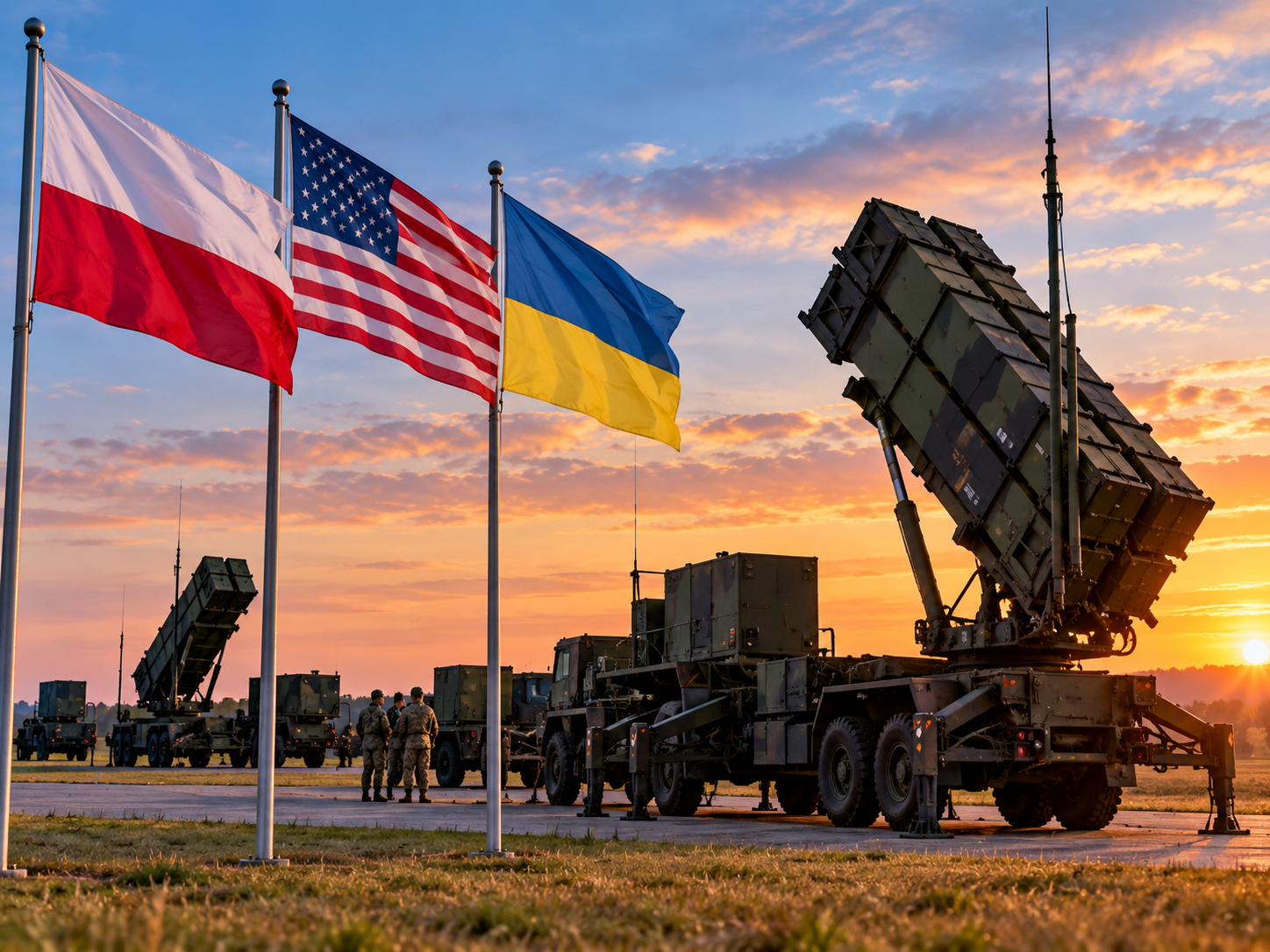
Poland has proposed jointly producing missiles for Patriot air-defence systems with the United States and Ukraine, but wants the manufacturing plant located on Polish territory rather than in Ukraine because of the risk that Russia could target such a strategically important facility.
The proposal was formally presented to the United States by Deputy Defence Minister Magdalena Sobkowiak-Czarnecka during talks in Washington involving officials from the Pentagon and US State Department.
In its official account of the Washington talks, Poland’s Defence Ministry said Warsaw had proposed cooperation in a triangle involving the United States, Ukraine and Poland, with the production itself taking place in a safer location.
- Find more news from Poland on our Homepage .
“The proposal we presented from the Polish side responds to certain concerns on the American side,” Sobkowiak-Czarnecka said.
“We proposed cooperation in a triangle — the United States, Ukraine, but also Poland — because the point is to secure this production, so that it simply takes place in a safe location.”
The proposal followed discussions at July’s NATO summit in Ankara, where US President Donald Trump raised the possibility of allowing Patriot missile production connected with Ukraine.
Polish officials subsequently argued that establishing the manufacturing capacity inside NATO-member Poland could combine Ukrainian participation with greater protection from Russian strikes.
Defence Minister Władysław Kosiniak-Kamysz has separately said Poland expects to play a role in expanding European Patriot missile production and servicing capacity, including cooperation with Ukraine.
Following the Ankara summit, he said Poland was one of four European NATO countries — alongside Germany, the Netherlands and Sweden — identified for possible transfers of technology connected with the production and servicing of Patriot missiles.
“Poland is one of the countries indicated by the United States where this production and servicing should take place, so here we will also cooperate with Ukraine,” Kosiniak-Kamysz said in July.
No agreement establishing a Patriot missile factory in Poland has yet been signed.
The distinction is important because Poland is simultaneously negotiating several related but separate projects involving the Patriot system.
The most advanced is a proposed European service centre for PAC-3 missiles in Poland.
Deputy Defence Minister Sobkowiak-Czarnecka said in Washington on 24 September that a decision on that facility could come within “several or a dozen days”. The centre would allow missiles currently sent back to the United States for maintenance to be serviced in Europe instead.
She described such a centre as a potential first step towards eventually establishing a PAC-3 production line in Poland.
According to her, American officials continue to have security concerns about locating missile production directly inside Ukraine, while Poland is presenting itself as a safer alternative that remains geographically close enough to support Ukrainian requirements.
The talks therefore remain at different stages.
A Polish-based PAC-3 servicing capability appears closer to a decision, while actual missile manufacturing would require further agreements, technology transfer and the participation of the American defence industry.
Poland is not currently producing complete Patriot interceptors.
That should also be distinguished from existing Polish involvement in the Patriot programme.


Polish industry already manufactures components of the system under the country’s Wisła air-defence programme. In 2024, Raytheon Polska and Huta Stalowa Wola signed an agreement for the manufacture of 48 M903 Patriot launchers in Poland for the programme’s second phase.
The Polish Defence Ministry said at the time that Polish companies would also participate in producing other components for the expanded system.
But manufacturing launchers is different from producing the highly sophisticated interceptor missiles they fire.
The latest Polish effort is aimed at moving further up that technological chain by securing the ability first to service — and ultimately potentially manufacture — PAC-3 missiles in Europe.
PAC-3 interceptors are among the most important weapons used by Patriot batteries against ballistic missiles and other advanced aerial threats.
Demand has increased sharply because of Russia’s war against Ukraine, the expansion of European air-defence forces and the need to replenish stocks held by NATO countries.
Kosiniak-Kamysz has repeatedly argued that Europe needs greater domestic missile-production capacity instead of depending almost entirely on long supply chains from the United States.
In July, he said existing manufacturing capacity for Patriot missiles was highly constrained and that transferring servicing and industrial capabilities to Europe was an important part of strengthening the continent’s air defence.
The Polish government has been pursuing a similar strategy with other missile programmes.
In July, state defence group PGZ, Military Aviation Works No. 2 and US company Anduril signed an agreement to establish assembly and later production in Poland of Barracuda-500M long-range cruise missiles.
Poland has also agreed to domestic production of missiles for its Korean-built Homar-K multiple-launch rocket systems.
Those projects form part of a wider policy of linking Poland’s rapidly expanding defence purchases with technology transfer and domestic manufacturing.
The Patriot proposal differs because it would potentially bring together the defence industries of three countries — Poland, the United States and Ukraine — around one of the most advanced Western air-defence systems.
Ukraine would bring direct wartime experience of operating Patriot batteries against Russian ballistic and cruise missiles, while Poland is offering an industrial site inside NATO territory and close to the Ukrainian border.
The United States and the system’s American manufacturers would, however, remain central to any agreement involving production licences and sensitive technology.
For now, the Polish proposal remains exactly that: a proposal under negotiation.
There is no completed factory, no announced production start date and no final agreement defining precisely which missile components would be manufactured in Poland or what role Ukrainian companies would play.
The most immediate decision concerns the PAC-3 servicing centre.
If that project moves ahead, Polish officials hope it could become the industrial foundation for something considerably more ambitious — eventually manufacturing Patriot interceptors in Poland for European and potentially Ukrainian requirements.