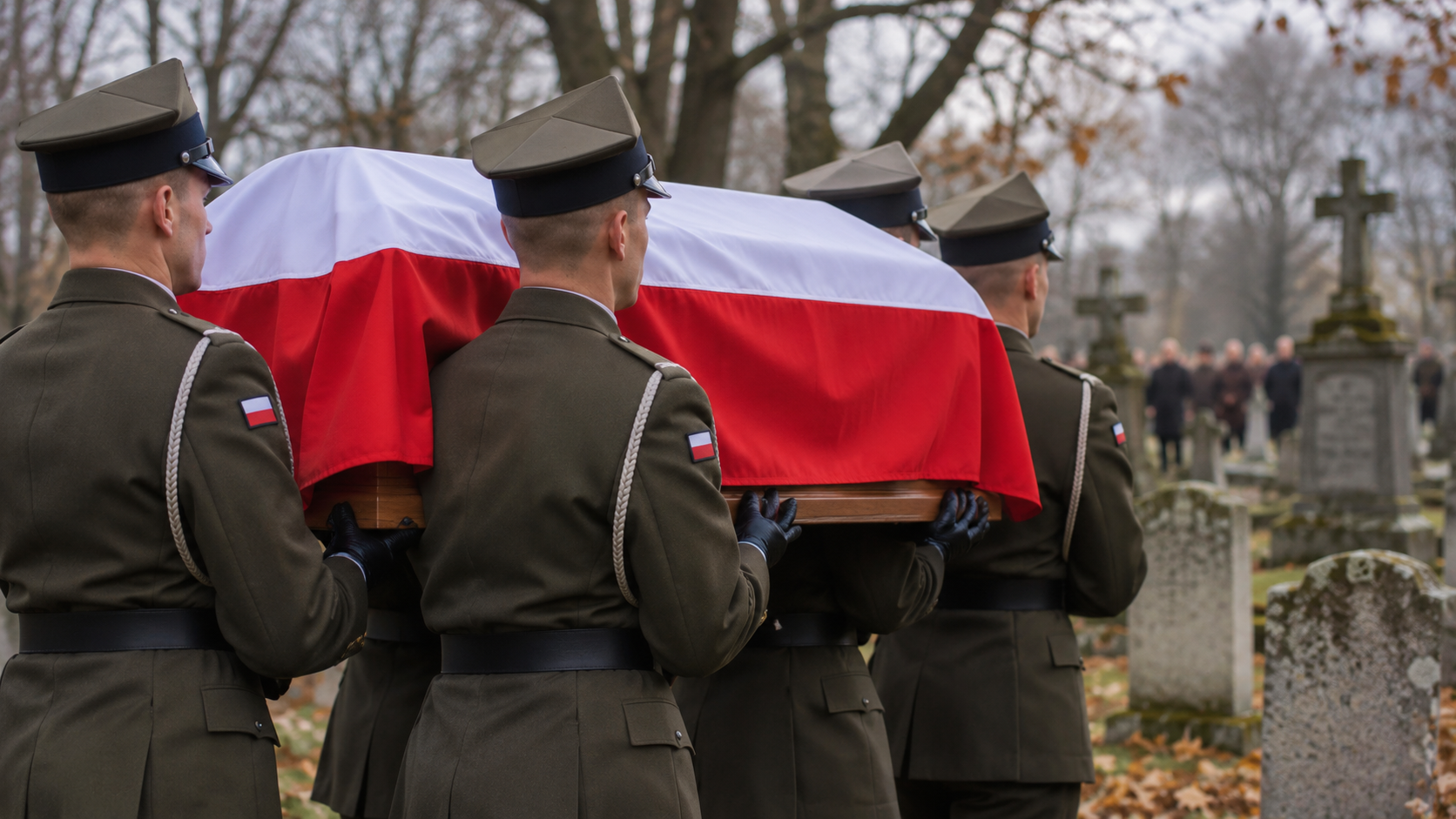
The remains of 115 Polish soldiers who died defending Lwów during the German invasion of Poland in September 1939 have been laid to rest in western Ukraine, 87 years after their deaths. The reburial ceremony took place on Friday, 27 November, at a Polish military burial site in Mościska, following archaeological excavations near present-day Lviv earlier this year.
The soldiers had remained in unmarked graves for decades before their remains were recovered during a joint Polish-Ukrainian operation.
The ceremony brought together senior representatives of both countries, military personnel, clergy and organisations dedicated to preserving Polish historical memory.
- Find more news from Poland on our Homepage .
According to the Polish Ministry of Culture and National Heritage, the burial took place at the Roman Catholic cemetery in Mościska, where a dedicated section accommodates Polish soldiers killed during the September 1939 campaign.
A final farewell after 87 years
The commemorations began with a Catholic Mass at the Church of the Nativity of St John the Baptist in Mościska, celebrated by Archbishop Mieczysław Mokrzycki, the Roman Catholic Metropolitan Archbishop of Lviv.
The soldiers were subsequently buried in the cemetery’s Polish military section.
Poland was represented by Deputy Culture Minister Marek Krawczyk, senior officials from the Institute of National Remembrance (IPN), and Wojciech Kolarski from the Polish President’s Office.
Ukrainian representatives included Deputy Culture Minister Ivan Verbytskyi and Oleksandr Alfirov, head of the Ukrainian Institute of National Remembrance.
President Karol Nawrocki did not attend in person but sent a letter, which was read during the ceremony.
In his message, Nawrocki described the burial as the fulfilment of Poland’s responsibility to remember those who died defending the country in 1939.
Speaking at the cemetery, Krawczyk emphasised that the soldiers’ individual identities remained unknown.
“We do not know their names. We do not know where they came from,” he told those attending.
He noted that the men had remained in unmarked graves for decades before archaeological investigations finally made their recovery possible.
Thousands of objects recovered during excavations
The soldiers’ remains were discovered at Hołosko Wielkie, a former burial site now within the administrative boundaries of Lviv.
Excavations were conducted in August and September 2026 by Poland’s Institute of National Remembrance in cooperation with the Ukrainian archaeological company Ukrainian Memory.
According to the ministry’s archaeological report, investigators examined approximately 260 square metres and uncovered three rows of graves containing the remains of 115 Polish soldiers.
Researchers also recovered around 2,900 objects, including:
- Military helmets, buttons, buckles and uniform components.
- Bayonets and other military equipment.
- Personal belongings such as wallets, coins and keys.
- Religious objects, including crosses and devotional medals.
- Military identification tags.
The excavations also uncovered the remains of 18 German soldiers.
Those remains were recovered separately and transferred to Volksbund, the German organisation responsible for locating and arranging the burial of German war dead.
Could the soldiers still be identified?
Although the 115 Polish soldiers have now received a formal burial, efforts to establish their identities are continuing.

The Institute of National Remembrance reported that six military identification tags were discovered during the excavations.
Researchers managed to decipher complete or partial information from five of them.
The findings could help historians trace relatives of the fallen soldiers and establish their identities through genealogical research and DNA comparisons.
Genetic material was collected from the recovered remains to support possible future identification work.
However, the authorities have not confirmed the individual identities of the soldiers buried on Friday.
Why were Polish soldiers fighting in today’s Ukraine?
Lwów, known internationally today as Lviv, was part of Poland before the Second World War.
When Nazi Germany invaded Poland on 1 September 1939, the city became an important defensive position in the country’s southeastern territories.
German forces began besieging Lwów on 12 September.
Polish troops under General Władysław Langner resisted German attacks, with particularly intense fighting taking place around the northern approaches to the city, including Hołosko.
Among the formations involved in the wider fighting were units commanded by General Kazimierz Sosnkowski and Colonel Stanisław Maczek, who later became one of Poland’s most prominent wartime commanders.
The situation deteriorated further on 17 September, when the Soviet Union invaded Poland from the east.
Lwów subsequently came under Soviet control.
The German and Soviet invasions, and the territorial changes that followed the war, fundamentally altered Poland’s eastern borders.
Lwów is now Lviv, a major city in independent Ukraine.
For further historical context, Poland-24 has previously explained the Soviet invasion of Poland on 17 September 1939 and its lasting consequences.
A significant step in Polish-Ukrainian historical cooperation
Friday’s ceremony also marked a practical achievement in Poland and Ukraine’s efforts to resolve longstanding disputes concerning wartime burial sites and exhumations.
The burial ground at Hołosko had been investigated previously, including during archaeological work in 2011 and 2019.
However, permission to exhume the remains was not granted at that time.
The situation changed following renewed diplomatic engagement and the establishment of a joint Polish-Ukrainian Working Group on Dignified Burials in November 2024.
The group was created to facilitate searches, exhumations and burials involving historical graves in both countries.
In August 2026, representatives of the two governments met in Lviv to review progress on outstanding applications and archaeological investigations.
Ukrainian authorities had granted permission for the Hołosko exhumations on 4 June 2026, allowing the recovery operation to proceed.
Although Polish-Ukrainian relations continue to be affected by disagreements over historical memory, the latest burial demonstrates that practical cooperation remains possible.
The soldiers reburied in Mościska were casualties of the September 1939 defensive campaign. Their case is distinct from investigations into the wartime massacres of Polish civilians in Volhynia and Eastern Galicia.
More Polish soldiers may eventually be buried at Mościska
The cemetery in Mościska has already hosted several ceremonies involving Polish soldiers recovered from former battlefields around Lwów.
In 2015, the remains of 111 Polish soldiers were buried there. Another 27 were laid to rest in 2016, followed by a further reburial ceremony in 2025.
Friday’s event was the fourth such ceremony at the site.
According to the Polish Ministry of Culture, the military burial section is ultimately intended to accommodate approximately 500 soldiers.
For the families of those who disappeared during the September 1939 campaign, the continuing identification work could still provide answers about relatives whose final resting places remained unknown for generations.
For the 115 soldiers buried on Friday, their names remain uncertain, but their graves have finally been given a recognised place of remembrance.