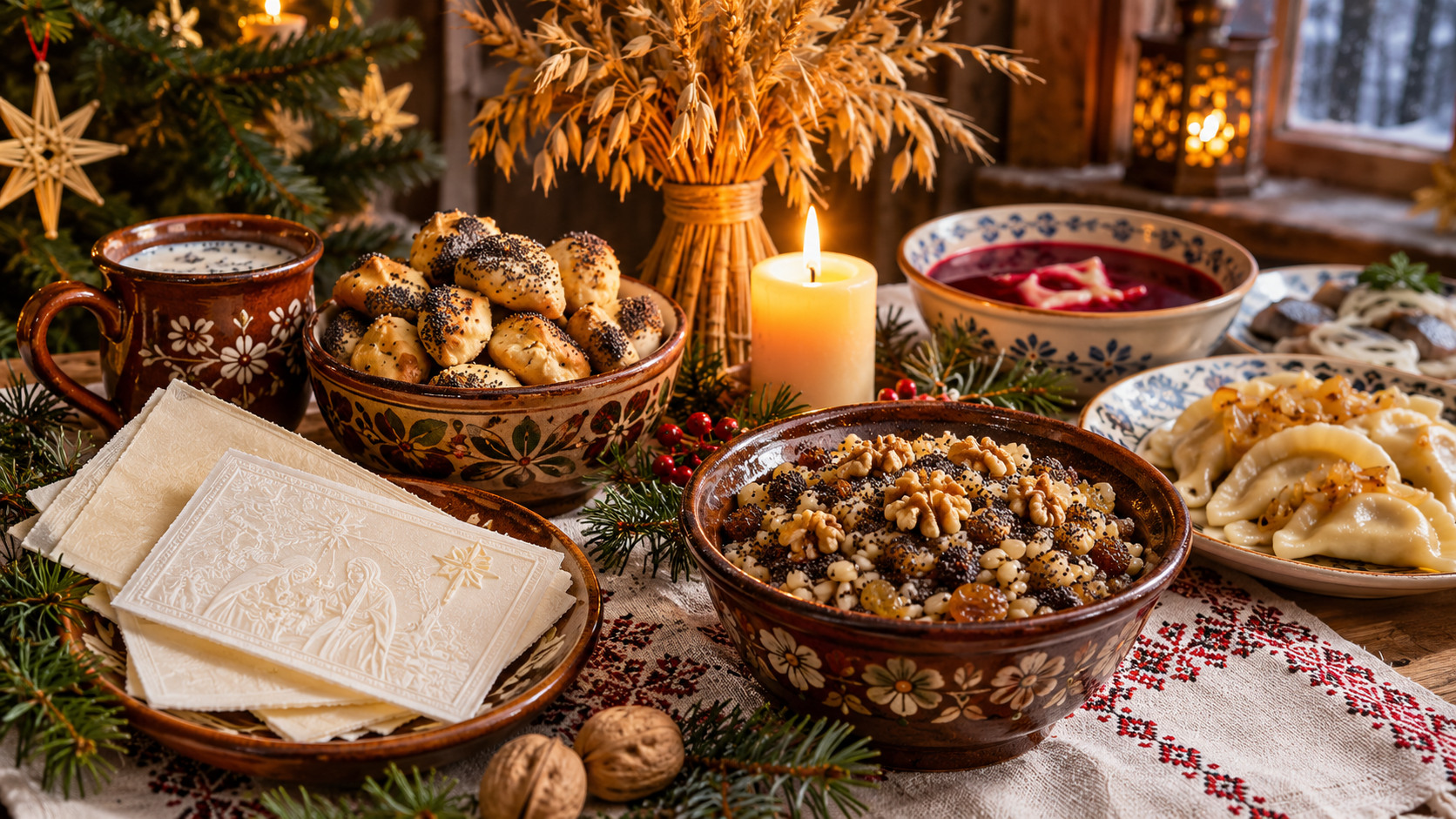
In Poland, families break a thin Christmas wafer before sitting down to dinner. In Lithuania, tiny poppy-seed pastries are served with a traditional milky drink. In Ukraine, a carefully arranged sheaf of grain may stand beside the Christmas Eve table, symbolising the family’s ancestors.
These customs might appear quite different, but they belong to a remarkably interconnected cultural tradition — one that Poland, Lithuania and Ukraine are now seeking to have recognised by UNESCO.
The three countries have jointly nominated their Christmas Eve celebrations for inscription on UNESCO’s Representative List of the Intangible Cultural Heritage of Humanity.
- Find more news from Poland on our Homepage .
The application received a favourable recommendation ahead of the final decision, according to an announcement by the Museum of the Kielce Countryside on 12 November 2026.
UNESCO’s Intergovernmental Committee is scheduled to consider the nomination during its meeting in Xiamen, China, from 30 November to 5 December.
If approved, the inscription would recognise not a single recipe or religious ceremony, but a living collection of family customs that have developed across a historically connected region of Europe.
Three countries, centuries of shared traditions
The Christmas Eve celebrations known as Wigilia in Poland, Kūčios in Lithuania and Sviatyi Vechir in Ukraine have deep connections extending beyond modern national borders.
For centuries, large parts of today’s Poland, Lithuania and Ukraine belonged to the same political and cultural sphere, particularly during the era of the Polish-Lithuanian Commonwealth.
Families, religious communities and regional traditions interacted across territories that now form three independent countries.
Their Christmas Eve celebrations consequently share striking similarities, even where the names of particular dishes and customs differ.
The central event is a ceremonial family supper, traditionally prepared without meat and accompanied by rituals associated with reconciliation, remembrance, faith and hopes for the coming year.
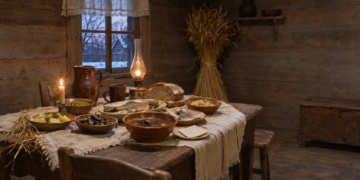
A white tablecloth, sometimes with hay placed beneath it, is one of the familiar symbols. Grain, bread, candles and particular foods carry meanings connected with family prosperity, religious belief and the memory of earlier generations.
In some households, a place is left for an unexpected guest or in remembrance of someone who is absent or has died.
According to the Polish Ministry of Culture’s explanation of the nomination, the traditions reflect several cultural and religious influences, including Roman Catholic, Orthodox, Greek Catholic and older rural customs.
The similarities do not mean that every family follows the same rituals.
Indeed, the regional differences are part of what makes the joint nomination culturally significant.
Three Christmas Eve tables, three distinctive identities
In Poland, one of the best-known traditions is sharing opłatek, a thin Christmas wafer, while exchanging personal wishes before the meal.
The supper often includes beetroot soup with mushroom-filled uszka, pierogi with cabbage and mushrooms, carp, herring, poppy-seed cake and dried-fruit compote.
Twelve dishes are traditionally associated with the evening, although the number and selection vary between families and regions.
In Lithuania, the Christmas Eve supper is called Kūčios.
You May Also Be Interested In
The Lithuanian National Culture Centre’s heritage inventory describes a ritual meal traditionally involving at least twelve dishes prepared from grains, fish, mushrooms, fruit and other plant-based ingredients.
Among the most distinctive foods are kūčiukai, small pastries containing poppy seeds, often served with aguonpienis, a drink prepared from poppy seeds.
Cranberry kissel, herring and mushrooms are also characteristic of Lithuanian celebrations.
Families may share a Christmas wafer known as kalėdaitis, a custom closely related to Poland’s opłatek tradition.
In Ukraine, kutia occupies an important place on many Christmas Eve tables.
Prepared from cooked grains, often wheat, mixed with poppy seeds, honey and sometimes nuts or dried fruit, it has close relatives in Polish and Lithuanian regional traditions.
Another particularly recognisable Ukrainian custom is bringing a didukh into the home.
This ceremonial sheaf of grain symbolises family ancestors and the agricultural cycle. The Polish Ministry of Culture notes that similar grain-sheaf customs were once practised in Polish rural households.
Ukrainian Christmas Eve meals may also include beetroot soup, varenyky (filled dumplings), mushroom dishes and uzvar, a drink made from dried fruit.
The three countries therefore share more than a collection of similar foods. Their customs express closely related ideas about family, hospitality, remembrance and the relationship between generations.
A tradition that crosses religious calendars
One important difference concerns when Christmas Eve is celebrated.
In Poland and Lithuania, 24 December is the customary date for the celebrations described in the nomination.
Ukrainian practice is more varied because of the country’s Christian traditions and the different ecclesiastical calendars used by religious communities.
In September 2023, the Ukrainian Greek Catholic Church and the Orthodox Church of Ukraine adopted new calendars for fixed religious feasts, bringing Christmas celebrations in many communities to 25 December and Christmas Eve to 24 December.
Some Orthodox communities continue to follow the older Julian calendar, celebrating Christmas on 7 January and Christmas Eve on 6 January.
These differences illustrate why the nomination is not an attempt to establish a single uniform Christmas Eve celebration.
Instead, it recognises traditions that share historical connections while continuing to evolve within different communities.
A joint effort to preserve living heritage
The UNESCO nomination began taking shape in early 2024, with Lithuania coordinating the international preparations.
Cultural institutions, researchers, museums and communities from all three countries contributed to the documentation.
The Lithuanian Ministry of Culture says more than 1,200 individuals, alongside numerous cultural and scientific institutions, expressed support for the nomination between November 2024 and February 2025.
Families also contributed photographs and videos documenting how Christmas Eve is celebrated in their own homes.
The completed application was submitted to UNESCO on 31 March 2025.
Poland had already entered its Christmas Eve traditions on the National List of Intangible Cultural Heritage on 15 January that year.
International recognition would place the shared celebrations among the cultural practices acknowledged by UNESCO for their significance to communities and the importance of passing them between generations.
Unlike UNESCO World Heritage status, which is associated with physical cultural and natural sites, intangible heritage recognition concerns living knowledge, customs and practices.
The proposed recognition would not prescribe how families must prepare their Christmas Eve meals. Its purpose is to support the continued safeguarding and transmission of the traditions.
More than a Christmas dinner
For millions of people with Polish, Lithuanian and Ukrainian roots, Christmas Eve is an occasion when family customs are repeated, explained and passed on.
The dishes may change over time. Families move abroad, marry across cultural traditions and adapt recipes to new circumstances.
Yet the familiar rituals — sharing bread or wafers, preparing particular foods, remembering absent relatives and gathering around a ceremonial table — can retain their significance across generations.
Whether or not UNESCO approves the nomination in December, the joint application has already brought together three countries to document something familiar to so many of their families.
It is a reminder that the traditions preserved around a Christmas Eve table can tell a story reaching far beyond the walls of a single home — and across centuries of shared European history.