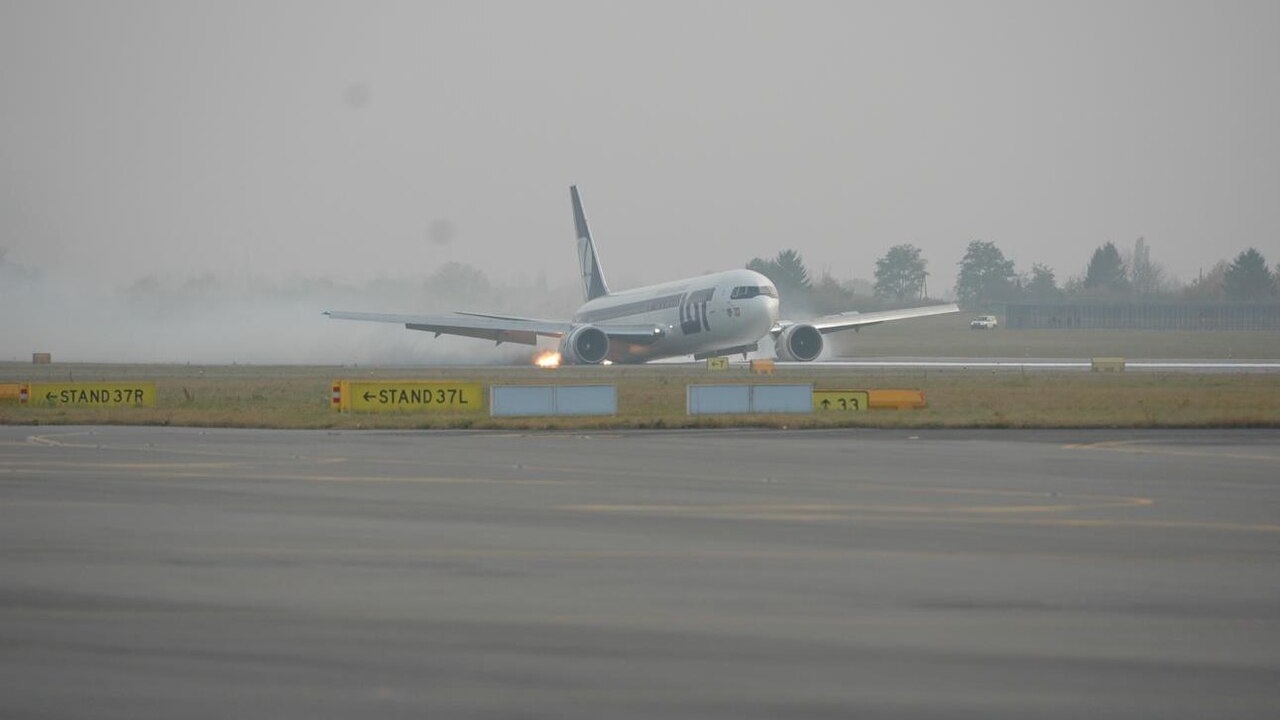
On 1 November 2011, a LOT Polish Airlines Boeing 767 touched down at Warsaw Chopin Airport with its landing gear still retracted. Sparks flew from its right engine as the aircraft slid along the runway, and a fire broke out before it came to a stop.
Yet all 231 people aboard survived without injury.
The remarkable emergency landing of flight LO16, commanded by Captain Tadeusz Wrona alongside First Officer Jerzy Szwarc, became one of the most widely remembered events in modern Polish aviation.
- Find more news from Poland on our Homepage .
Fifteen years later, the incident remains both an extraordinary account of a successful emergency landing and a case study in how technical failures, cockpit procedures and crew decisions interact under pressure.
A problem that began over America
Flight LO16 was operating a scheduled transatlantic service from Newark Liberty International Airport in New Jersey to Warsaw on 1 November 2011.
The aircraft was a Boeing 767-300ER, registration SP-LPC, carrying 221 passengers and 10 crew members.
Shortly after departure, during the retraction of the landing gear and flaps, the aircraft suffered a failure in its central hydraulic system.
Hydraulic pressure is used to operate several aircraft systems, including the normal mechanism for extending and retracting the landing gear.
The crew received an alert indicating the loss of hydraulic pressure. After following the appropriate procedures and consulting LOT’s operations centre, the pilots decided to continue the flight to Warsaw.
The aircraft remained capable of flying, and the crew planned to use its alternative landing-gear extension system when approaching the Polish capital.
However, that system would also fail.
The final approach to Warsaw
At approximately 12.17 pm local time, as the Boeing approached Warsaw, the pilots attempted to extend the landing gear using the alternative system.
Nothing happened.
They checked the procedure and tried again, but the landing gear remained retracted.
The crew abandoned its initial approach and declared an emergency at approximately 12.25 pm.
While the aircraft remained airborne, the pilots consulted technical specialists and attempted further procedures to release the landing gear.
Two Polish Air Force F-16 fighters were dispatched to inspect the Boeing from the air.
Their pilots confirmed that the landing gear was still retracted.
With repeated attempts unsuccessful and the aircraft’s remaining fuel becoming a concern, the crew decided to land without extending the wheels.
Airport emergency services prepared runway 33, spreading firefighting foam along approximately three kilometres of the landing surface. Firefighters and medical teams stood ready.

Inside the aircraft, the cabin crew prepared passengers for an emergency landing.
At 1.39 pm, Captain Wrona brought the Boeing down onto the runway.
The aircraft remained close to the runway centreline as it slid across the surface. Sparks emerged from the right engine, followed by a fire that emergency crews extinguished.
Once the aircraft stopped, evacuation slides were deployed and passengers began leaving the plane.
All 231 occupants escaped without injury.
The Boeing itself sustained substantial damage and was subsequently withdrawn from service.
What the official investigation discovered
The successful landing attracted widespread attention, but the official investigation revealed a more complicated chain of events than a straightforward mechanical failure.
Poland’s State Commission on Aircraft Accidents Investigation, known as PKBWL, published its final report in 2017.
Investigators established that a damaged hydraulic hose had caused the original loss of pressure.
However, this alone did not explain why the aircraft’s alternative landing-gear system also failed.
The investigation found that an electrical circuit breaker identified as C829 was in the open position, interrupting power to the alternative extension mechanism.
Investigators also established that the position of this breaker was difficult to observe from the first officer’s normal seat and that its open state did not trigger a cockpit warning.
The crew had not identified the problem during its attempts to extend the landing gear.
The commission could not establish precisely when or how the circuit breaker had opened.
Its report also identified shortcomings in technical support arrangements, checklist procedures and protective equipment around the circuit-breaker panel.
The findings led to safety recommendations involving the aircraft manufacturer, LOT and airport authorities.
A landing that Poland remembers
The incident brought widespread public recognition to Captain Wrona and his colleagues, whose handling of the emergency was praised in Poland and internationally.
But the outcome also depended on the work of the cabin crew, air traffic controllers, military pilots and airport emergency services.
The official investigation recorded no injuries among the passengers or crew, despite a landing that seriously damaged the aircraft.
Warsaw Chopin Airport remained closed for more than 29 hours while the disabled Boeing was removed from the runway.
The event is still commemorated in Polish aviation history, including by the Polish Aviation Museum in Kraków.
Fifteen years on, flight LO16 is remembered not simply for the dramatic sight of a passenger jet sliding along a runway without its wheels, but for the 231 people who walked away safely — and the aviation lessons established by the investigation that followed.